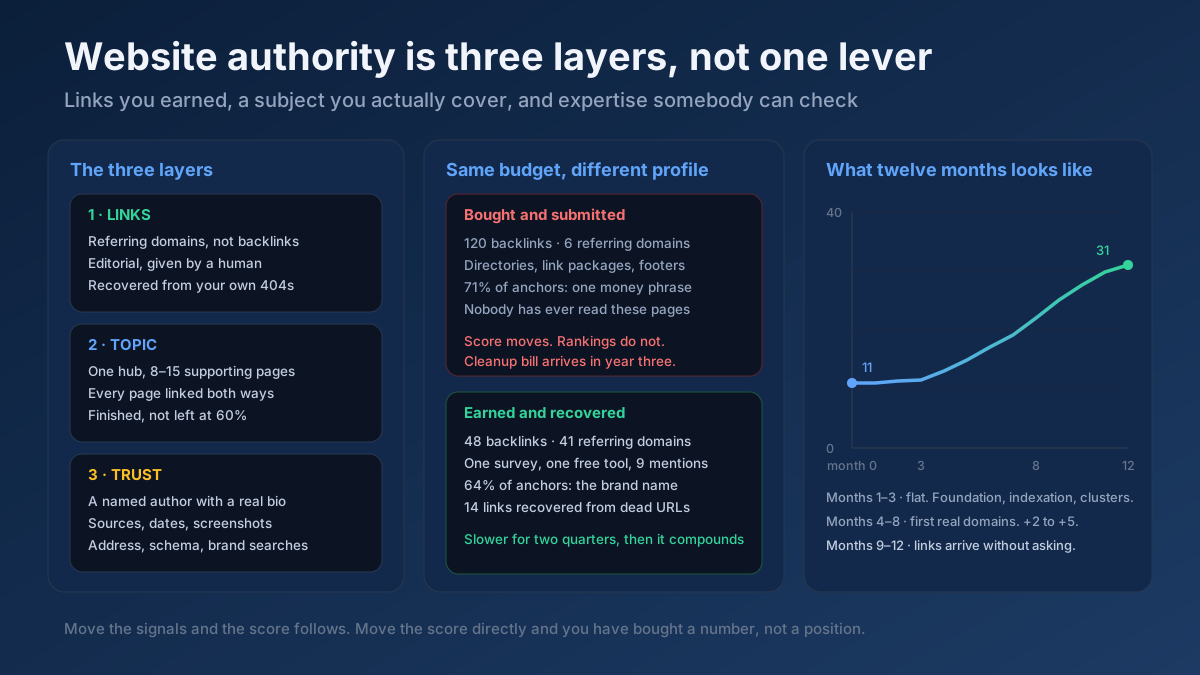
Short answer: You increase website authority by earning editorial links from sites that already have it, covering one subject completely instead of many subjects thinly, and making your expertise verifiable on the page itself. Authority scores are third-party estimates of that work, so move the underlying signals and the number follows.
That sentence is easy to write and slow to execute, which is why most sites stall. This guide is the ten steps in the order they actually pay off — measure, fix the floor, own a topic, redistribute what you already have, earn links, clean up, prove expertise, build brand, prune, and measure again — with the timelines each stage realistically takes and the traps that waste a year.
What website authority actually is
Before spending six months chasing a number, it is worth knowing what the number is. This is the part almost every guide skips, and skipping it is how people end up buying links to move a score that Google never looks at.
The scores you see are third-party estimates
Domain Authority, Domain Rating, Authority Score, Trust Flow: every one of these is a metric invented by an SEO tool vendor. Each is calculated from that vendor’s own crawl of the web, usually as a logarithmic 1–100 scale weighted heavily toward the number and quality of linking domains. Moz describes Domain Authority as a prediction of how likely a site is to rank, trained against real search results — a forecast, not a grade.
Because the scale is logarithmic, the effort curve is brutal and non-obvious. Moving from 10 to 20 is a season of steady work. Moving from 60 to 70 is a different sport entirely. If you are at 12 and your goal is 50 by December, the goal is wrong, not the effort.
Google does not have a domain authority metric
Google has said this repeatedly and unambiguously: there is no single site-wide authority score inside Google Search that ranks your pages. What exists instead is a large collection of signals evaluated mostly at the page and query level, with some site-level understanding layered on top. The practical consequence matters: a strong site can publish a weak page that ranks nowhere, and a modest site can publish one exceptional page that outranks everybody. If site authority were a simple multiplier, neither would happen — and both happen every day.
So why track the score at all?
Because it is a cheap, comparable proxy. You cannot see Google’s internal signals, but you can see whether your linking-domain count is growing faster or slower than the three sites that keep outranking you. Used that way — as a relative trend line against named competitors, checked quarterly — an authority score is genuinely useful. Used as a KPI reported to a board, it becomes a target that people optimise directly, which is exactly how sites end up with 400 links from directories nobody has ever visited.
Get your current numbers from a DA / PA Checker — Domain & Page Authority and treat them as a starting photograph, not a scoreboard.
Step 1 — Measure where you are before you touch anything
Almost nobody records a baseline, and then nine months later nobody can prove whether anything worked. Fifteen minutes now saves that argument.
The five numbers worth writing down
- Referring domains, not backlinks. One site linking to you a thousand times is one vote, not a thousand. Referring domains is the number that tracks authority; total backlinks is the number that flatters it. Pull both with a Backlink Checker / Verifier and record the ratio.
- Your authority score and your top three competitors’. The gap is the target, not the absolute figure.
- Indexed pages versus published pages. If you have published 340 pages and Google has indexed 90, authority is not your problem yet.
- Total organic keywords and how many sit in the top ten. An Organic Research / Top Pages run gives you both, and the second number is where authority actually shows up.
- Domain age and history. A Domain Age Checker check tells you whether you are working with a two-month-old domain or a fifteen-year-old one with forgotten equity.
Benchmark against real competitors, not the category leader
Your competitor is whoever occupies positions three to eight for the queries you want — not the industry giant at position one, and not the brand you admire. Run a Link Intersect / Backlink Gap against two of them and a Content / Keyword Gap against the same two. That produces two lists: domains that link to both of them and not to you, and topics they cover that you do not. Those two lists are your next two quarters of work, and they came from ten minutes of tooling rather than a strategy offsite. The competitor analysis guide walks through reading the output properly.
Step 2 — Fix the technical floor before you build on it
Authority is distributed through links, and links are followed by crawlers. If the plumbing leaks, everything you earn afterwards leaks with it. This step is unglamorous, takes a week, and is the highest-return week in the whole list.
Four leaks account for most of the loss. Redirect chains — every hop is a small tax and a chain of four or five is a real one; find them with a Redirect & HTTP Status Checker and flatten each chain to a single 301, as covered in the 301 versus 302 guide. Broken outbound and inbound links — a Broken Link Checker run finds pages that earned links and then 404’d, which is authority sitting in a skip; 301 each one to the closest live equivalent. Duplicate URLs — the same content reachable at four addresses splits the votes four ways, which is what canonical tags exist to prevent. Blocked or unindexable pages — a Technical Site Audit (Crawler) run surfaces the accidental noindex and the over-broad robots.txt rule that quietly excluded your best section.
Speed and stability belong here too, but with proportion. Core Web Vitals are a light ranking factor, not an authority factor. Fix a page that takes eight seconds to load; do not spend a month chasing a 91 to a 97 while your site has forty broken redirects. The technical SEO audit checklist has the full sequence.
Step 3 — Own one topic completely before you start a second
This is the step that separates sites that compound from sites that plateau, and it is the one most often ignored because it feels slower than it is.
Topical authority versus domain authority
Domain authority, as measured by tools, is roughly a function of your link profile. Topical authority is a different thing: it is whether your site demonstrably covers a subject end to end. The two are not interchangeable, and topical authority is the one you can build without asking anybody for anything.
The observable evidence is everywhere once you look for it. A specialist site with 40 referring domains and 60 connected articles about one narrow subject routinely outranks a general site with 400 referring domains and one article about that subject. The generalist has more authority by every tool score and loses anyway, because for that query the specialist has more of what the query is about.
The cluster arithmetic
Pick the subject where you have a genuine claim — what you actually sell, do, or know. Map it with a Topical Authority Map and check the current coverage with a Semantic Coverage Analyzer run. Then build a hub page for the head term and eight to fifteen supporting pages for the sub-questions, every one linking to the hub and the hub linking back to every one.
Fifteen connected pages on one subject beat forty scattered pages across five subjects, and it is not close. The scattered forty have no internal reinforcement, no accumulated relevance and no reason for anyone in any single field to link to the site as a resource. The topic clusters and pillar pages guide covers the structure, and the long-tail keyword guide explains why the supporting pages should target four-word questions rather than category terms.
The discipline is finishing. Most sites cover a topic to 60% and move on because a new subject looks more exciting. Sixty per cent is the worst place to stop: enough work to have cost you a quarter, not enough coverage to own anything.
Step 4 — Turn internal links into a distribution system
You already have authority. On most sites it is pooled in three or four pages and never reaches the pages that need it. Redistributing it costs nothing, needs nobody’s permission, and is the fastest-moving item on this list.
Start by finding where the pool is. Your homepage, your oldest guide and whichever page once got shared widely will hold most of your inbound links; a Link Analyzer shows the internal picture and a Site Explorer shows which of your pages actually attracted the external links. Then link deliberately from those pages down into the cluster pages that have no links at all.
Next, find the pages receiving nothing. Every site accumulates orphans — published, indexed in theory, linked from nowhere. An Internal Link Opportunity Finder run lists them along with the existing pages whose text already mentions the topic and could carry the link naturally. On a mid-sized site this typically surfaces between 50 and 200 sensible additions, and adding them is an afternoon. The orphan pages guide explains why they persist and the internal linking strategy guide covers the structure.
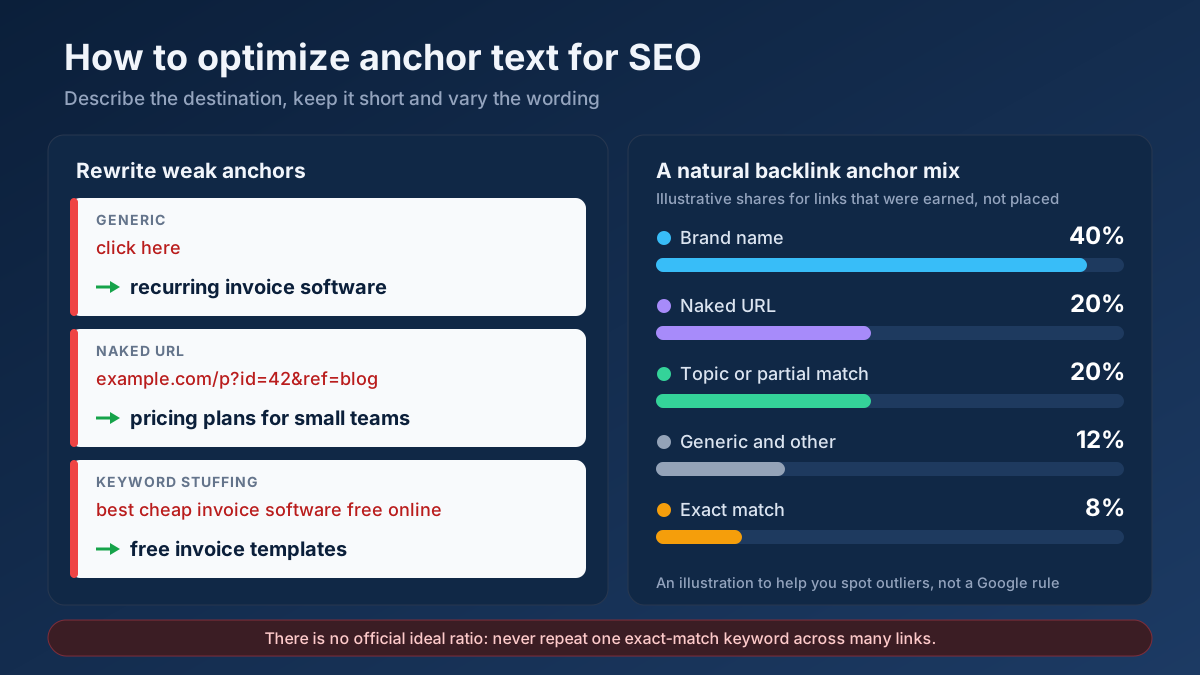
Anchor text matters more internally than most people assume, because internally you control all of it. Click here and read more tell a crawler nothing. Descriptive anchors that name the destination topic tell it exactly what the target page is about; an Anchor Text Optimizer run flags where yours have gone generic or, in the other direction, become so repetitive they look manufactured.
Step 5 — Earn links a human decided to give
The uncomfortable truth of authority building is that there is no shortcut worth taking. Google’s link spam policies are explicit about paid links, exchanges and large-scale guest posting with keyword-rich anchors, and modern spam detection largely neutralises those links rather than announcing a penalty — so you pay for something that simply does not count. Four approaches still work, and all four are slower and more durable.
Publish something with a number in it
Original data is the most linkable asset a small site can produce, because journalists and bloggers need statistics to cite and there are never enough. You do not need a research budget. Survey 200 people in your industry. Analyse the 500 listings you already have in your own database. Test twelve products and publish the measurements. Anything that produces a sentence somebody else wants to quote, with your domain attached, earns links for years without further effort.
Build the free thing
A calculator, a template, a checker, a comparison table that is genuinely maintained. Free tools accumulate links passively because people recommend them in forums, newsletters and answers years after publication. The cost is real and the maintenance is real, but a tool that solves one small problem well outperforms twenty outreach emails a week indefinitely.
Be quotable, and be reachable
Journalist request services, industry podcasts, conference panels, expert roundups: all of them run on a shortage of people willing to say something specific on the record. Reply within an hour, give a concrete opinion rather than a hedge, include a number, and keep it short. A named expert quote in a trade publication is worth more than fifty directory submissions, and it also builds exactly the experience and expertise signals covered in the E-E-A-T guide.
Replace what is already broken
Broken link building is unfashionable and still works, because you are offering a favour rather than asking one. Find dead pages on relevant sites, check what used to be there, publish a better version, and tell the person maintaining the page. Conversion is low — expect five to ten per cent — but every accepted link is editorial and contextual. The broken link building guide has the process, and the backlink analysis guide covers finding the prospects.
What to stop doing: buying links, exchanging links in reciprocal schemes, mass directory submissions, comment and forum signature spam, and private blog networks. These were reliable in 2012. They are now, at best, money spent on links that are ignored, and at worst a toxic link profile you will pay somebody to clean up in three years.
Step 6 — Clean up the links you already have
Authority is not only about acquisition. Most sites older than five years are carrying links from a previous agency, a previous strategy or a previous owner, and some of them are actively unhelpful.
Run a Toxic Backlink Audit and read the profile for shape rather than for individual entries. Three patterns are worth attention. Anchor text concentration: if 40% of your inbound anchors are the same commercial phrase, that is not how natural link profiles look — real ones are dominated by brand names and bare URLs. Irrelevant clusters: two hundred links from gambling or pharmaceutical sites when you sell accounting software did not arrive by accident. Sudden historical spikes: a month in 2019 where 900 domains appeared usually marks a campaign somebody has forgotten to mention.
The correct default is to do nothing. Google is generally good at ignoring junk links, and the disavow file is a scalpel that people use as a hammer — disavowing legitimate links is a self-inflicted wound that takes months to reverse. Use it only for links you or somebody working for you actually built, or when you have a manual action naming them. The disavow guide covers where the line sits.
The other half of cleanup is recovery. Pages that once earned links and now return 404 are pure loss. A Broken Link Checker run against your own domain finds them; redirect each to the closest live page and you recover authority you already paid for. On sites that have been through a redesign or a migration this single fix is often worth more than a quarter of outreach — see the migration checklist for why redesigns cause it.
Step 7 — Make your expertise verifiable on the page
Google’s helpful content guidance asks a question worth answering honestly: does the content present information in a way that makes you want to trust it? Trust here is not a feeling; it is a set of things that are either present on the page or absent from it.
The absent list is remarkably consistent across low-authority sites. No named author, or an author called Admin. No author biography explaining why this person is qualified to write this. No dates, or a date that updates automatically every night so nothing is ever old. No sources for any factual claim. No physical address, no company registration, no real contact route. No evidence anybody has ever used the product.
Fixing this is a week of work, not a strategy. Give every article a real human author with a real biography and a linked profile page — an Author Page Audit checks whether yours carry the signals they should. Cite sources with outbound links to primary material; linking out to authoritative sources does not leak value, it demonstrates that your claims have a foundation. Show the work: screenshots, numbers, the thing that did not work. Mark up the organisation and the authors with structured data via a Schema (JSON-LD) Generator so the relationships are machine-readable, as covered in the structured data guide. Then score the result with an E-E-A-T Analyzer run and fix whatever it flags.
Step 8 — Build the brand the score cannot see
Two sites, identical link profiles. One has four thousand people a month searching its name; the other has none. They do not perform the same, and no authority score captures the difference.
Branded search volume is the closest public proxy for the thing Google is actually trying to approximate: is this an entity people know and choose deliberately? You can watch it directly in Search Console by filtering queries containing your brand name and tracking the count month over month. It is the slowest-moving number in this guide and the most predictive.
Unlinked mentions are the practical starting point. Your brand is already named in forum threads, comparison posts, newsletters and reviews without a link. A Brand Mention Monitoring run finds them, and a short, polite note converts a meaningful share of them — you are asking somebody to link to something they already chose to write about, which is the easiest ask in the discipline.
Beyond that, brand is built where your audience already is rather than where SEO advice says it should be: consistent presence in one community, one recurring format people recognise, and consistent business data everywhere you appear. For anything with a physical location, citation and NAP consistency and a maintained Google Business Profile are the entity foundations, not optional extras.
Step 9 — Prune the dead weight
Publishing more is the reflex. On sites that have been running for years, deleting is frequently the higher-return move, and it is the one nobody wants to make.
Pull every URL and its organic traffic over the last twelve months. On a typical mature site, a large minority of pages will have received effectively nothing. Sort them into four piles. Improve: right topic, thin execution — expand it properly. Merge: three or four pages competing for the same query — consolidate into one and 301 the rest, which also fixes the cannibalisation you probably have. Delete: no traffic, no links, no purpose, no path to any — remove it and return 410. Keep: it serves a purpose that is not organic traffic, such as documentation or legal pages.
Find the candidates with a Thin Content Checker and check overlap with a Keyword Cannibalization Checker before merging anything. Two cautions from watching people do this badly: never delete a page that has inbound links without redirecting it, and check Search Console for impressions before removing anything — a page with 4,000 impressions and 12 clicks is a title problem, not a deletion candidate, as the impressions without clicks guide explains.
Step 10 — Measure on the right cadence
The final step is knowing what to look at and how often, because checking an authority score weekly is a reliable way to make bad decisions.
Weekly: nothing about authority. Look at Search Console coverage and any new errors, and get on with the work.
Monthly: new referring domains gained and lost, total keywords in the top ten, organic clicks against the same month last year. These move quickly enough to be informative and slowly enough not to be noise. The Search Console guide covers pulling them without a paid tool.
Quarterly: your authority score and your competitors’, via a DA / PA Checker — Domain & Page Authority run on all four domains on the same day. Record the four numbers in a spreadsheet. What you want is the gap narrowing; the absolute values matter far less.
Annually: the honest one. Are you ranking for harder queries than a year ago? Do people cite you without being asked? Would somebody in your field name you unprompted? Those are the questions the score is a poor substitute for.
How long does it realistically take?
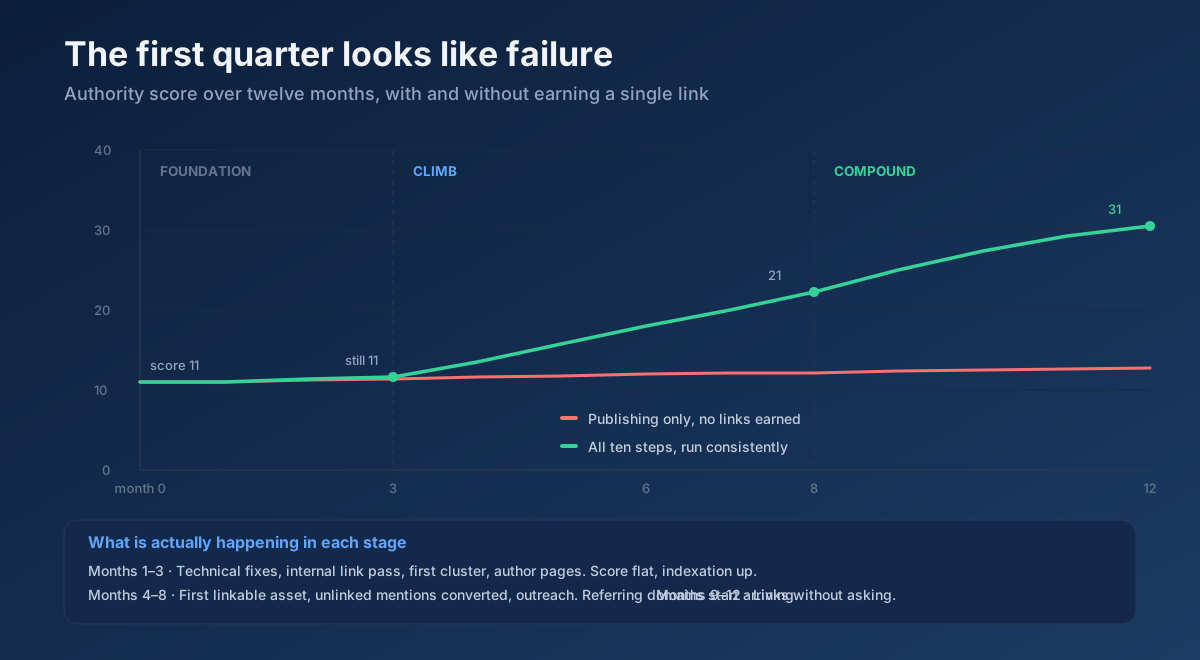
The honest answer is that authority is measured in quarters, not weeks, and the first quarter looks like failure. The pattern below is what steady, competent work on a small site typically produces — not a guarantee, but a far better planning assumption than the three-month promises in agency pitches. The how long SEO takes guide covers the underlying reasons.
| Period | What you do | What you see |
|---|---|---|
| Months 1–3 | Technical fixes, internal link pass, first 10–15 cluster pages, author and schema work | Authority score flat. Indexation and impressions improve. Long-tail rankings appear. |
| Months 4–6 | First linkable asset published, unlinked mentions converted, outreach begins | First real referring domains. Score moves 2–5 points. Top-ten keyword count starts climbing. |
| Months 7–12 | Second cluster, second linkable asset, consistent expert presence | Links start arriving unprompted. Mid-competition queries become reachable. Score up 10–20 from baseline. |
| Year 2 | Same work, more of it, plus pruning and refreshing | Compounding. New pages rank in weeks rather than months. |
| Year 3+ | Maintenance and defence | Head terms become realistic. The site is cited as a source. |
The most common failure is abandoning the plan in month four, when the foundation work is complete and the score has not moved. That flat first quarter is not the strategy failing; it is the strategy working invisibly, because indexation and topical coverage improve before any link metric reflects it.
Seven mistakes that cost a year
- Buying links. Modern link spam detection largely ignores them, so the usual outcome is not a penalty but a wasted budget with nothing to show for it. The money buys a number in a tool, not a position in Google.
- Optimising the score instead of the site. Once an authority score becomes the reported KPI, somebody will find the cheapest way to move it, and the cheapest way is always low-quality links.
- Publishing volume without structure. Two hundred unconnected articles across nine subjects build no topical authority at all. Forty connected ones about a single subject do.
- Ignoring internal links. The single cheapest authority action available, skipped by most sites, because it produces no invoice and no screenshot.
- Aggressive disavowing. Removing links Google was happily counting, on the advice of a tool that flagged them as toxic. Slow to notice, slow to reverse.
- Anonymous content. No author, no bio, no sources — then wondering why a site with better information ranks below one with a named specialist behind it.
- Restarting every quarter. New agency, new strategy, new topic, four times in two years. Authority compounds only if the direction stays the same long enough to compound.
Your first 90 days
If the ten steps look like a lot at once, they are. Here is the order that front-loads the work with no dependencies on anybody else.
Weeks 1–2 — measure and fix. Record the five baseline numbers. Run a Technical Site Audit (Crawler) and a Broken Link Checker and fix everything they surface. Flatten redirect chains. This is the entire technical floor.
Weeks 3–4 — redistribute. Run an Internal Link Opportunity Finder and add every sensible internal link it suggests. Fix generic anchor text. Nothing here requires permission or budget, and it is the first thing that moves.
Weeks 5–8 — choose and cover. Pick one topic. Map it with a Topical Authority Map and publish the hub plus the first six supporting pages, each one written to the standard in the blog post guide rather than to a word count.
Weeks 9–12 — prove and reach. Add author pages, biographies and organisation schema. Publish one asset worth linking to. Run a Brand Mention Monitoring pass and convert the unlinked mentions you already have.
At day 90 the authority score will most likely be within two points of where it started, and the site will be measurably healthier in every way that leads to the score moving in month six.
Frequently asked questions
How long does it take to increase domain authority?
Expect no visible movement for roughly three months, then two to five points by month six and ten to twenty points over the first year on a small site doing consistent work. The scale is logarithmic, so early gains come faster than later ones: 10 to 20 is achievable in a year, 60 to 70 usually is not.
Does domain authority affect Google rankings?
Not directly — it is a third-party score Google does not use or see. It correlates with rankings because it is calculated from link data that overlaps with signals Google does use. Treat it as a thermometer: useful for reading the temperature, useless for changing it.
How do I check my website authority for free?
Run your domain through a DA / PA Checker — Domain & Page Authority for the score, a Backlink Checker / Verifier for referring domains, and Search Console for the ranking and impression data that actually reflects performance. Check all of them for your competitors on the same day so the comparison is fair.
Is topical authority more important than domain authority?
For most sites below the top tier, yes. Comprehensive coverage of one subject beats scattered coverage backed by more links, and it is buildable without asking anybody for a link. Domain authority becomes the deciding factor mainly when two sites cover a topic equally well.
Can I increase authority without building any backlinks?
You can improve rankings substantially through topical coverage, internal linking, technical health and trust signals — and those often produce links passively. But a tool-measured authority score is mostly a link metric, so a site with no external links will see limited movement in the number regardless of how good it gets.
How many backlinks do I need?
Wrong unit. Count referring domains, and count them relative to the sites currently ranking for your target queries. A Link Intersect / Backlink Gap run against two competitors gives you the actual figure for your market, which is usually far smaller than people fear.
Do nofollow links help website authority?
They are treated as hints rather than passed endorsements, so their direct contribution is limited. Their indirect value is real: referral traffic, brand exposure, and the tendency for one visible mention to produce followed links elsewhere. Never turn down a relevant nofollow link.
Does buying an aged domain increase authority?
Rarely, and it is a common way to inherit a problem. Age alone carries no benefit, the previous owner’s history comes with it, and expired-domain marketplaces are full of sites whose authority score reflects link schemes rather than reputation. If you are tempted, audit the full link history first with a Toxic Backlink Audit and a Domain Age Checker check.
Start with the numbers you have
Website authority is the accumulated result of ten unremarkable habits, not a lever anybody can pull. Fix the technical floor, cover one subject properly, redistribute the equity you already own, earn links from people who chose to give them, and make your expertise checkable. The score is the receipt, not the goal.
The useful next step is small: run your domain and your two closest competitors through the DA / PA Checker — Domain & Page Authority , pull the referring domain gap with a Link Intersect / Backlink Gap , and put the four numbers in a spreadsheet with today’s date on them. In ninety days that sheet will tell you whether the work is compounding — and it costs nothing but the fifteen minutes.