The single most common question every website owner asks is also the hardest to answer honestly: how long does SEO take to work? You have published the pages, fixed the technical errors and earned a few links — so where are the rankings? This guide gives you a realistic, evidence-based timeline for 2026, explains exactly why search engine optimization is slow, breaks down the factors that speed it up or drag it out, and shows you how to measure real progress long before your rankings move. Everything here you can track for free.
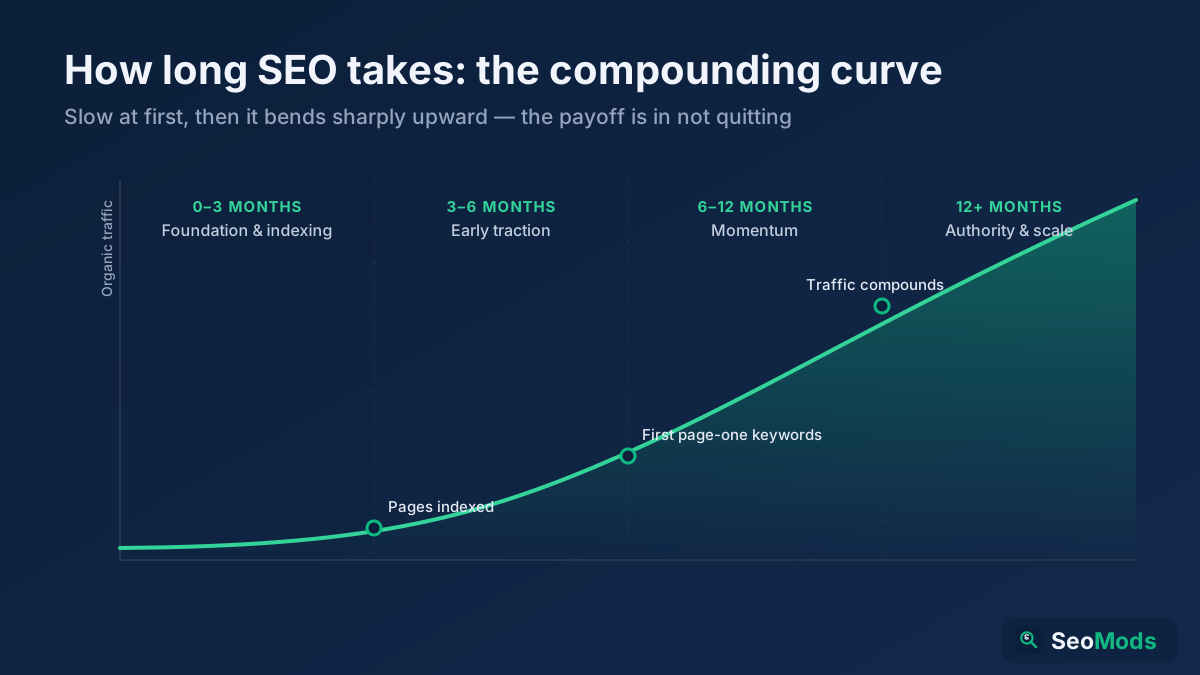
SEO is not a switch you flip; it is a compounding investment. The good news is that the curve, while slow at first, bends sharply upward once it catches — and understanding the shape of that curve is the difference between quitting three months too early and building an asset that pays off for years.
Short answer: how long SEO takes
Short answer: For most websites, SEO takes four to six months to show meaningful movement and six to twelve months to produce significant, business-changing organic traffic. Brand-new domains and competitive niches sit at the slower end; established sites making targeted fixes can see results in weeks. There is no fixed number — your timeline depends on your site's age and authority, the competitiveness of your keywords, your content quality, your technical health and how consistently you publish. SEO compounds, so results accelerate the longer you stay consistent.
Keep that range in mind — four to twelve months — but treat it as a starting map, not a promise. The rest of this article explains what moves you toward the fast end and what pins you at the slow end, so you can set honest expectations and stop guessing.
Why SEO takes time in the first place
SEO is slow because ranking is not a decision Google makes once — it is a verdict Google reaches gradually, after crawling, indexing, testing and re-testing your pages against real user behavior. Three mechanical realities create the delay, and none of them are under your direct control.
Crawling and indexing take time. Before a page can rank, Google has to discover it, crawl it, render it and add it to the index. For a new page on a small site that can take days to a few weeks; Google visits low-authority sites less often and budgets fewer crawls to them. You can shorten this with a clean XML sitemap and internal links, but you cannot eliminate it. Learn how Google allocates crawls in our guide to crawl budget.
Google tests before it trusts. Search engines rarely hand a fresh page its final position immediately. They often place it provisionally, watch how searchers interact with it — clicks, dwell time, whether people bounce straight back to the results — and adjust over weeks. A page that satisfies users climbs; one that disappoints slides. This evaluation period is why rankings wobble for the first month or two after publishing.
Authority accrues slowly. Trust and authority — earned through quality content, backlinks and a consistent track record — build over months and years, not days. A domain that has published useful content for three years starts every new page from a higher baseline than a domain launched last week. This is the single biggest reason two identical articles on two different sites rank months apart.
A realistic SEO timeline, month by month
Here is what a typical, well-executed SEO campaign looks like over its first year. Your mileage varies with the factors in the next section, but this is the shape most sites follow.
Months 0-3: foundation and indexing
The first quarter is almost entirely invisible from the outside, and that is normal. This is when you fix technical problems, publish your first cornerstone content, get pages crawled and indexed, and set up measurement. Expect little to no ranking movement for competitive terms. What you should see: pages entering the index, impressions starting to appear in Google Search Console for long-tail queries, and perhaps a handful of low-competition keywords landing on pages two or three. Run a full On-Page SEO Audit now and fix everything it flags — foundations laid here decide how fast everything else moves.
Months 3-6: early traction
This is where the first real signals appear. Long-tail and low-competition keywords begin ranking on page one, impressions climb steadily, and you start earning your first meaningful clicks. Rankings will bounce around as Google tests your pages — do not panic at day-to-day volatility. By month six, a healthy campaign shows a clear upward trend in impressions and a growing set of keywords in positions 5-20, ready to be pushed higher. Track exactly which terms are moving with a free Keyword Rank Checker and watch the trend, not the daily noise.
Months 6-12: momentum and compounding
Between six and twelve months, momentum builds and the compounding effect kicks in. Pages that were stuck on page two climb to page one, your best content starts ranking for dozens of related keywords rather than just its target, and organic traffic becomes a real, growing channel you can plan around. Mid-competition keywords become winnable. This is when most businesses first say SEO is clearly working. Use Organic Research / Top Pages to see the full spread of keywords each page now ranks for and find the ones a small push would move to the top.
Months 12+: authority and scale
After a year of consistent work, your domain has real authority and your content library covers your topic broadly. New pages rank faster because they inherit that authority, competitive head terms come into reach, and traffic compounds month over month with far less effort per result than in the early days. This is the payoff phase — the reason SEO is worth the wait. The sites that reach it are simply the ones that did not stop at month four.
The seven factors that decide your timeline
Why does one site rank in six weeks and another in sixteen months? Seven factors explain almost all of the variance. Score yourself honestly on each to predict where you land in the range.
- Domain age and authority. Older, more trusted domains rank new content dramatically faster. A brand-new domain spends its first months earning baseline trust before anything ranks well; an established site skips that tax.
- Keyword competition. Ranking for a long-tail phrase with weak competitors can take weeks. Ranking for a high-volume commercial head term dominated by major brands can take a year or more — or may be unrealistic without significant resources. Check the difficulty before you commit; our keyword research guide shows how.
- Content quality and depth. Thin, generic pages take far longer to rank, if they ever do. Comprehensive, genuinely useful content that fully answers the query ranks faster and holds its position. Depth beats volume.
- Technical health. A fast, crawlable, mobile-friendly, error-free site ranks faster because Google can access and trust it easily. Technical problems act as a handbrake on everything else. Verify your foundation with the technical SEO checklist.
- Backlinks. Quality links from relevant, authoritative sites accelerate rankings by transferring trust. A page with strong links climbs faster than an identical page with none. See our guide to backlink analysis and link building.
- Publishing consistency. Sites that publish quality content steadily build topical authority and earn crawls faster than sites that post once and go quiet. Momentum is real; Google rewards active, growing sites.
- Search intent match. A page that perfectly matches what searchers actually want ranks faster than a technically optimized page that misreads the intent. Nail the search intent before anything else.
New site versus established site
The gap between a new domain and an established one is the biggest single variable in your timeline. A brand-new website typically needs six to twelve months just to build enough trust for competitive pages to rank, because it starts with zero authority, zero backlinks and no track record. Google is cautious with unproven domains, and there is no shortcut around earning that baseline trust — only ways to earn it faster through great content and early links.
An established site with existing authority is a different game entirely. Adding a new page, refreshing old content or fixing on-page issues can produce results in days to weeks, because the domain's trust is already banked and Google crawls it often. If you already run an aging site, your fastest wins usually come not from new pages but from improving what you have — a content refresh on pages ranking in positions 5-15 frequently moves them to page one within a crawl cycle or two.
How long different SEO tasks take
Not all SEO work pays off on the same schedule. Matching your expectations to the specific task prevents the false conclusion that SEO is not working when a slow-by-nature task simply has not matured yet.
- Technical fixes (days to weeks). Correcting indexation errors, fixing broken redirects, improving page speed or repairing a botched migration can show up in as little as a few days once Google re-crawls. These are your fastest wins. Start with a free Technical Site Audit (Crawler) to find them.
- On-page optimization (weeks). Rewriting a title tag, improving content, adding internal links or better matching intent on an existing page often moves rankings within two to eight weeks. Check your pages with the On-Page SEO Checker (Keyword) and rewrite weak titles with the Meta Tag Generator.
- New content (2-6 months). A newly published article on a mid-authority site typically takes two to six months to reach its ranking potential, longer on a new domain or for competitive terms.
- Link building (3-6+ months). Earned links take time to acquire and time for their value to register in rankings. Expect a lag of several months between building a strong link profile and seeing its full ranking effect.
- Local SEO (weeks to months). Optimizing a Google Business Profile and local citations can move map-pack rankings within weeks — often faster than organic web results in competitive niches.
How long to appear in AI Overviews and ChatGPT
In 2026, ranking on Google is only half the visibility picture — you also want to be cited in AI answers from Google AI Overviews, ChatGPT Search, Perplexity and Gemini. The timeline here follows your SEO closely but with a twist: AI engines mostly pull from pages that already rank or are already indexed, so a strong SEO foundation is the prerequisite. Once a page is indexed and ranking on page one, it can start appearing in AI answers within weeks, because these engines retrieve from the live index and re-evaluate frequently.
To shorten the AI timeline, make each page answer-first and easy to quote: lead sections with direct, self-contained answers, add clear structured data, and allow the AI crawlers in your robots file. Check how ready a page is with the GEO / AEO checker and follow the full playbook in how to optimize for AI search. The pages that earn AI citations first are almost always the ones already doing classic SEO well.
How to measure progress before rankings move
The biggest reason people give up on SEO too early is that they watch only rankings and revenue — the two slowest indicators — and see nothing for months. The fix is to track leading indicators that move weeks before rankings do, so you can confirm the machine is working before it pays out. Watch these in Google Search Console, which is free:
- Indexed pages. Are your new pages getting into the index? If yes, step one is working.
- Impressions. Rising impressions mean Google is showing your pages for more queries — the earliest sign of traction, often visible in weeks.
- Average position. A keyword drifting from position 45 to 22 to 14 is winning, even though it has not reached page one yet. Momentum you can see.
- Query count. The number of distinct queries you appear for should climb steadily as Google understands your pages more broadly.
- Clicks and CTR. The last leading indicator to move before traffic becomes material.
Our guide on measuring SEO with Search Console walks through each metric. When impressions and average position are trending up, SEO is working — the traffic simply has not caught up yet. Confirm which specific terms are climbing with a Keyword Rank Checker.
How to speed up your SEO results
You cannot skip the timeline, but you can compress it. These tactics reliably move sites toward the fast end of the range without gaming anything Google will later punish.
- Fix technical foundations first. Nothing ranks fast on a slow, broken, hard-to-crawl site. Run a On-Page SEO Audit and clear every critical error before investing in content.
- Target achievable keywords early. Win long-tail and low-competition terms in the first months to build momentum and authority, then use that foundation to attack harder keywords. Do not open with a head term you cannot win.
- Publish genuinely comprehensive content. Depth ranks faster than thin coverage. Fully answer the query and its follow-ups so Google has no reason to prefer a competitor. Fill the gaps competitors leave with the content gap tool.
- Match search intent exactly. A page that gives searchers precisely what they came for ranks faster and holds. Read the SERP before you write and mirror the winning format.
- Build internal links. Link new pages from relevant existing ones to speed discovery and pass authority. This is free and immediate.
- Earn a few quality links. Even a handful of relevant, authoritative backlinks early can meaningfully accelerate a new page. Prioritize relevance over quantity.
- Refresh and improve, do not just add. On an established site, updating pages that already rank in positions 5-15 is usually the fastest ROI in all of SEO.
- Stay consistent. Steady publishing compounds. A site that publishes every week for a year beats one that publishes twenty pages in month one and stops.
For the complete strategy, see how to rank higher on Google and, if you are running it solo, how to do SEO yourself.
Why your SEO might be taking too long
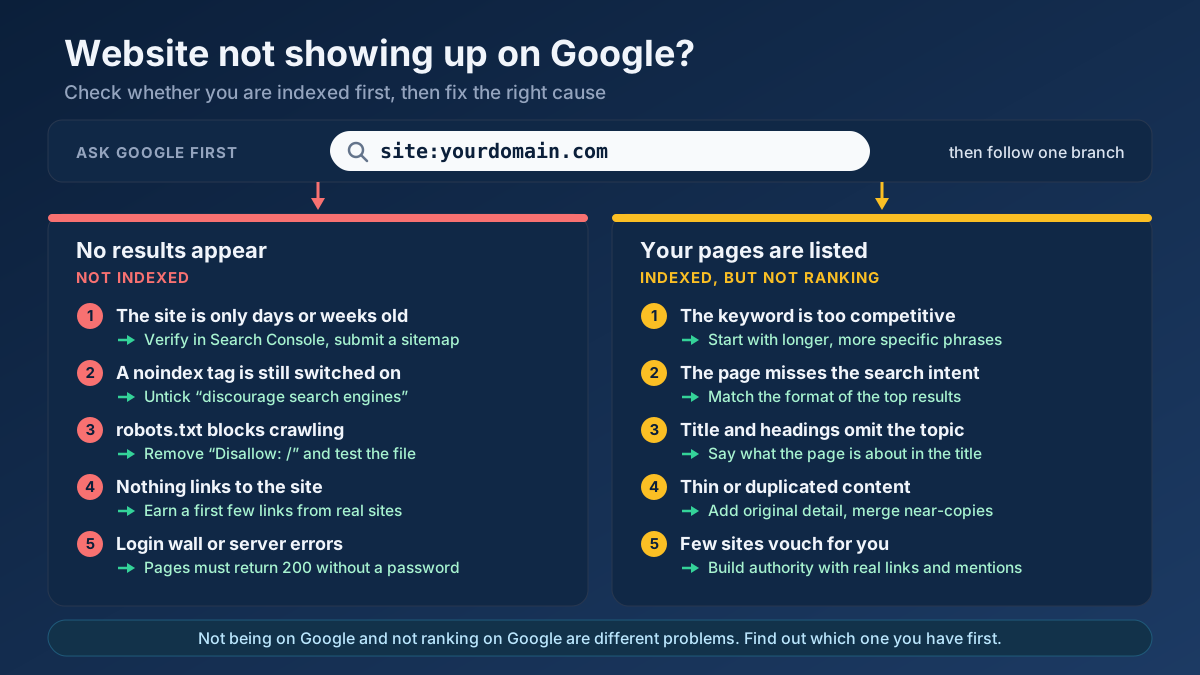
If you are past six months with genuinely no movement — not even rising impressions — something is wrong, and it is usually one of these fixable causes:
- Technical problems blocking indexing. A stray
noindex, a robots.txt block or crawl errors can quietly keep pages out of the index entirely. Confirm your key pages are indexed first. - Targeting keywords that are too competitive. A new site aiming straight at head terms owned by major brands may wait indefinitely. Recalibrate to winnable targets.
- Thin or unhelpful content. If your pages do not fully satisfy the query, they will not rank no matter how long you wait. Depth is not optional.
- Intent mismatch. Ranking a how-to guide for a query where searchers want a product page will never work. Match the format Google already rewards.
- No authority signals. Zero backlinks and no topical depth leaves Google no reason to trust you over established competitors.
- Inconsistency. Stopping and starting resets your momentum. SEO rewards the sites that keep going.
Run a fresh On-Page SEO Audit and a Technical Site Audit (Crawler) to rule out the technical causes first — they are the most common and the easiest to fix.
Setting realistic expectations
The healthiest way to think about SEO is as an asset, not an ad campaign. Paid ads stop the moment you stop paying; SEO keeps working. The trade-off is patience: the first months feel slow because you are building the foundation on which everything later compounds. A page that reaches page one keeps earning traffic for months or years at effectively no marginal cost, which is why the slow start is worth it.
Judge SEO on a rolling six-to-twelve-month horizon, not week to week. Set leading-indicator milestones — indexed by month one, rising impressions by month three, first page-one keywords by month six — and measure against those. If the leading indicators are trending up, stay the course; the traffic and revenue follow. The businesses that win at SEO are not the ones with secret tactics. They are the ones that set honest expectations, tracked the right signals, and did not quit at month four.
Frequently asked questions
How long does SEO take to show results?
Most websites see meaningful ranking movement in four to six months and significant organic traffic in six to twelve months. Established sites making targeted improvements can see results in days to weeks, while brand-new domains in competitive niches often need a full year or more.
Can SEO work faster than six months?
Yes, in specific cases. Technical fixes on an indexed page can move rankings within days. On-page improvements to existing content often work within weeks. Established, authoritative sites rank new pages far faster than new domains. The six-to-twelve-month figure is for building substantial organic traffic from a relatively new or low-authority starting point.
Why is my SEO taking so long?
The usual causes are technical issues blocking indexing, targeting keywords that are too competitive for your site's authority, thin content that does not fully answer the query, a mismatch between your page and search intent, or simply a new domain that has not yet earned trust. Run a free On-Page SEO Audit to identify which applies.
How long until a new website ranks on Google?
A new website typically needs six to twelve months to rank for competitive keywords, because it must first build baseline trust and authority. It can rank for long-tail, low-competition terms much sooner — sometimes within a few weeks of being indexed.
Does SEO ever stop working?
No — but rankings are not permanent. Once you rank, you keep earning traffic at little marginal cost, which is SEO's core advantage over paid ads. Positions can slip if competitors improve, your content goes stale, or an algorithm update changes the landscape, so maintenance and periodic content refreshes keep your rankings healthy.
How do I know if my SEO is working before rankings move?
Watch leading indicators in Google Search Console: indexed pages, impressions, average position and query count all rise weeks before clicks and rankings do. If impressions and average position are trending up, your SEO is working even if traffic has not yet materialized. See measuring SEO with Search Console for the full method.
Conclusion
How long does SEO take? Four to six months for meaningful movement, six to twelve for significant traffic, and longer for a new domain in a competitive niche — but faster for technical fixes and established sites. SEO is slow because Google crawls, tests and trusts gradually, and because authority compounds over time. You cannot skip that curve, but you can compress it: fix your foundations, target winnable keywords, publish deep content that matches intent, build authority steadily, and track leading indicators so you know it is working before the traffic arrives. Start today by running a free On-Page SEO Audit, set your milestones, and give the compounding time to do its work.