Topic Clusters & Pillar Pages: Build Topical Authority
Modern SEO is won with topical authority, not single pages. Learn the pillar-and-cluster model.
Read article →Compare your page against a competitor and reveal the keywords & terms they cover that you are missing.
Fetching live data…
The Content / Keyword Gap tool compares your page against a competitor's and reveals the keywords and terms they cover that you are missing. It fetches both live pages, extracts the meaningful words and phrases from each, and shows you exactly where their content is richer than yours. The result is a concrete list of topics to add — built from real page content, free to use, with no signup.
Compare your email marketing guide against a higher-ranking competitor and the tool might flag missing terms like segmentation, deliverability and A/B testing — three sections to add so your page covers the topic as fully as theirs.
Yes — completely free with no signup and no limits. Compare as many page pairs as you need.
Yes. The tool fetches and parses both live pages, so the gaps reflect the actual content on each URL right now — nothing is estimated.
Add the missing terms where they fit naturally, then check structure with the On-Page SEO Checker (Keyword) tool. Our content refresh guide explains how to update pages without losing rankings.
Guides, tips and tutorials hand-picked for this tool — go from running a check to actually fixing it.
Modern SEO is won with topical authority, not single pages. Learn the pillar-and-cluster model.
Read article →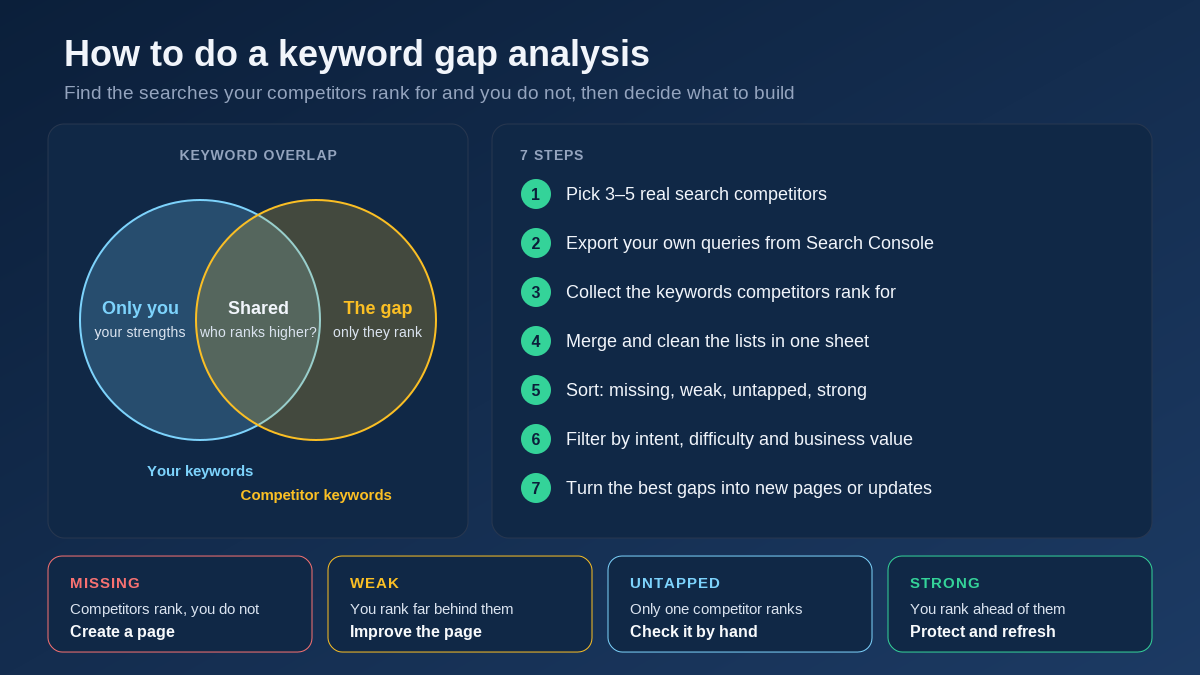 Keyword Research
Learn how to do a keyword gap analysis in 7 steps: find the keywords competitors rank for and you don’t, sort the gaps, then turn them into a content plan.
Read article →A practical, no-budget keyword research workflow: find ideas, understand intent, and group keywords into clusters that rank.
Read article →Reverse-engineer what works for your competitors and find your fastest wins. Here is a free workflow.
Read article →When multiple pages target the same keyword, they compete with each other and dilute rankings. Here is the fix.
Read article →Updating old content is often the highest-ROI SEO task. Here is a simple refresh workflow.
Read article →Predict which Google SERP features (featured snippet, PAA, video, local pack) a keyword is likely to trigger.
Open tool →Understand what a searcher really wants. Analyzes a query’s primary and secondary intent, maps it to a funnel stage, recommends the content type and the SERP features it’s likely to trigger, and shows real related queries with their own intent — so your page matches what Google rewards.
Open tool → EstimateEstimate commercial value and competition of keywords and group them for paid campaigns.
Open tool →Classify a whole keyword list by search intent in one pass. Labels each keyword Informational, Commercial, Transactional or Navigational, maps it to a funnel stage (ToFu/MoFu/BoFu) and the best content type, and charts the intent distribution — perfect for prioritizing a content calendar.
Open tool →Pixel-accurate preview of how your title and description will appear in Google search results.
Open tool →Turn one seed keyword into semantic clusters ready for content planning. Expands your seed with real Google Autocomplete queries, groups them into topic clusters by shared terms, labels each cluster’s search intent and charts the distribution — so you can build a hub-and-spoke content architecture.
Open tool →