Keyword research is the single most important skill in SEO. It is the process of discovering the exact words and phrases your audience types into search engines, understanding why they search them, and mapping those queries to content you can realistically rank for. Get it right and everything downstream — content, structure, internal links, even your product roadmap — becomes easier. Get it wrong and you can publish brilliant content that nobody ever finds.
In 2025, keyword research has shifted. Google's systems are far better at understanding meaning, synonyms and context, so the old game of repeating one exact phrase is dead. What matters now is covering a topic completely and matching search intent. This guide walks you through a complete, repeatable workflow you can run for free.
Why keyword research still matters
Every month, billions of searches happen, and each one is a person looking for an answer, a product or a solution. Keyword research turns that demand into a map. It tells you which topics have real audiences, how hard they are to rank for, and what format the searcher expects. Without it, you are guessing — and guessing is expensive when content takes hours to produce.
Done well, keyword research also reveals your customers' language. The words they use to describe their problems are rarely the words you use internally. Aligning with their vocabulary improves not just rankings but conversion rates across your whole site.
Step 1: Build a list of seed keywords
Seeds are the broad, obvious terms that describe your niche. If you sell running shoes, your seeds might be 'running shoes', 'trail running', 'marathon training' and 'running injuries'. You only need five to ten. Brainstorm them from your products, your customers' questions, and the language competitors use on their homepages.
Next, expand each seed into hundreds of real variations. Drop each one into the Keyword Research — it pulls live suggestions from Google Autocomplete and layers on A–Z, question and preposition modifiers, so a single seed becomes a rich list of phrases real people actually search. Pair it with the Keyword Suggestion Tool for fast idea generation, then pressure-test real-world demand and seasonality for any term with Google Trends.
Step 2: Understand search intent
Intent is the reason behind a query, and matching it is non-negotiable. Google ranks pages that satisfy intent, so a mismatch is fatal no matter how good your content is — Google's Search Essentials frames satisfying the searcher as the heart of ranking. There are four classic types:
- Informational — the searcher wants to learn ('how to clean running shoes'). Answer with guides, tutorials and explainers.
- Commercial — the searcher is researching before buying ('best running shoes for flat feet'). Answer with comparisons, reviews and round-ups.
- Transactional — the searcher is ready to act ('buy Nike Pegasus 41'). Answer with product and category pages.
- Navigational — the searcher wants a specific brand or page ('Strava login'). Answer with clear brand destinations.
Classify any keyword automatically with the Search Intent Analysis, which analyzes live signal patterns and tells you the dominant intent. The simplest rule: never point a commercial keyword at a product page, or a transactional keyword at a blog post. Match the format to the intent and you are already ahead of most competitors.
Step 3: Group keywords into topic clusters
Modern SEO rewards topical authority — proving to Google that you cover a subject deeply, not just one page at a time — a principle Google describes in its helpful content guidance. Instead of one page per keyword, organize related terms into clusters: a broad pillar page supported by focused articles that all link to each other.
For example, a 'marathon training' pillar could be supported by clusters on training plans, nutrition, recovery and gear. Generate these clusters automatically with the Topic Research & Content Ideas, which sorts a single seed into questions, comparisons and preposition groups you can map straight onto a content calendar. Read more in our guide to topic clusters and pillar pages.
Step 4: Judge difficulty and prioritize
Not every keyword is worth chasing. A brand-new site will not outrank established authorities for 'running shoes' any time soon, but it can win 'best zero-drop running shoes for plantar fasciitis'. These long-tail phrases have lower competition and clearer intent, so they convert better. Learn why in our long-tail keyword guide.
Prioritize by a simple mix of three factors: how relevant the keyword is to your business, how realistic it is to rank for given your authority, and how much commercial value it carries. Start with low-competition, high-relevance long-tails to build momentum, then graduate to broader head terms as your site earns authority.
Step 5: Find the gaps your competitors exploit
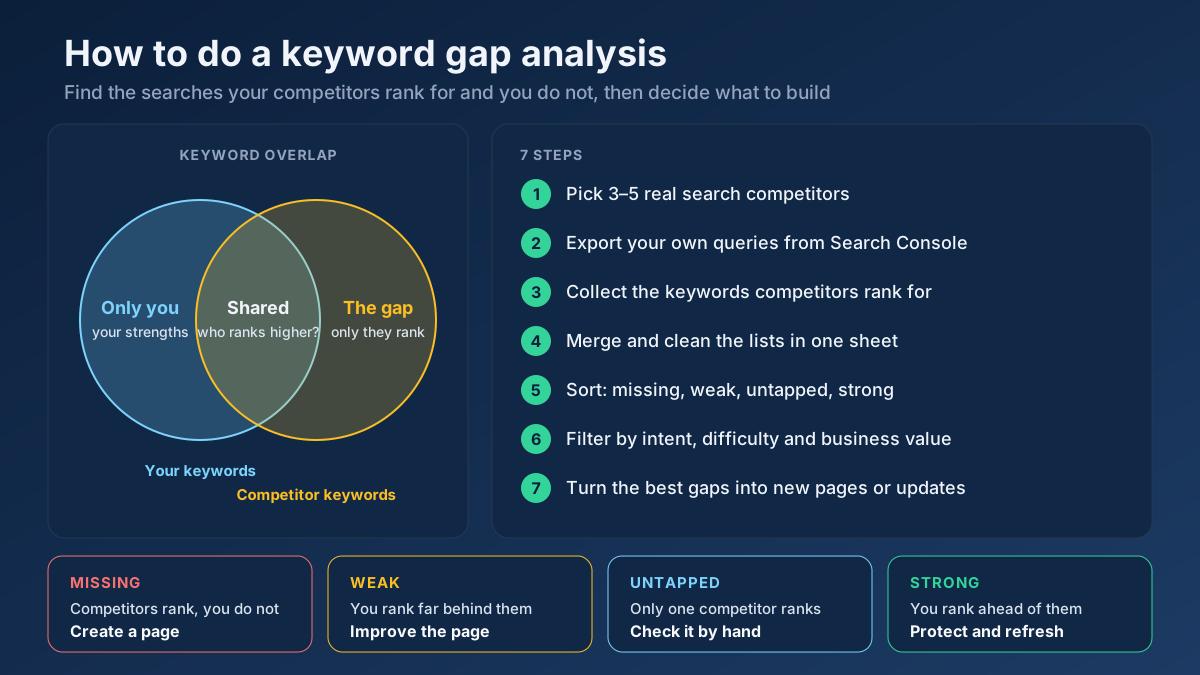
If a competitor consistently outranks you, they are almost certainly covering subtopics and terms you are missing. Run your page and theirs through the Content / Keyword Gap to reveal exactly which keywords they cover that you do not — then fill those gaps with new sections or new articles. This is one of the fastest ways to grow an existing page's rankings without starting from scratch.
Step 6: Turn keywords into content
Once you have a prioritized, intent-mapped, clustered keyword list, the writing gets easier. Each target keyword becomes a page; its cluster of related terms becomes the subheadings and supporting points. Place your primary keyword in the title, H1, URL and first paragraph naturally, and weave related terms through the body. When the draft is done, score it against the target with the On-Page SEO Checker (Keyword) and preview how it will look in search with the Google SERP Snippet Preview.
Common keyword research mistakes
- Chasing volume over intent. A high-volume keyword you cannot satisfy is worthless. Relevance beats reach.
- Ignoring long-tails. They are easier to rank for and collectively drive most search traffic.
- Keyword stuffing. Repeating a phrase unnaturally hurts readability and rankings. Cover the topic instead.
- Targeting one keyword per page when several pages compete. This causes keyword cannibalization, where your own pages fight each other.
Applying this to your own site? See the tools picked by audience: SEO Tools for Bloggers and SEO Tools for SEO Beginners.
Putting it all together
Keyword research is not a one-time task — it is an ongoing loop. Search behavior shifts, new questions emerge, and competitors publish. Revisit your research every few months, refresh underperforming pages, and keep expanding your clusters. The compounding effect is real: each well-researched page strengthens the topical authority of the next.
Start now: expand a seed with the Keyword Research, classify intent with the Search Intent Analysis, and build your first cluster with the Topic Research & Content Ideas. Then continue with our complete on-page SEO guide to turn those keywords into rankings.