llms.txt Explained: How to Help AI Models Understand Your Site
llms.txt is a simple Markdown file that gives AI models a clean, accurate summary of your site or product. Here is what it is, what to include, and how to create one.
Read article →Locate a domain’s XML sitemap(s), validate the format and count the URLs inside.
Fetching live data…
The Sitemap Finder & Validator is a free tool that locates a domain's XML sitemap(s), checks that the format is valid, and counts the URLs listed inside. An XML sitemap is how a site tells Google which pages exist and deserve to be crawled, so a missing, broken or empty sitemap can quietly hold back indexing. This tool checks the common sitemap locations and the robots.txt declaration, fetches the real, live file, and reports exactly what a crawler would find — no signup required.
example.com)./sitemap.xml and reads the Sitemap: line in robots.txt.Run the tool on a blog and you might find /sitemap.xml is actually a sitemap index that points to /post-sitemap.xml and /page-sitemap.xml, together listing 312 valid URLs — confirming the whole site is discoverable and the feed is healthy.
Yes — completely free, with no signup and no limits. Check as many domains as you like.
The convention is /sitemap.xml at the root, and it should be referenced in robots.txt so crawlers find it automatically. Verify that reference with the Robots.txt Tester and learn the full structure in our XML sitemaps guide.
No. A sitemap helps Google discover pages, but each URL still has to be crawlable and worth indexing. Check page-level health with the On-Page SEO Audit to make sure listed pages aren't blocked or thin.
Guides, tips and tutorials hand-picked for this tool — go from running a check to actually fixing it.
llms.txt is a simple Markdown file that gives AI models a clean, accurate summary of your site or product. Here is what it is, what to include, and how to create one.
Read article →An XML sitemap helps Google discover and prioritize your pages. Here is how to build and submit one correctly.
Read article →robots.txt controls what crawlers can access. One wrong line can deindex your whole site — here is how to get it right.
Read article →Targeting multiple countries or languages? hreflang tells Google which version to show whom. Here is how it works.
Read article →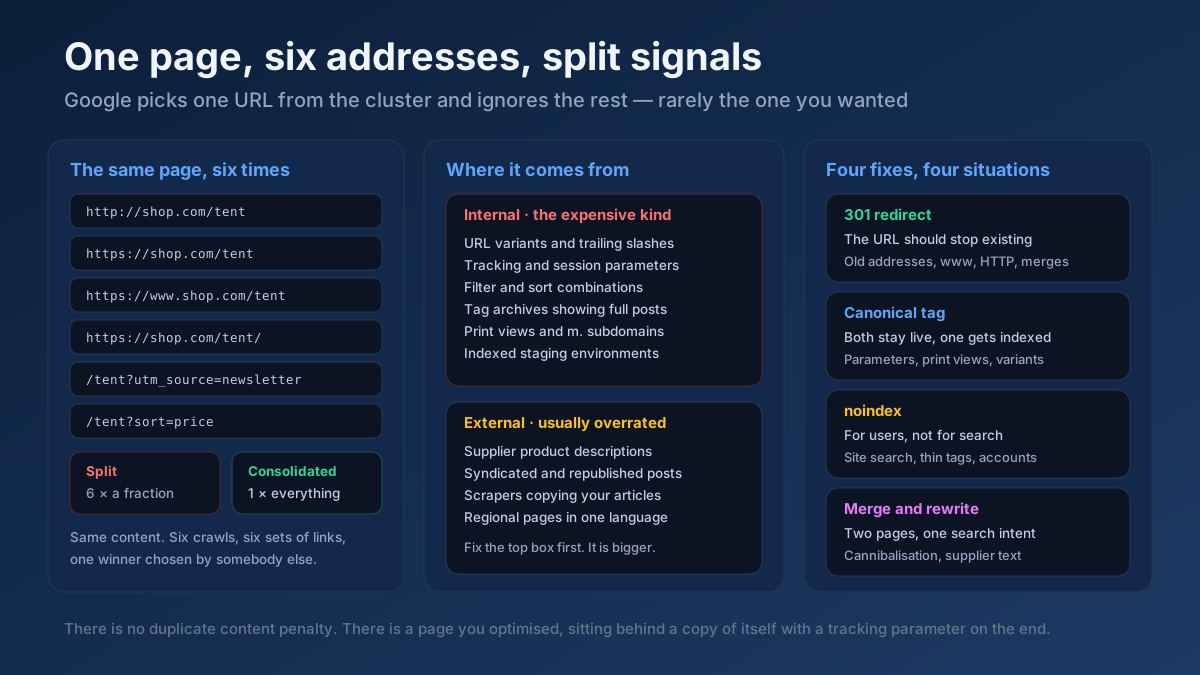 Technical SEO
How to fix duplicate content issues in 9 steps: find every duplicate URL, choose between a canonical, a 301 and noindex, and stop the problem returning.
Read article →Crawlability, indexability, speed and structured data — the technical foundations that let your content rank.
Read article →Retrieve real domain registration data: registrar, creation/expiry dates, name servers and status.
Open tool →Query live A, AAAA, MX, NS, TXT, CNAME, SOA and SRV records for any domain.
Open tool →Inspect the live TLS certificate: issuer, validity dates, days remaining and SAN domains.
Open tool →View raw response headers, server software, caching, security headers and content type of any URL.
Open tool →Passive security scan of any website: HTTPS and TLS, HSTS, CSP and other security headers, exposed .env / .git / phpinfo files, cookie flags, mixed content, version leaks and the PHP2Shell (CVE-2026-109618 / CVE-2026-109619) PHP version check.
Open tool →Trace the full redirect chain (301/302/307) of a URL and verify the final status code.
Open tool →Your site may have a critical PHP vulnerability
PHP2Shell (CVE-2026-109618 and CVE-2026-109619) lets attackers run code on servers running PHP older than 8.2.35, 8.3.36, 8.4.27 or 8.5.12, without logging in. Attacks have been seen since 17 October. Check whether your site is affected.