What Is LLMO (LLM Optimization)? A Practical 2026 Guide
LLMO is the practice of making your content easy for large language models to ingest, understand and reproduce accurately. Here is what it is and how to do it.
Read article →Fetch and parse a site’s robots.txt, test any URL against it for Googlebot and Bingbot, list rules per user-agent and locate sitemap declarations.
Fetching live data…
The Robots.txt Tester is a free tool that fetches a site's robots.txt file directly over HTTP and parses it into readable rules. Every site uses robots.txt to tell search engine crawlers which paths they may or may not request, so a single typo can accidentally block Google from an entire section. This tool reads the real, live file, groups the directives by user-agent, highlights every Allow and Disallow rule, and pulls out any sitemap declarations — no signup, no guessing.
https://example.com)./robots.txt from that host exactly as a crawler would and reads the raw response.User-agent block.User-agent group each one obeys and the exact line that decides, matched the way Google does: longest pattern wins, Allow wins a tie.* wildcard.Sitemap: line and its URL.Disallow: / isn't hiding your whole site.Run the tool on a store and you might see a User-agent: * block that disallows /cart/ and /checkout/, an explicit Allow: /cart/info exception, and a Sitemap: https://example.com/sitemap.xml line — confirming the right pages are blocked while products stay crawlable.
Yes — completely free, with no signup and no limits. Test as many domains as you like.
Not on its own. A Disallow only stops crawling; a blocked URL can still appear in results if other pages link to it. To keep a page out of the index use a noindex tag — check tags with the Meta Tag Analyzer — and read our robots.txt guide.
This tool reads and validates a live file. To build a new one from scratch use the Robots.txt Generator and then confirm the sitemap it references with the Sitemap Finder & Validator.
Guides, tips and tutorials hand-picked for this tool — go from running a check to actually fixing it.
LLMO is the practice of making your content easy for large language models to ingest, understand and reproduce accurately. Here is what it is and how to do it.
Read article →robots.txt controls what crawlers can access. One wrong line can deindex your whole site — here is how to get it right.
Read article →llms.txt is a simple Markdown file that gives AI models a clean, accurate summary of your site or product. Here is what it is, what to include, and how to create one.
Read article →An XML sitemap helps Google discover and prioritize your pages. Here is how to build and submit one correctly.
Read article →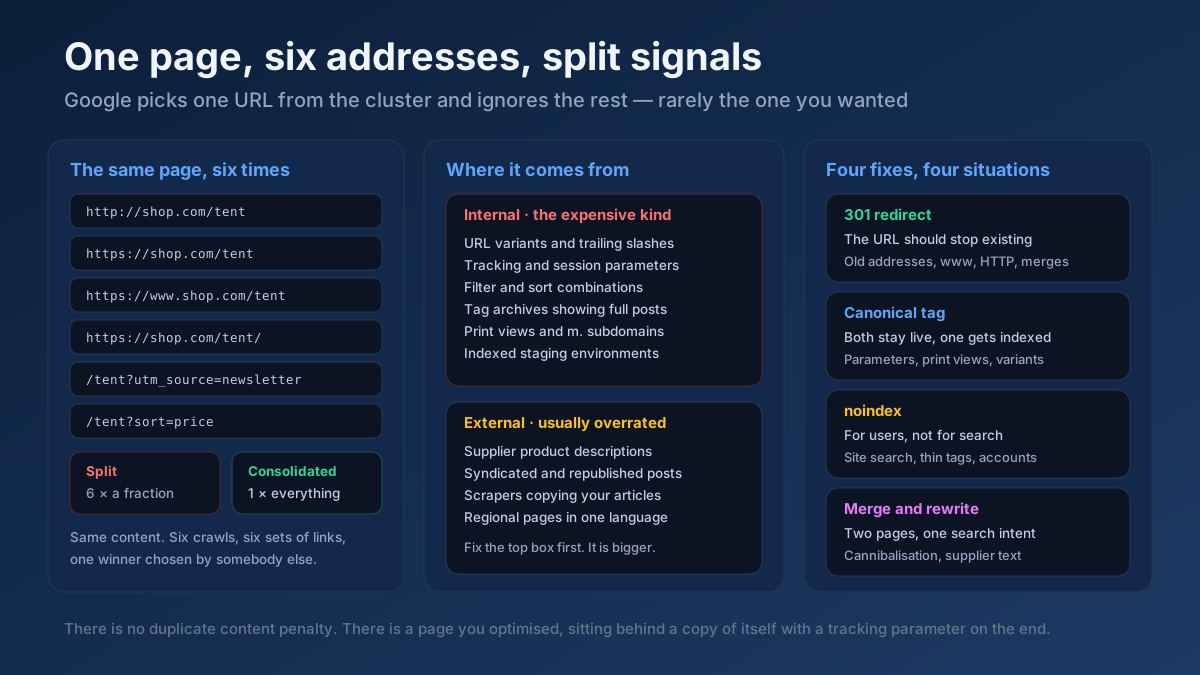 Technical SEO
How to fix duplicate content issues in 9 steps: find every duplicate URL, choose between a canonical, a 301 and noindex, and stop the problem returning.
Read article →Crawlability, indexability, speed and structured data — the technical foundations that let your content rank.
Read article →Retrieve real domain registration data: registrar, creation/expiry dates, name servers and status.
Open tool →Query live A, AAAA, MX, NS, TXT, CNAME, SOA and SRV records for any domain.
Open tool →Inspect the live TLS certificate: issuer, validity dates, days remaining and SAN domains.
Open tool →View raw response headers, server software, caching, security headers and content type of any URL.
Open tool →Passive security scan of any website: HTTPS and TLS, HSTS, CSP and other security headers, exposed .env / .git / phpinfo files, cookie flags, mixed content, version leaks and the PHP2Shell (CVE-2026-109618 / CVE-2026-109619) PHP version check.
Open tool →Trace the full redirect chain (301/302/307) of a URL and verify the final status code.
Open tool →Your site may have a critical PHP vulnerability
PHP2Shell (CVE-2026-109618 and CVE-2026-109619) lets attackers run code on servers running PHP older than 8.2.35, 8.3.36, 8.4.27 or 8.5.12, without logging in. Attacks have been seen since 17 October. Check whether your site is affected.