How to Increase Website Authority: 10 Steps
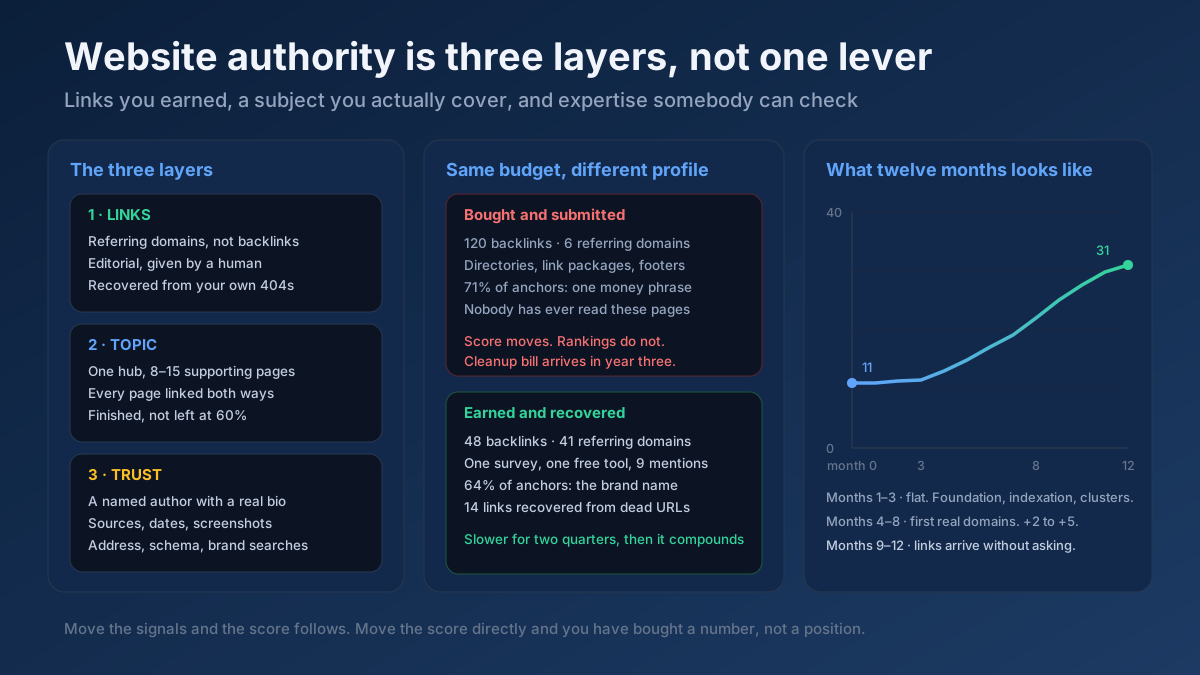
How to increase website authority in 10 steps: what the score really measures, the link and content work that moves it, and how long each stage takes.
Read article →Map how completely your site covers a topic — the way Google and AI engines judge topical authority. Crawls your internal links, titles and headings, compares them against the real subtopics people search for, and shows your covered subtopics plus the content gaps to build for a stronger topic cluster.
Fetching live data…
The Topical Authority Map shows how completely your site covers a topic — the same way Google and AI engines judge topical authority. You give it a URL and a topic, and it crawls your internal links, page titles and headings, then compares that coverage against the real subtopics people search for. The result is a clear map of the subtopics you already cover well and the content gaps you still need to fill to build a stronger, more authoritative topic cluster.
Google and AI engines increasingly rank sites, not single pages, on how thoroughly they cover a subject. A site that answers every related question becomes the trusted source and earns rankings — and citations — across the whole topic. If your coverage has holes, searchers leave to find the missing answer elsewhere and engines learn that a competitor is the fuller resource. Mapping your coverage against what people actually search for turns topical authority from a vague goal into a concrete checklist of pages to build.
Start with the priority gaps the map surfaces and build a dedicated page for each missing subtopic, using the exact question language searchers use in titles and headings. Link every new page into the cluster and back to your main topic page so the connections are clear to crawlers. Deepen thin pages that only skim a subtopic, and prune or merge overlapping ones. Re-run the map after publishing to confirm the gap has closed and your coverage of the topic keeps widening.
Topical authority is how thoroughly and credibly your site covers a subject as a whole, rather than how one page ranks. When you answer the full range of related subtopics and questions, search and AI engines treat you as a trusted source and reward you across the topic instead of a single keyword.
Keyword research finds individual terms to target, while the Topical Authority Map looks at coverage across a whole topic. It compares the subtopics your site already addresses against the ones searchers expect, so you see structural gaps in your cluster — not just isolated keywords to chase.
A topic cluster is a group of related pages covering the subtopics of one subject, linked together and to a central pillar page. Clusters signal depth to search engines and help both readers and crawlers move between related answers, which is what the map helps you build out completely.
Guides, tips and tutorials hand-picked for this tool — go from running a check to actually fixing it.
 Link Building
How to increase website authority in 10 steps: what the score really measures, the link and content work that moves it, and how long each stage takes.
Read article →Score how likely AI answer engines (ChatGPT, Google AI Overviews, Perplexity, Copilot) are to see, understand and surface your brand. Checks AI crawler access, brand-entity signals, structured data, citable content and llms.txt — out of 100 with a fix list.
Open tool →Measure how citation-worthy a page is for AI answer engines. Grades the signals LLMs use to quote and attribute sources — direct answers, statistics, outbound citations, author/date, schema and clear structure — with concrete ways to earn more AI citations.
Open tool →Score how easily large language models can parse, chunk and reuse your content. Measures sentence length, passage size, structure, jargon and ambiguity — the traits that make text easy for LLMs to extract clean answers from. Paste text or enter a URL.
Open tool →Check how optimized your site is for generative engines. Focuses on the GEO fundamentals — AI crawler access, llms.txt, brand-entity strength, structured data and quotable content — and estimates readiness for ChatGPT, Google AI Overviews and Perplexity.
Open tool →Grade how ready a page is to win AI answers and featured snippets. Analyzes answer-engine structure — question headings, concise self-contained answers, lists, tables, FAQ schema and a clear H1 — the format AI answer engines lift and cite.
Open tool →Find and grade the passages AI engines are most likely to quote — then get a rewritten, snippet-ready answer. Detects the best 40–60 word answer block, scores its snippet-worthiness and shows how to tighten it for AI Overviews and featured snippets.
Open tool →Your site may have a critical PHP vulnerability
PHP2Shell (CVE-2026-109618 and CVE-2026-109619) lets attackers run code on servers running PHP older than 8.2.35, 8.3.36, 8.4.27 or 8.5.12, without logging in. Attacks have been seen since 17 October. Check whether your site is affected.