How it works
- Configure your input — paste or type the page title you want to convert.
- The tool lowercases the text, transliterates special characters and removes punctuation.
- It joins the remaining words with single hyphens and trims any stray ones.
- Copy the finished slug and use it in your page URL.
What it generates
- Lowercase output — avoids case-sensitivity issues across servers.
- Hyphen separators — words joined with
-, the search-friendly choice over underscores. - Turkish & accent handling — non-ASCII letters mapped to clean equivalents.
- Punctuation removal — commas, quotes and symbols stripped out.
- Collapsed spaces — multiple spaces become a single hyphen, with no leading or trailing dash.
- Stop-word friendly — concise slugs that keep the meaningful keywords.
Common use cases
- Blog posts — turn an article headline into a clean permalink.
- Product & category pages — build consistent, readable e-commerce URLs.
- Turkish content — convert titles with ş, ğ, ı, ç to safe ASCII slugs.
- Bulk planning — draft slugs while mapping out a site's URL structure.
Example
The title "2025'te En İyi SEO İpuçları!" becomes the slug 2025te-en-iyi-seo-ipuclari — lowercase, hyphenated, ASCII-safe and ready to drop into a URL.
Frequently asked questions
Is the Slug Generator free?
Yes — completely free, with no signup. It runs in your browser and never stores what you type.
Why use hyphens instead of underscores?
Google treats hyphens as word separators but underscores as joiners, so seo-tips is read as two words while seo_tips is read as one. After choosing a slug, review your tags with the Meta Tag Analyzer and add a canonical with the Meta Tag Generator.
Should I change a slug after a page is published?
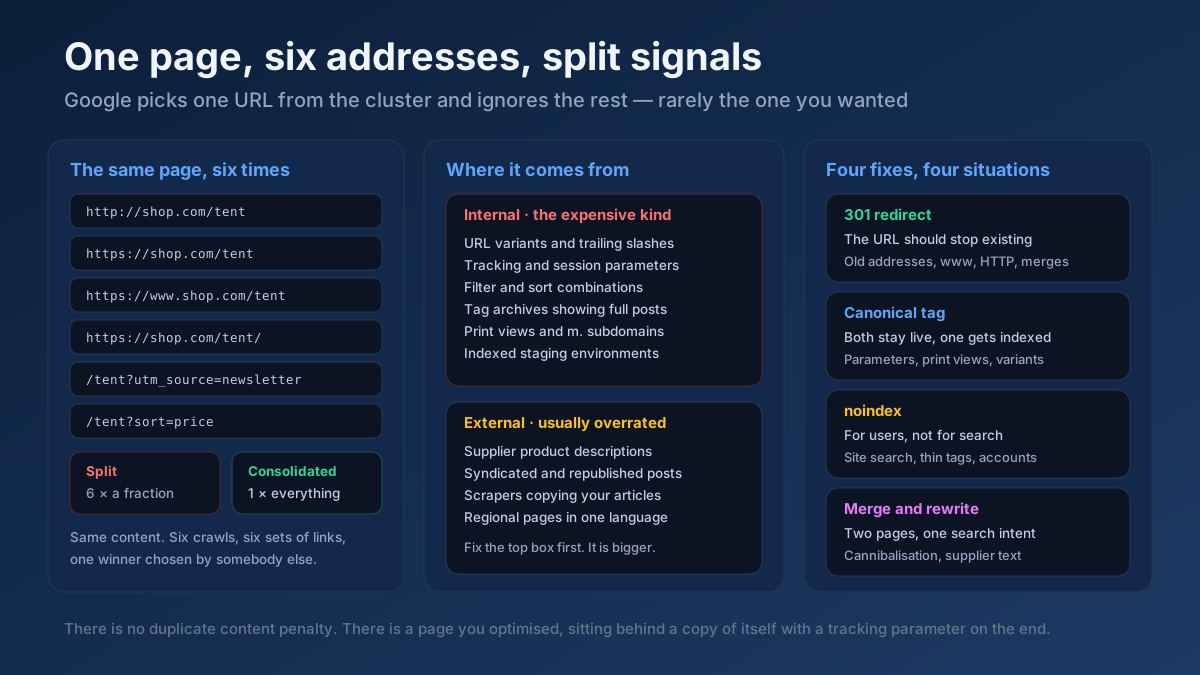
Avoid it if possible — changing a URL breaks links unless you add a 301 redirect. Plan slugs carefully up front using our URL structure best practices guide.