
If you have ever wondered why some websites appear at the very top of Google while others are buried on page five where no one ever looks, the answer is almost always the same three letters: SEO. Search engine optimization is the practice of making a website easier for search engines to understand and more useful to the people searching, so that it earns higher, more visible positions in the unpaid (organic) results. It is not a trick, a secret, or a one-time task you buy and forget. It is a discipline made up of many small, understandable pieces — words on a page, the speed of a server, the links pointing to a site, the way content answers a real question — that add up to whether Google trusts you enough to recommend you. This guide is written for complete beginners. By the end you will understand what SEO actually is, how search engines decide what ranks, the main areas you need to work on, and a simple, practical roadmap you can follow starting today.
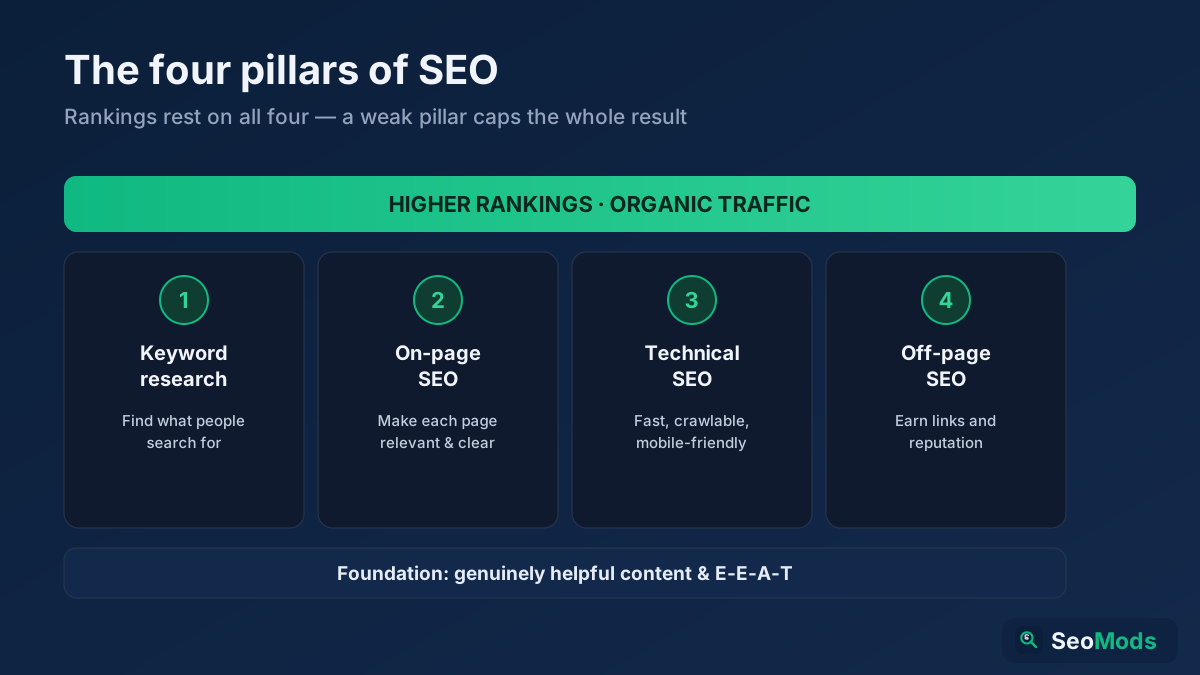
Quick answer: SEO (Search Engine Optimization) is the process of improving a website so it ranks higher in search engines like Google for the terms your audience is searching. It works across four connected areas: keyword research (finding what people search for), on-page SEO (making each page relevant and clear), technical SEO (making the site fast, crawlable and mobile-friendly), and off-page SEO (earning links and reputation). You can start for free by checking your site with a On-Page SEO Audit and researching terms with a Keyword Research tool. SEO is a long-term investment: results usually appear over weeks and months, not days.
What is SEO, exactly?
SEO stands for Search Engine Optimization. In plain terms, it is everything you do to help a search engine find your website, understand what it is about, and decide that it deserves to be shown to someone who is searching for what you offer. When that happens well, your pages appear higher in the search results, more people click through, and — because that traffic is free and ongoing — it becomes one of the most cost-effective ways to grow an audience or a business online.
It helps to separate SEO from the two things people often confuse it with. SEO is not paid advertising: with ads you pay for each click and the traffic stops the moment you stop paying, whereas SEO earns organic positions that keep working long after the initial effort. SEO is also not the same as social media: social posts can send visitors, but they rarely build the kind of durable, compounding visibility that ranking in search does. SEO is the slow, steady engine — the asset that keeps delivering visitors month after month once it is built.
Crucially, modern SEO is about serving people, not gaming a machine. Search engines have spent two decades getting better at rewarding pages that genuinely help the person searching and ignoring pages that merely stuff keywords or chase shortcuts. The single most reliable SEO strategy is to be the best, clearest, most trustworthy answer to a real question — and then make sure a search engine can find and understand that answer. Everything else in this guide is a means to that end.
How search engines actually work
To do SEO well, you need a mental model of what a search engine does behind the scenes. It comes down to three stages: crawling, indexing, and ranking — a pipeline Google Search Central documents in depth.
- Crawling. Search engines run automated programs called crawlers or spiders (Google's is Googlebot) that follow links from page to page across the web, discovering new and updated content. If a crawler cannot reach a page — because nothing links to it, or your settings block it — that page effectively does not exist to the search engine.
- Indexing. Once a page is crawled, the search engine analyzes its content — the words, images, headings, and structure — and stores what it learns in a colossal database called the index. Being indexed means you are eligible to appear in results; not being indexed means you never will, no matter how good the page is.
- Ranking. When someone types a query, the search engine sifts through its index and orders the eligible pages from most to least useful for that specific search, using hundreds of signals. The result is the page of blue links (and other features) you see. SEO is, in essence, the work of improving how your pages perform at each of these three stages.
You can check whether search engines are able to reach and index your site with a few free checks: confirm your Robots.txt Tester is not accidentally blocking important pages, make sure your Sitemap Finder & Validator reveals a valid XML sitemap that lists your URLs, and run an On-Page SEO Checker (Keyword) to see how a single page presents itself to a crawler. If crawling and indexing are broken, no amount of content or link building will help — so this foundation comes first.
Why SEO matters for beginners
It is worth being concrete about why SEO deserves your attention. Search is how most people begin nearly every online task — buying, learning, comparing, deciding, fixing. The vast majority of those searches never reach the paid ads or the second page; the clicks concentrate on the top handful of organic results. If you are not there, you are invisible for the exact moment when your ideal visitor is actively looking for what you do.
The economics are also compelling for anyone on a budget. Unlike advertising, which charges you for every visitor, organic search traffic is free to receive once you have earned the ranking. A single well-optimized article can attract visitors for years with no ongoing cost per click. That compounding quality — effort you put in once continuing to pay off — is what makes SEO so powerful for small businesses, creators, and startups who cannot outspend larger competitors but can out-teach and out-help them. And because SEO forces you to understand what your audience actually searches for, it tends to make everything else you do — your product, your content, your messaging — sharper too.
The four pillars of SEO
SEO can feel overwhelming because it touches so many things at once. The simplest way to organize it is into four connected pillars. Nearly every SEO task you will ever do fits into one of them.
- Keyword research — figuring out the exact words and questions your audience types into search, and the intent behind them.
- On-page SEO — optimizing the content and HTML of each individual page so it clearly matches what people are searching for.
- Technical SEO — making sure the site itself is fast, secure, mobile-friendly, and easy for crawlers to navigate and index.
- Off-page SEO — building reputation and authority beyond your own site, mostly through earning links and mentions from other trustworthy sites.
A healthy SEO strategy pays attention to all four. A brilliant article on a slow, unindexable site will not rank; a fast, technically perfect site with thin, keyword-less content has nothing to rank for. Let us walk through each pillar in the order a beginner should tackle them.
Pillar 1: Keyword research
Keyword research is the foundation because it tells you what to create in the first place. There is no point writing a beautiful page about a topic no one searches for, or targeting a phrase so competitive that you have no realistic chance of ranking. Good keyword research finds the sweet spot: terms with genuine demand that you can actually compete for.
Start by brainstorming the topics your audience cares about, then expand them into real search phrases using a Keyword Research and a Keyword Suggestion Tool tool. Pay attention to two things for each term: how many people search it (volume) and how hard it looks to rank for (difficulty). As a beginner, you will win fastest by targeting long-tail keywords — longer, more specific phrases like "best budget running shoes for flat feet" rather than the impossibly broad "shoes." They have less traffic individually but far less competition, clearer intent, and higher conversion.
Just as important as volume is search intent — the reason behind the query. Someone searching "how to tie a tie" wants a tutorial, not a product page; someone searching "buy silk tie" wants to shop. Matching your page to the intent behind the keyword is one of the biggest levers in modern SEO. Use a Search Intent Analysis check to classify whether a term is informational, commercial, or transactional, and build the type of page that satisfies it. If you want a deeper walkthrough, our keyword research guide covers the whole process step by step.
Pillar 2: On-page SEO
On-page SEO is everything you control directly on a page to make it relevant and easy to understand — for both readers and search engines. Once you know the keyword and intent for a page, on-page optimization is how you signal that relevance clearly.
- Title tag. The clickable headline in search results and the single most important on-page element. Include your main keyword naturally, keep it under about 60 characters, and make it compelling enough to earn the click. Preview how it will look with a Google SERP Snippet Preview before you publish.
- Meta description. The short summary beneath the title. It is not a direct ranking factor, but a good one improves your click-through rate. A Meta Tag Generator can help you draft titles and descriptions that fit the ideal length.
- Headings (H1, H2, H3). Structure your content with a single clear H1 and logical subheadings. This helps readers scan and helps search engines understand your page's organization.
- Content quality and keyword use. Cover the topic thoroughly and use your keyword and related terms naturally — never stuff them. Aim to genuinely be the best answer on the page.
- URL, images, and internal links. Keep URLs short and descriptive, add alt text to images, and link to your other relevant pages to help users and crawlers move around.
You can grade any page against these fundamentals in seconds with an On-Page SEO Checker (Keyword) and analyze the tags on it with a Meta Tag Analyzer. For a complete treatment of every element, see our dedicated on-page SEO guide. Get on-page right and you have done the majority of the work most pages ever need.
Pillar 3: Technical SEO
Technical SEO is the plumbing. It does not directly write your content, but if the plumbing is broken, nothing else flows. The goal is a site that search engines can crawl and index without friction and that visitors experience as fast, secure, and easy to use on any device.
The essentials a beginner should care about are: speed (pages should load quickly — test yours with a Page Speed & Size Test tool and watch your Core Web Vitals), mobile-friendliness (most searches happen on phones, so confirm your layout works with a Mobile-Friendly Checker check), security (your site should run on HTTPS), and crawlability (a clean structure, a working XML sitemap, and a robots file that does not block important pages). A Technical Site Audit (Crawler) will surface most of these issues at once — broken links, missing tags, slow pages, redirect problems — and hand you a prioritized list to fix.
Technical SEO sounds intimidating, but for most small sites it comes down to a handful of one-time fixes and occasional maintenance. Working through a technical SEO audit checklist once will resolve the majority of problems, and understanding Core Web Vitals will help you keep the experience fast as your site grows.
Pillar 4: Off-page SEO and backlinks
Off-page SEO is everything that builds your site's reputation out in the wider web — and the biggest part of it is backlinks. A backlink is simply a link from another website to yours. Search engines treat each quality link as a vote of confidence: if many trustworthy, relevant sites link to your page, that is strong evidence your page is valuable, and it tends to rank higher as a result.
Not all links are equal. One link from a respected, topically relevant site is worth far more than dozens from spammy, unrelated ones — and buying links or using manipulative schemes can get a site penalized. The durable way to earn links is to create genuinely useful content that others want to reference: original research, thorough guides, helpful tools, clear explanations. You can see who links to any site, and compare your profile to competitors, with a Backlink Checker / Verifier and a Toxic Backlink Audit tool.
For beginners, do not obsess over links on day one. Focus first on publishing content worth linking to and on the on-page and technical basics; links become far easier to attract once you have pages that deserve them. When you are ready to be deliberate about it, our guide to backlink analysis and link building explains how to build authority safely.
Content and E-E-A-T: the thread that ties it together
Running underneath all four pillars is content — and the quality bar keeps rising. Google increasingly rewards content that demonstrates E-E-A-T: Experience, Expertise, Authoritativeness, and Trustworthiness. In practice this means writing from real knowledge or first-hand experience, being accurate and up to date, citing credible sources, showing who is behind the content, and covering topics comprehensively rather than superficially — the qualities Google spells out in its guidance on creating helpful, reliable, people-first content.
For a beginner, the takeaway is simple: create content you would genuinely be proud to show an expert in your field. Answer the question fully, include the practical details only someone who has actually done the thing would know, keep it current, and make it easy to read. Thin, generic, obviously AI-spun pages that add nothing new are exactly what search engines are getting better at filtering out. Depth, accuracy, and a distinct point of view are what set content apart — and they are also what earn the backlinks and the trust that the other pillars depend on.
SEO in the age of AI: getting found in AI answers (GEO)
Search is changing. Alongside the classic list of blue links, people now get answers directly from AI systems — Google's AI Overviews, ChatGPT, Perplexity, and other assistants that read the web and summarize it. Optimizing to be cited and included in these AI-generated answers is often called GEO (Generative Engine Optimization) or answer-engine optimization, and the good news is that it builds directly on solid SEO.
To improve your chances of being surfaced by AI answer engines, lean into a few habits. Answer questions directly and early — a clear, self-contained response near the top of a section (like the "quick answer" box at the start of this guide) is easy for a model to lift and cite. Structure content clearly with descriptive headings, short paragraphs, lists, and a genuine FAQ, so the meaning is unambiguous. Add structured data where relevant with a Schema (JSON-LD) Generator so machines can parse your content precisely. And above all, be accurate, specific, and trustworthy: AI systems, like search engines, are trying to surface reliable sources, so the same E-E-A-T qualities that win rankings also win citations. GEO is not a replacement for SEO — it is what good SEO looks like when the audience includes machines that read and summarize.
How to measure and track your SEO
SEO without measurement is guesswork. Two free tools from Google are the backbone of tracking: Google Search Console, which shows how your site performs in search — which queries you appear for, your clicks and average position, and any indexing or technical issues — and Google Analytics, which shows what visitors do once they arrive. Set both up early; they are the closest thing to ground truth about your organic performance; set up Google Search Console first.
Beyond Google's own tools, keep an eye on a few key indicators. Track where you sit for your target terms over time with a Keyword Rank Checker, re-run a On-Page SEO Audit periodically to catch new issues before they hurt you, and watch your overall organic traffic trend rather than day-to-day noise. Remember that SEO is slow: meaningful movement typically shows up over weeks and months, so measure trends, be patient, and let the data — not your assumptions — tell you what is working.
Common beginner SEO mistakes to avoid
Most beginners lose time to the same handful of avoidable errors. Steering clear of these puts you ahead of much of the field.
- Expecting instant results. SEO compounds over months. Judging it after two weeks and giving up is the most common mistake of all.
- Keyword stuffing. Cramming the same phrase repeatedly reads badly and can hurt you. Write for humans and use keywords naturally.
- Chasing impossible keywords. Targeting hyper-competitive head terms from a brand-new site wastes effort. Start with long-tail, lower-difficulty phrases you can actually win.
- Ignoring search intent. Ranking requires matching what the searcher wants, not just repeating their words. Build the type of page the query calls for.
- Neglecting the technical basics. A slow, unindexable, or mobile-hostile site caps your ceiling no matter how good the writing is.
- Buying cheap links or spinning thin content. Shortcuts that try to trick the algorithm are exactly what search engines penalize. There is no substitute for being genuinely useful.
- Not measuring anything. Without Search Console and rank tracking, you are optimizing blind. Set up measurement from day one.
A simple SEO roadmap for beginners
Here is a practical sequence you can follow. Do them roughly in order; each builds on the last.
- Audit where you stand. Run a On-Page SEO Audit on your site to get a baseline and a list of obvious problems to fix.
- Fix the technical foundation. Confirm the site is on HTTPS, loads quickly, works on mobile, and is crawlable and indexable. Use a Technical Site Audit (Crawler) to find and prioritize issues.
- Do keyword research. Build a list of realistic, intent-matched target terms with a Keyword Research tool, favoring long-tail phrases you can win.
- Create and optimize content. Write genuinely helpful pages that match each keyword's intent, and apply on-page basics — check each one with an On-Page SEO Checker (Keyword) and preview it in a Google SERP Snippet Preview.
- Build internal links. Connect related pages so users and crawlers can navigate, and so authority flows through your site.
- Earn backlinks and reputation. Promote your best content and pursue links from relevant, trustworthy sites; monitor progress with a Backlink Checker / Verifier.
- Measure, learn, and repeat. Track rankings and traffic, re-audit regularly, and double down on what works. SEO is a cycle, not a one-off. For a hands-on plan, follow our guide on how to do SEO yourself.
Frequently asked questions
What is SEO in simple terms?
SEO (Search Engine Optimization) is the practice of improving your website so it appears higher in search engines like Google for the words your audience searches. It works by making your site easier for search engines to crawl and understand, and more useful to the people searching, so you earn free organic traffic. You can start by checking your site with a free On-Page SEO Audit and finding target terms with a Keyword Research tool.
How long does SEO take to work?
SEO is a long-term strategy. For a new site, meaningful results typically take three to six months, and competitive topics can take longer. You may see small movements sooner, but SEO compounds over time as your content, authority, and trust grow. Track progress with a Keyword Rank Checker and be patient — consistency matters more than speed.
Can I do SEO myself for free?
Yes. The core skills — keyword research, writing helpful content, on-page optimization, and fixing technical basics — can all be learned and done yourself, and many essential tools are free. Google Search Console and Analytics cost nothing, and free tools like an On-Page SEO Checker (Keyword) and Technical Site Audit (Crawler) cover most of what a beginner needs. See our step-by-step guide on doing SEO yourself.
What is the difference between SEO and paid ads?
Paid ads (like Google Ads) buy you an immediate spot at the top of results, but the traffic stops the moment you stop paying. SEO earns organic positions that keep delivering visitors for free long after the work is done. Ads are fast but rented; SEO is slower but becomes a lasting asset. Many businesses use both.
Do I need to know how to code to do SEO?
No. Most SEO — keyword research, content, on-page optimization, link building — requires no coding at all. Some technical SEO touches settings and HTML, but modern platforms and free tools handle much of it for you, and a Technical Site Audit (Crawler) will flag technical issues in plain language so you know what to fix or delegate.
What is the most important part of SEO for a beginner?
Creating genuinely helpful content that matches what people are searching for. If you understand your audience's intent and answer it better than anyone else, and your pages are crawlable and reasonably fast, you have covered the majority of what drives rankings. The other pillars amplify good content — they cannot replace it.
Conclusion
SEO is not magic and it is not a trick — it is the disciplined, ongoing work of making your website the clearest, fastest, most trustworthy answer to the questions your audience is already asking, and then making sure search engines can find and understand it. Break it into the four pillars — keyword research, on-page, technical, and off-page — layer genuinely helpful content on top, measure your progress, and keep improving. That is the whole game. Start today with a single, honest look at where you stand: run a free On-Page SEO Audit to see your baseline, research a handful of realistic keywords with a Keyword Research tool, and optimize your first page with an On-Page SEO Checker (Keyword). Then follow the roadmap, be patient, and let the results compound. Every website that now ranks at the top started exactly where you are — with a beginner deciding to learn one piece at a time. For your next step, read how to do SEO yourself and how to rank higher on Google to turn this overview into action.