Why Affiliate Marketers need this
Google describes a reviews system that rewards reviews sharing in-depth research and original analysis, written by experts or enthusiasts who know the topic, over thin content that summarises a list of products. It mainly assesses single pages, but on a site with a lot of review content any page might be evaluated. For an affiliate site, that means a weak roundup can drag on more than its own ranking.
Many affiliate reviews are tested and still never say so. The testing sits in a separate "how we test" page, in the photos, or in passive sentences, and the review itself reads like a spec summary.
The E-E-A-T Analyzer reads one page and runs 11 checks in four groups. Its critical Experience check looks for first-person testing phrases in the main text, such as "we tested", "I used" or "hands-on". It tells you whether your review states its testing in words a reader notices. It cannot tell whether the testing happened, whether the photos are yours, or whether the verdict is right.
Affiliate Marketers specific guidance
Tips for Affiliate Marketers
Read "First-hand experience signals" as a wording check. It passes when the main text contains one of a short list of phrases: i tested, we tested, i tried, we tried, i used, we used, in my experience, our experience, hands-on, first-hand. Menus and footers are not read. "The headphones were tested over two weeks" does not match, and "in our testing" does not either. If you did test the product, the fix is one plain first-person sentence near the top that says what you did: how long, where and against what.
"Original media" counts every image on the page, logos and product feed images included, so it passes on almost any review. Google asks for your own photos, audio or measurements as evidence; only you know which images are yours.
Then open "Cites authoritative sources". It counts every link to another site except social networks, and affiliate links are links to another site. A roundup with fifty merchant buttons shows fifty "outbound citations". Look at where the links go. A manufacturer's spec sheet, a standards body or a lab report is a source; an Amazon or network redirect is not.
"Named author / byline" reads markup only: Person schema, rel="author", itemprop="author", a meta author tag or an element with an author or byline class. Most review themes pass it. "Reviews / testimonials" passes whenever the text uses the word review or rating, which a review page always does, so don't count it as evidence of anything.
The costliest mistake
The costly misreading is to treat a green Experience row as proof the review is first-hand, or a red one as proof it is not. Both are about wording. A thin roundup can pass by pasting "we tested" into the intro, and a review that really was tested for weeks can fail because it describes the testing in the passive.
Quick start
- Paste a review or roundup that earns commissions.
- If Experience is Missing, find where the page describes testing and rewrite it in the first person.
- Open the outbound links and add one real source next to the affiliate links.
- Check the byline points to a reviewer page.
- Re-run, then test one page from each other review template.
What this tool does not tell you
- It cannot tell whether a product was really bought, used or measured. It matches phrases, so a false "we tested" passes and passive descriptions of real tests fail.
- It cannot tell your own photos from manufacturer or stock images; every image on the page counts.
- It does not judge whether pros and cons, measurements or the "best" pick are justified, or compare your review with others.
- It reads one page's raw HTML without running JavaScript and does not open your about, methodology or reviewer pages.
Real examples
1. A hiking boot roundup that passes all 11 checks
- Situation
- Treeline Review's men's hiking boots guide, updated in September 2026 with six newly tested boots and a named lead tester. We ran it on 11 November 2026.
- Input
https://www.treelinereview.com/gearreviews/best-hiking-boots- Reading the result
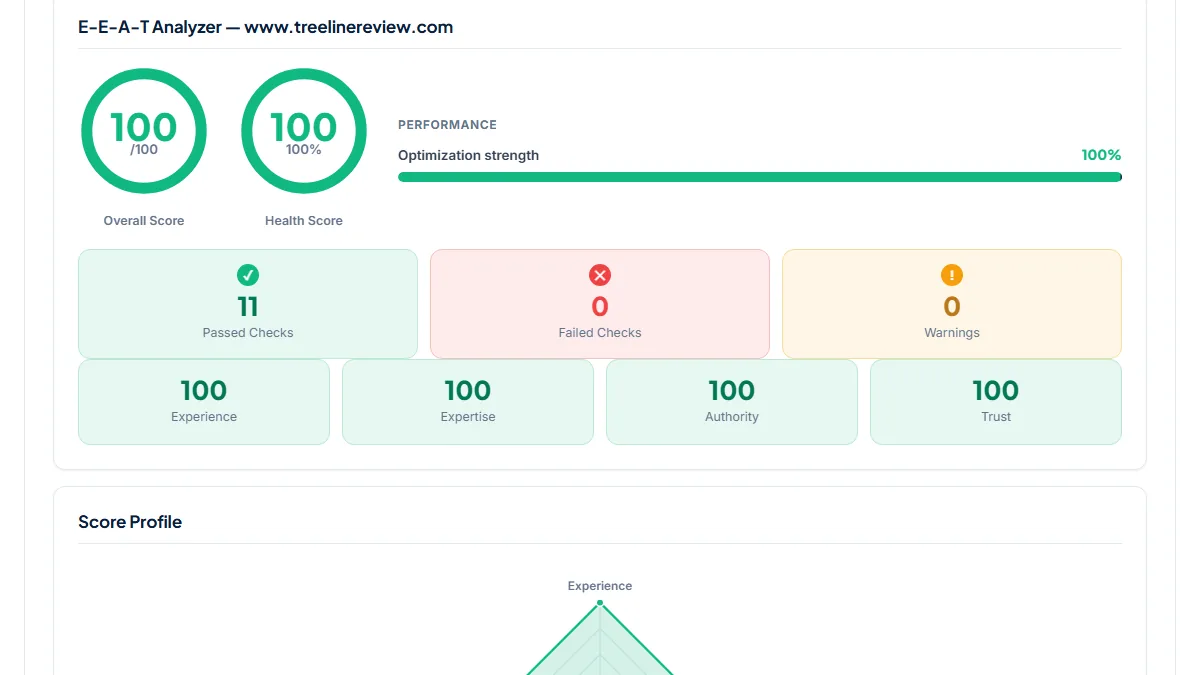
- Overall Score 100, Health Score 100%, all four pillars 100. The main text says "we tested" six times and "hands-on" once, the page carries Person and Review schema, and Original media counts 95 images. The detail lines show what 100 does not mean: of the 63 outbound citations, 59 go to REI, Amazon, Backcountry and affiliate networks, 2 to the site's own address without www, and only one each to Footwear News and Reddit. The score confirms the signals are on the page. The test conditions the guide describes (snow, scree, stream crossings, several seasons) are the actual evidence, and the tool does not read those.
2. A two-week headphone review marked Missing on Experience
- Situation
- Trusted Reviews' review of the Sony WH-1000XM6, a single-product review with test results and a stated testing period. Same day.
- Input
https://www.trustedreviews.com/reviews/sony-wh-1000xm6- Reading the result
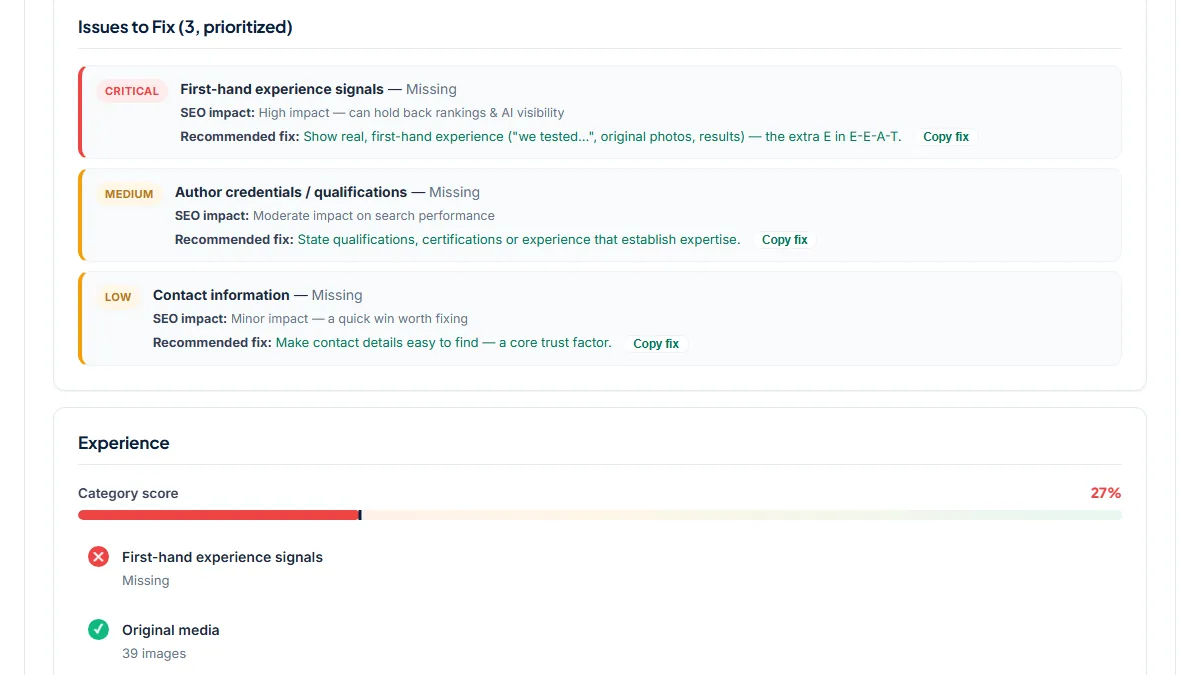
- Overall Score 70, Health Score 73% (8 of 11). Experience 27, Expertise 71, Authority 100, Trust 80. "First-hand experience signals" is Missing (critical), although the review says the headphones "were tested over the course of two weeks", that noise cancelling was "tested on planes, trains, buses", and mentions "the tests I carried out". None of those is on the phrase list. The byline and Person schema pass; credentials and contact are Missing. Of the 14 citations, 6 go to the site's own forum and comparison subdomains. One first-person sentence would turn Experience green honestly, because the testing is real.
3. A "10 best headphones" ranking with no reviewer at all
- Situation
- A product-ranking site's headphone list: ten products with long marketplace titles, discount badges, "Sponsored" slots and short summaries. Same day.
- Input
- The "10 best headphones" page of a product-ranking site
- Reading the result
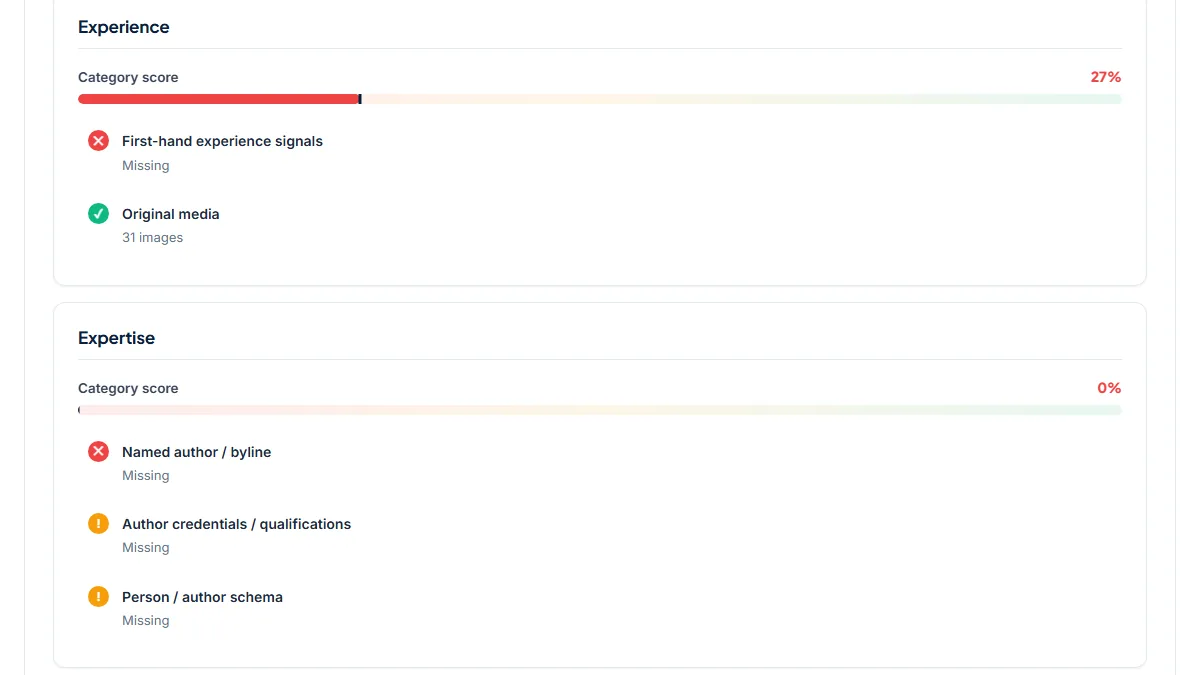
- Overall Score 43, Health Score 55%. Experience 27, Expertise 0, Authority 100, Trust 67. No experience phrase, no byline, no credentials, no Person schema and no date in the markup. Original media passes on 31 product images and Reviews / testimonials passes on the page's own Review and Rating schema. Authority is 100 on just 2 citations, both links to deal and shopping sites. This is the page type Google's guidance describes as summarising a bunch of products; adding the missing phrases would change the score, not the page.
Common mistakes
- Pasting "we tested" into a roundup nobody tested. The row turns green, the page is no more first-hand than before, and readers who check the photos and details can tell.
- Assuming a Missing Experience row means the review is weak. Passive wording such as "were tested" fails the check even when the testing was thorough.
- Counting affiliate links as citations. Merchant buttons and network redirects make "Cites authoritative sources" pass on almost every roundup.
- Testing only the homepage or the "how we test" page. The check reads one page, so the testing has to be stated on the review that earns the commission.
Frequently asked questions
Does a high E-E-A-T score mean Google's reviews system will rank my roundup?
No. The score is SeoMods' own weighting of 11 checks, and Google says E-E-A-T is not a ranking factor by itself. Google's reviews system looks for in-depth research and original analysis, and it states that its assessment of review content is one of many ranking factors. A full score shows the visible signals are on the page; it cannot show the review is better than the ones it competes with.
We really tested the product. Why is "First-hand experience signals" Missing?
Because the check matches a short list of first-person phrases, such as "we tested", "I used" or "hands-on", in the main text. Passive sentences like "the headphones were tested for two weeks", or "in our testing", do not match. Rewrite one sentence near the top in the first person and make it specific: how long you used the product, where, and what you compared it with. That helps readers as much as the check.
Why does it say I cite 60 sources when they are affiliate links?
The citation count includes every link to another site except social networks. Amazon links, merchant buttons and affiliate network redirects all count, and duplicates count again. Open the detail and look at the destinations. Add at least one link that supports a claim, such as the maker's spec sheet, a test standard or a safety notice, so the review cites something besides the places it sends buyers.
Should I test every review on my site?
Test one page from each template first, since the byline, schema, menu and date come from the template and usually give identical results. Then test the reviews that earn the most, because the experience wording is written page by page. Google notes that on sites with a lot of review content, any page might be evaluated, so the weak roundups matter as well as the best ones.
Reference: Google's page on the reviews system and your website explains what that system rewards: reviews with in-depth research and original analysis by people who know the topic, not thin content that summarises a list of products. It also says that on sites with a lot of review content, any page might be evaluated.