Why Affiliate Marketers need this
Google's spam policies name the problem directly. Thin affiliation is publishing affiliate links where "the product descriptions and reviews are copied directly from the original merchant without any original content or added value." The same page lists what counts as value: price information, original reviews, rigorous testing and ratings, product navigation and comparisons. A roundup that rewrites ten listings and adds a Buy button offers none of that, however long it gets.
Two different problems hide in a review archive, and each needs its own check. Some pages are simply too thin to earn rankings: a short "best" list, a comparison grid with a few lines of text, a review stub. Others are long but say only what the maker already says.
The Thin Content Checker handles the first. Paste one roundup URL and it counts the words in the main content, the text-to-HTML ratio, vocabulary variety, headings, lists and internal links, then returns Thin, Borderline or Substantial. It never compares your text with anything else, so for the second problem paste a product paragraph and the merchant's description into Text Similarity.
Affiliate Marketers specific guidance
Tips for Affiliate Marketers
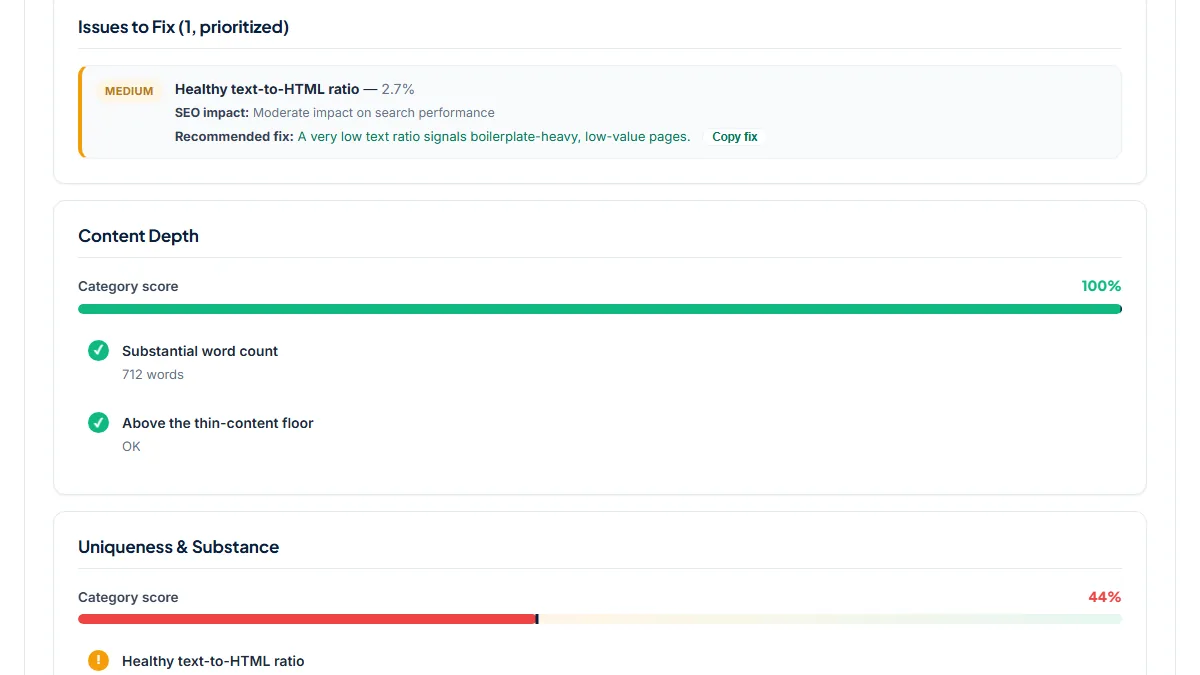
Start with the pages that earn, or used to earn, the most commission, and run them one URL at a time. Read the Words card first, then open the page and subtract whatever isn't about the products. The count covers the main content area after menus marked as navigation, sidebars and footers are removed, but a category menu or deals widget placed inside the main area still counts. A low "Healthy text-to-HTML ratio" is the hint that template outweighs writing.
A score of 100 means the page is long and organised. It does not mean anything was tested. For every pick, ask what a reader learns that the listing doesn't already say: a measurement, a photo you took, a comparison with the runner-up, a reason it beats the cheaper option. If the answer is nothing, the page needs work even when every check is green.
To catch copied merchant copy, paste one product paragraph as Text A in Text Similarity and the maker's description as Text B. Above 70 % it calls the pair likely duplicates, and 40 to 70 % is moderate. A low score only proves that the words differ. A reworded listing scores low too, so also read the paragraph against the maker's bullet list, claim by claim, and mark any fact that came from you.
The costliest mistake
The usual mistake is padding a thin roundup with a generic buying guide and an FAQ until the Words card turns green. That moves the verdict, not the value. Spend the extra words on what only you can say about each product, and cut the sections any competitor could have written.
Quick start
- Paste one roundup or review URL.
- Compare Words with what the page is really about.
- Note any warning on text ratio or vocabulary.
- Compare one product paragraph with the maker's description in Text Similarity.
- Add test notes, photos and comparisons where the page only restates specs.
What this tool does not tell you
- It does not compare text with anything. Copied merchant descriptions, excerpts repeated across pages and near-duplicate reviews all pass unnoticed; Text Similarity compares a pair of texts.
- It does not run JavaScript. A single-product review on a large lab-testing site came back as 9 words, Thin, on 7 November 2026 because its review text loads by script.
- The heading, media and internal-link checks count the whole page, menus included, so they pass on almost any real site. The word count is the one that reads the main content.
- It does not judge accuracy, first-hand testing or affiliate disclosure, and Google publishes no minimum word count.
Real examples
1. A comparison grid: 712 words, about 70 of them about garlic presses
- Situation
- A UK multi-category comparison site lists four garlic presses with Amazon ratings, prices and a spec grid. We ran the page on 7 November 2026.
- Input
- The garlic press comparison page of a UK multi-category comparison site
- Reading the result
- Words 712, verdict Substantial, score 87/100. The only issue is "Healthy text-to-HTML ratio" at 2.7 %, and vocabulary is 40.1 %, just over the 35 % line. Opening the page explains both. By our count about 640 of the counted words are the site's category menu (pram, air fryer, tumble dryer and so on), which sits inside the main content area, and about 70 are product bullets such as "Can be cleaned in the dishwasher". No sentence on the page is about how any press performs. The verdict says Substantial; the ratio warning is the number to believe.
2. A lab-tested roundup: 5,698 words and the same score of 87
- Situation
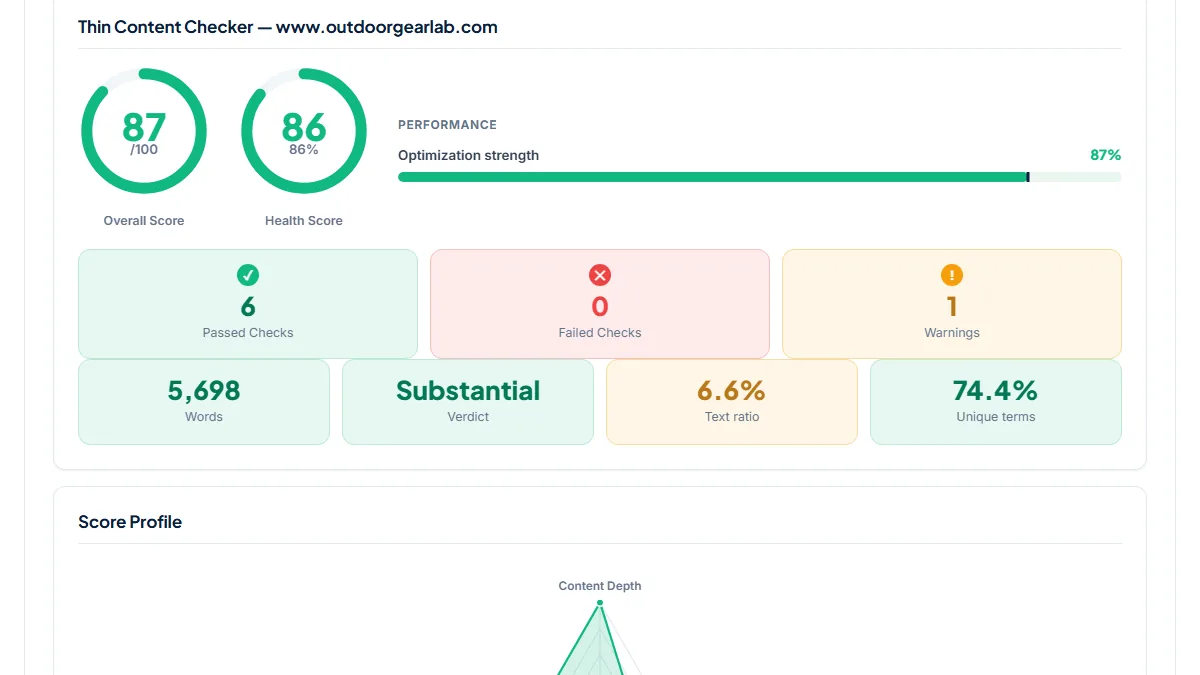
- OutdoorGearLab's headlamp roundup says it bought and compared 27 headlamps this round, measuring brightness with light meters and battery life in its own test box. Same day, same run.
- Input
https://www.outdoorgearlab.com/topics/camping-and-hiking/best-headlamp- Reading the result
- Words 5,698, Substantial, 41 H2/H3 headings, 178 lists, tables and images, vocabulary 74.4 %. Score 87/100 with one warning: text-to-HTML ratio 6.6 %, under the 8 % line because of the photos, charts and score tables. It ties with the grid in example 1. The checker cannot tell measured ratings from a spec list; the test results in the text are what make this page the kind of affiliate content Google describes as valuable. Don't remove images to fix the ratio.
3. A 100/100 roundup whose product text restates the maker's
- Situation
- A small kitchen-gadget site's "10 best stainless steel garlic mincers" says the presses were tested and reviewed. We ran the checker, then compared its Alpha Grillers paragraph and feature list (128 words) with the maker's own product description (202 words).
- Input
- Thin Content Checker: the roundup URL. Text Similarity: Text A = the roundup's Alpha Grillers section, Text B = the description on alphagrillers.com
- Reading the result
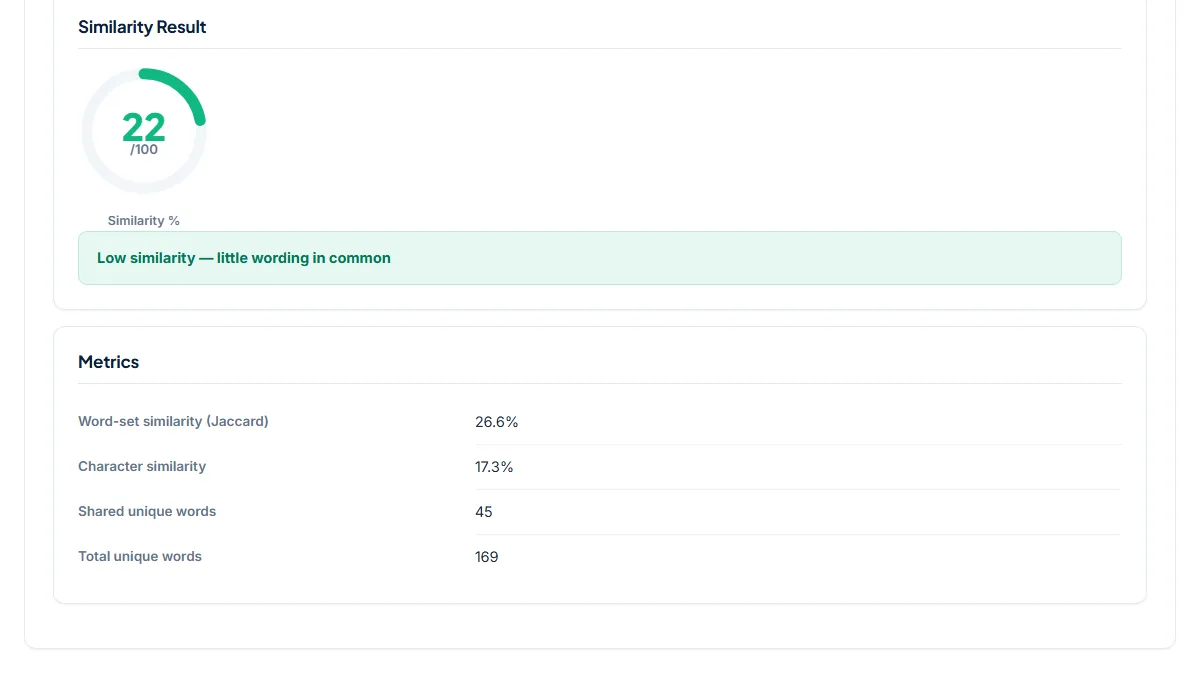
- Thin Content Checker: 3,380 words, 100/100, no issues (ratio 16.4 %, vocabulary 77.8 %, 15 H2/H3). Text Similarity: 22 %, "Low similarity — little wording in common" (word-set 26.6 %, character 17.3 %, 45 of 169 unique words shared). The wording is new, yet eight of the section's eleven claims (stainless steel, unpeeled cloves, silicone peeler, ginger, nuts, flip-out chamber, dishwasher-safe, ergonomic handles) are in the maker's description, and the other three are specs: 304 steel, three cloves, a cleaning brush. There is no measurement, own photo or comparison. Both scores pass; only the claim-by-claim reading shows what is missing.
Common mistakes
- Treating the score as a quality ranking. In our runs a lab-tested roundup and a spec grid both scored 87, and a roundup that restates listings scored 100.
- Taking a low Text Similarity score as proof of originality. Rewording a merchant description drops the score without adding a single fact of your own.
- Removing photos, charts or comparison tables to raise the text-to-HTML ratio. Images from your own testing are part of the value; the ratio is a hint, not a target.
- Pasting the whole roundup into Text Similarity against one product description. The unrelated words dilute the score, so compare one product section with that product's description.
Frequently asked questions
Can the Thin Content Checker tell whether my roundup copies merchant descriptions?
No. It reads one page and measures its length, text-to-HTML ratio, vocabulary variety and structure; it never compares your words with another text. A roundup built from pasted listings can score 100. To check copying, paste one product section as Text A in Text Similarity and the merchant's or manufacturer's description as Text B. Repeat for the products that earn the most, because one copied section usually means the others were written the same way.
How many words does an affiliate review need?
Google publishes no minimum. The 300 and 600 word lines in this checker are rules of thumb: under 300 is Thin, 300 to 599 Borderline, 600 or more Substantial. They help you find stubs, but a long review that only restates specs is still thin in Google's sense, and a short review with real measurements may be fine. Judge length by whether every product gets something the listing doesn't say, such as a test result or a comparison.
Does Google treat every affiliate site as thin?
No. Google's spam policies say plainly that not every site in an affiliate program is a thin affiliate, and that good affiliate sites add value with meaningful content or features. The examples Google gives are price information, original product reviews, rigorous testing and ratings, product or category navigation and product comparisons. Affiliate links are not the problem; pages whose only content is the merchant's description are.
What Text Similarity score means my product text is copied?
Text Similarity averages a word-set overlap and a character comparison. Above 70 % it reports likely duplicate content, 40 to 70 % moderate similarity, below 40 % low. Pasted merchant copy usually lands in the top band. A rewritten description can land low, as the 22 % in our garlic press example did, while still adding nothing. So treat a high score as a clear signal and a low one as a cue to read the claims.
Reference: Google's spam policies for Google web search define thin affiliation as affiliate pages whose product descriptions and reviews are copied from the merchant without original content or added value, and list original reviews, testing, ratings and comparisons as what good affiliate pages add.