Why Affiliate Marketers need this
Affiliate reviews are usually written with the merchant's product page open in another tab. The specs have to be right, so phrases slip across: the brand's name for its heating system, its claim about latte art, the sentence that opens the listing. Google names this pattern directly. Its spam policies describe thin affiliation as pages whose product descriptions and reviews are copied from the original merchant without original content or added value.
The same product text also travels. Retailers, marketplaces and product feeds carry the brand's copy, often an older version of it, so a paragraph you took from a retailer can still be the merchant's words.
This tool gives you a quick, private check before publishing. Paste the merchant text and your section, and it returns a similarity score from two measures: shared vocabulary and character-by-character overlap. A high score means you have kept the merchant's wording. A low score only means the words differ; whether the section adds anything of your own is a second check, and the examples below show why.
Affiliate Marketers specific guidance
Tips for Affiliate Marketers
Collect the text you actually worked from. That is the brand page if you wrote from it, but also the retailer listing or feed text your affiliate network gives you, because those versions differ: our retailer example quotes a 19-gram dose where Breville's current page says 18 grams. If you used two sources, run the check twice.
Compare like with like. Paste one product section into Text B, roughly the length of the merchant paragraph in Text A. Both measures divide by the size of both texts, so a 70-word description against a 2,450-word review scored 5 even though the review discusses the same machine. A short block hidden in a long page would disappear the same way.
Read the three bands for what they are. Above 70 the tool says "High similarity — likely duplicate content": in our test, swapping four phrases in the brand paragraph still scored 82. Between 40 and 70 is "Moderate similarity", worth a second look. "Low similarity — little wording in common" covers everything else, and that includes copy problems: a rewrite we made that keeps every Breville fact in new words scored 34.
So after the score, do the check the tool cannot. Go through your section sentence by sentence and mark each claim as either the merchant's (specs, heat-up time, marketing promises) or yours (what you measured, what annoyed you, who should skip it, what to compare it with). Google's review guidance asks for exactly that second kind: first-hand evidence, your own pros and cons, comparisons. A section with nothing in the second column needs new material, not new words.
The costliest mistake
The costly mistake is treating Low as a pass. The score measures wording, so rewording the merchant's claims moves it down without adding value. The opposite mistake is chasing zero: product names, model numbers and specs have to match, so a well-written review of the same machine still shares a fifth or more of its vocabulary.
Quick start
- Copy the merchant description you wrote from into Text A.
- Copy the matching section of your review into Text B.
- Run it; above 70, rewrite from your own notes, not from the listing.
- Below 70, mark each claim as merchant or yours.
- Repeat for each product in a roundup.
What this tool does not tell you
- It compares only the two texts you paste. It does not search the web for copies, so it cannot tell you who else uses the merchant's text.
- It does not list or highlight the shared words or passages; you get a score, a verdict and two counts.
- It measures wording, not meaning or value. A paraphrase of merchant claims can score Low, and the score says nothing about whether you tested the product.
- The bands (above 70 high, above 40 moderate) are this tool's own cut-offs, not a Google threshold.
Real examples
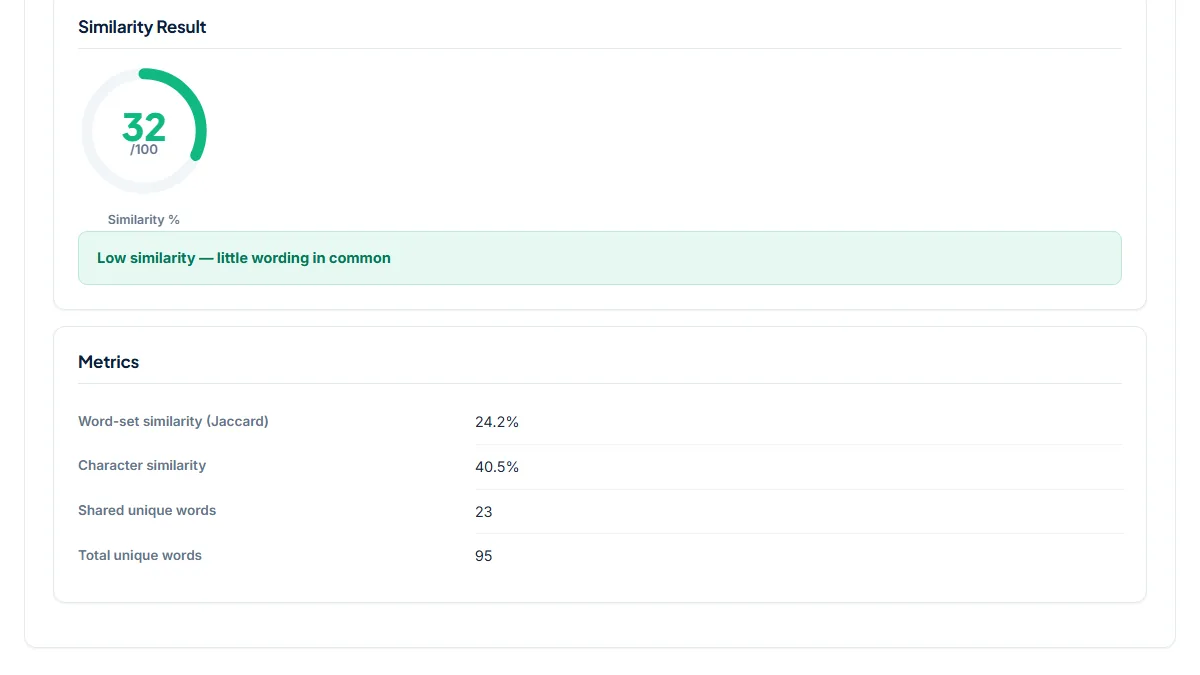
1. Brand copy on a retailer page: 32, and still the merchant's words
- Situation
- An affiliate drafting a Bambino Plus review copied the product text from a large US appliance retailer's page instead of Breville's site. That text speaks in the brand's voice ("Our machine delivers third wave specialty performance…"). We compared it with Breville's current description on 9 November 2026.
- Input
- Text A: Breville's Bambino Plus description (71 words). Text B: the retailer page's two intro paragraphs (69 words).
- Reading the result
- 32 Similarity %, "Low similarity — little wording in common". Word-set similarity 24.2 %, character similarity 40.5 %, 23 of 95 unique words shared. Both texts are Breville's copy, written for different launches, so they share the claims (third wave coffee, 54mm portafilter, 3-second heat-up, automatic steam wand) but few sentences. Checked only against the brand site, this paste would pass. Checked against the retailer text it was copied from unchanged, it would score 100.
2. An affiliate review written from testing notes: 22
- Situation
- A coffee review site that earns Amazon commissions published a Bambino Plus review. We took its verdict paragraph and its "What stands out" line and compared them with the same Breville description, same day.
- Input
- Text A: Breville's description (71 words). Text B: the review's verdict and "What stands out" (53 words).
- Reading the result
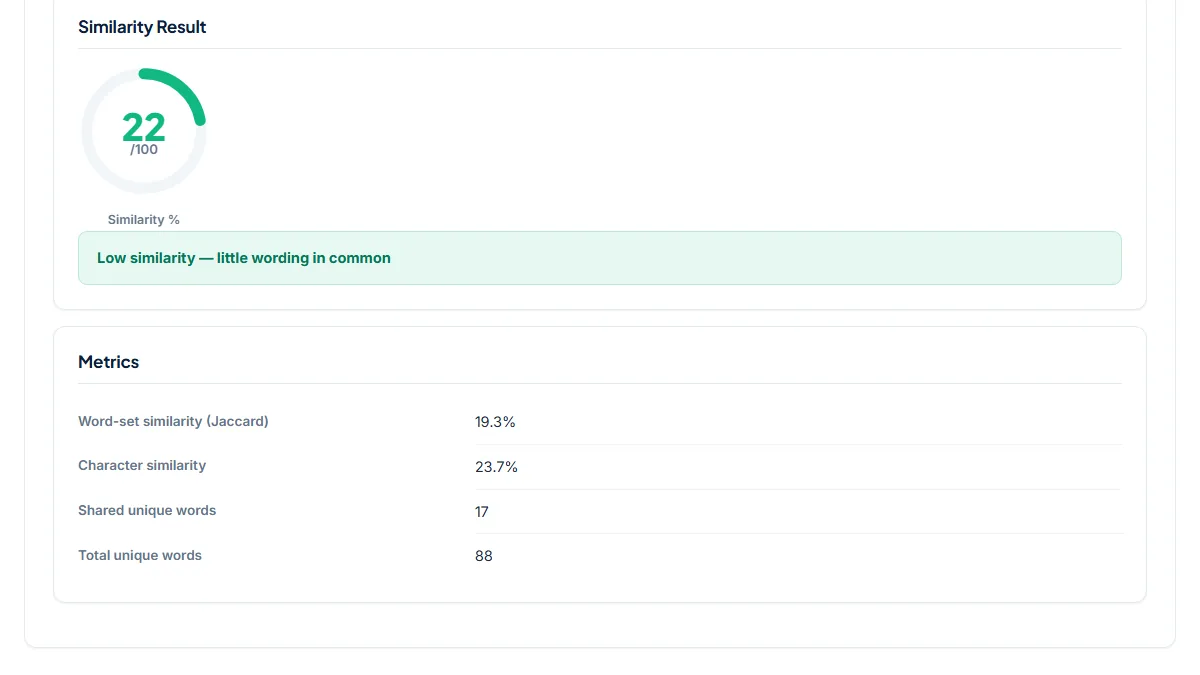
- 22 Similarity %, Low. Word-set 19.3 %, character 23.7 %, 17 of 88 unique words shared, mostly the product name and "ThermoJet". The section repeats one brand claim (about 3 seconds, attributed to Breville) and adds judgements the merchant would never print: one heating system means no brewing and steaming at the same time, the buyer needs a separate grinder, it suits small kitchens. Note how close 22 is to the retailer copy's 32. Comparing the paragraph with the whole 2,450-word review scored 5 (Jaccard 5.9 %, character 3.9 %): length alone sinks the number.
3. A lightly edited paste: 82, the case the tool catches
- Situation
- To see where High starts, we took Breville's paragraph and changed four phrases, the way a hurried draft often begins: "Like professional machines" became "Just like the machines in cafés", "ready to start in 3 seconds" became "ready in only 3 seconds", and two more.
- Input
- Text A: Breville's description. Text B: the same paragraph with four phrases swapped (our test edit, not a published page).
- Reading the result
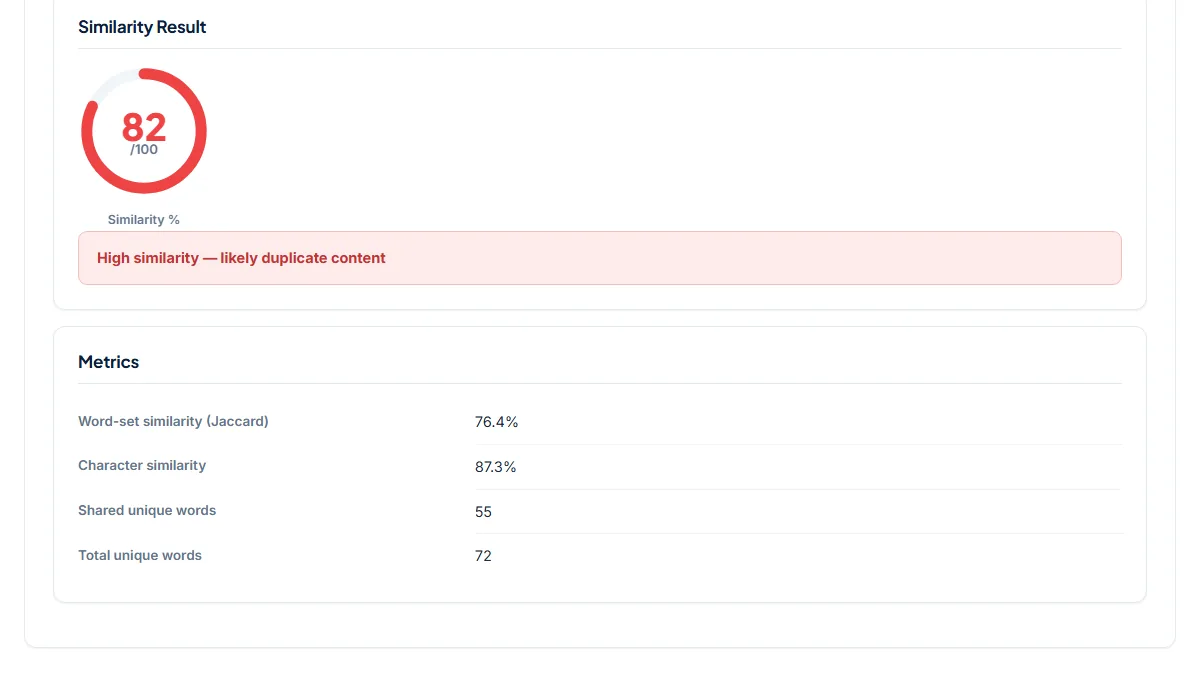
- 82 Similarity %, "High similarity — likely duplicate content". Word-set 76.4 %, character 87.3 %, 55 of 72 unique words shared. This is what the tool is reliable at: a paste with cosmetic edits stays far above 70. When we rewrote the same facts in new sentences instead, the score fell to 34, Low, although not one fact of our own had been added.
Common mistakes
- Taking a Low verdict as proof that a review is original. Our rewrite of Breville's facts scored 34, in the same band as a review written from testing notes.
- Comparing only against the brand site. Retailer and feed copy is often an older version of the merchant text, and it scores low against the current one.
- Pasting the whole review against one paragraph. A 2,450-word review scored 5 against the 71-word description; compare section with section.
- Rewording until the number drops. The score falls, but the section still says only what the merchant says. Add measurements, comparisons or drawbacks instead.
Frequently asked questions
What score is safe for an affiliate review?
There is no safe number, and Google publishes none. Treat High, above 70, as a clear signal that you kept the merchant's wording and should rewrite from your own notes. Below that, the score has done its job and the real question begins: does the section add anything the merchant page does not? In our runs a review based on testing scored 22 and a rewrite of brand claims scored 34, so the number alone cannot tell them apart.
Why did a review of the same product score so low?
Because the score counts shared wording, and a review written in your own words naturally uses different words, apart from the product name and specs. The 53-word review section in our second example shared 17 of 88 distinct words with Breville's description, mostly "Bambino", "Plus", "ThermoJet" and "seconds". Some overlap is unavoidable: model names, sizes and numbers must match the merchant. Never change a spec just to lower the number.
Can I compare my whole review page in one go?
You can paste it, but the result will mislead you. Both measures divide by the size of both texts, so one merchant paragraph against a long page always scores low: 71 words against 2,450 gave 5. Split the review into product sections, or into the part where you describe the product, and compare each with the matching merchant text. For roundups, run one check per product, using the description from the shop you link to.
Does a low score mean Google will not see my page as thin affiliation?
No. Google's spam policies describe thin affiliation as copied merchant content without original content or added value, and they list what good affiliate pages add: price information, original reviews, testing and ratings, product navigation and comparisons. A low score only shows that you did not copy the wording. Whether you added value is a separate question this tool cannot answer, which is why the guidance above ends with a claim-by-claim reading of your section.
Reference: Google's spam policies for web search define thin affiliation as affiliate pages whose product descriptions and reviews are copied directly from the original merchant without original content or added value, and say that good affiliate sites add value with original reviews, testing, ratings and comparisons.