Short answer: Answer-first content is writing that states the direct answer in the very first sentence under a question-shaped heading, then expands with evidence below. This inverted-pyramid pattern is what Answer Engine Optimization (AEO) rewards, because AI answer engines and featured snippets lift a single self-contained passage — so the page that says the answer plainly and early gets quoted, while the page that buries it merely ranks.
What is AEO and how does it differ from SEO?
Answer Engine Optimization is the practice of writing and structuring content so that answer engines — Google AI Overviews, featured snippets, ChatGPT, Perplexity, Bing Copilot and voice assistants — return your exact words as the response to a question. Classic SEO aims to place a link in a ranked list and win the click. AEO aims to make your sentence the answer the engine displays, synthesizes or reads aloud, whether or not anyone clicks through.
The two are not rivals. AEO sits on top of SEO and depends on it completely. An answer engine cannot quote a page it cannot crawl, index or trust, so every technical and authority signal that helps you rank also makes you eligible to be extracted. What AEO adds is a specific way of writing: answer-first passages, question-shaped headings, one idea per paragraph, declarative sentences, and machine-readable structure. If you already know the fundamentals, our primer on what AEO is covers the strategy layer; this article is the writing craft that makes it work on the page.
The overlap is large. Both disciplines reward genuine expertise, clear structure, fast pages and accurate facts. The difference is intent. SEO asks "can this page rank for the query?" AEO asks "is there a passage on this page an engine can lift, in isolation, and be confident it fully answers the question?" A page can rank well and still never get quoted because its answer is scattered across three paragraphs, hedged into vagueness, or hidden behind a long windup. Answer-first writing closes that gap.
Why do answer engines reward short, self-contained passages?
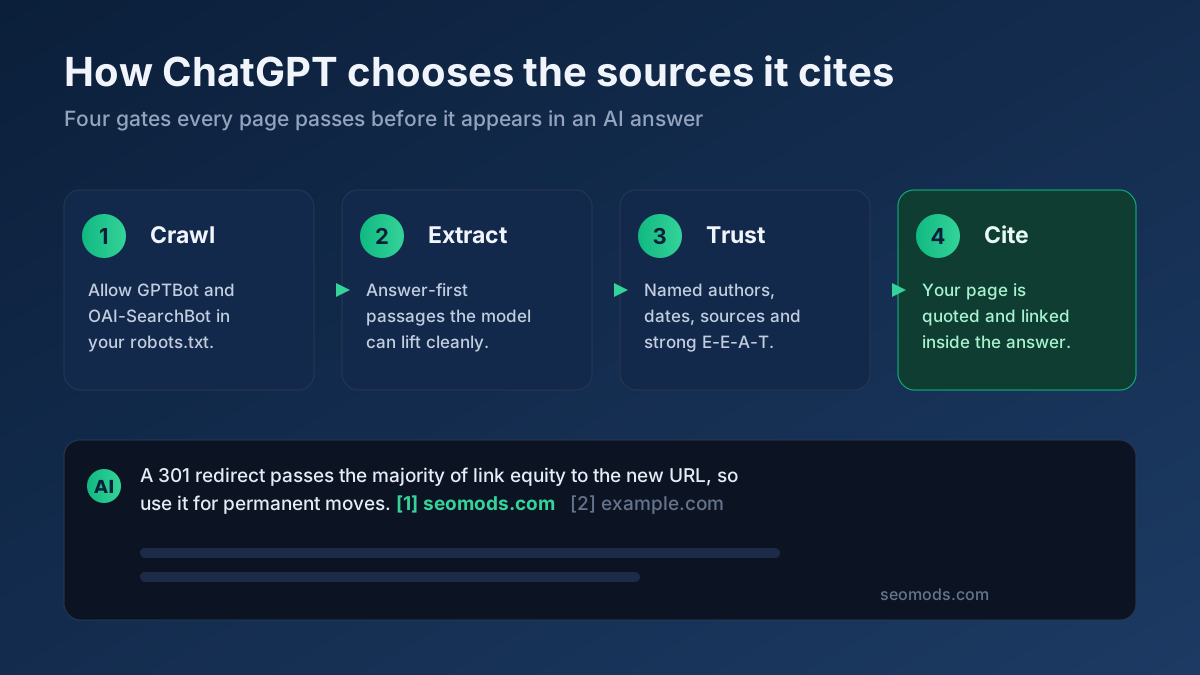
Answer engines reward extractable passages because of how they work. When someone asks a question, the engine parses the intent, scans indexed pages for candidate passages, and selects the single passage that most cleanly resolves the query. It then displays that passage in a snippet box, weaves it into an AI Overview, or speaks it back. At no point does it read your page top to bottom the way a human does. It hunts for a chunk it can quote out of context.
That mechanic has three consequences for how you write. First, the answer must be self-contained: true and complete on its own, without depending on the sentence before it or the paragraph after it. A sentence that begins "As mentioned above" is worthless to an engine that never saw what was above. Second, it must be concise: roughly 40 to 60 words is long enough to resolve most questions and short enough to fit a snippet box or a spoken reply in one breath. Third, it must be positioned near a heading that matches the question, so the engine can map query to answer without guessing.
This is why featured snippets, AI Overviews and chat answers all converge on the same content shape even though they are different products. They are all extraction engines, and extraction engines prefer passages that survive being cut loose from their surroundings. Learn to write those passages and you optimize for every answer surface at once. For the snippet-specific mechanics, our featured snippets guide breaks down paragraph, list and table snippet formats in detail.
What is the answer-first, inverted-pyramid pattern?
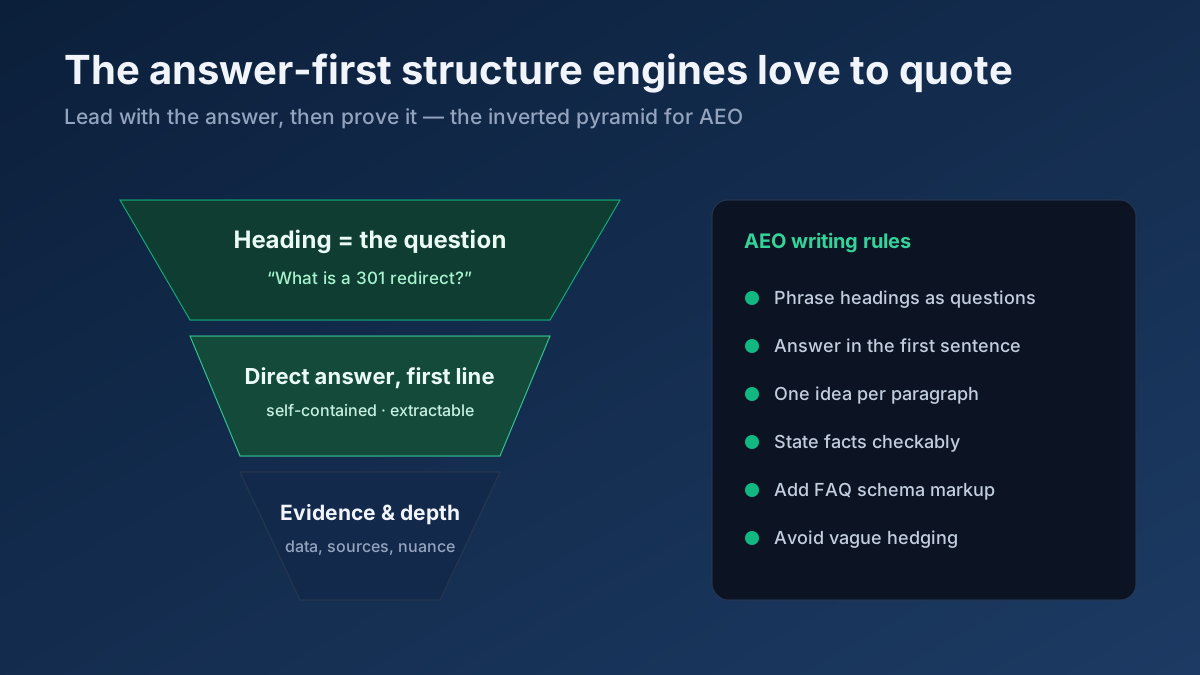
The answer-first pattern means you state the conclusion in the first sentence of a section, then expand with reasons, evidence and nuance below it. Journalists call this the inverted pyramid: the most important information sits at the top, and each layer below adds supporting detail that a reader — or an engine — can take or leave. It is the opposite of the academic build-up, where you set context first and reveal the point at the end.
Most writers are trained to build up to a conclusion. That instinct is exactly wrong for AEO. When you save the answer for the end, the engine has to read past a paragraph of throat-clearing to find it, and it usually will not bother — a competitor who led with the answer is easier to quote. Reverse the order. Put the payoff first, then justify it.
Here is the pattern applied to a single section. Notice how the first sentence would make sense even if you deleted everything after it:
- Sentence one — the answer. A complete, plain-language resolution of the question the heading asks.
- Sentence two or three — the qualification. The main caveat, condition or number that makes the answer precise.
- The rest — the evidence. Examples, steps, data, edge cases and context that a curious human reads and an engine can ignore.
Write every important section this way and your page becomes a stack of self-contained answers, each one a candidate for extraction. That is the single highest-leverage change most content can make for answer engines.
How do you turn headings into the questions people actually ask?
Turn each heading into the exact question a person types or speaks, because headings are the map an engine uses to match a query to a section. "How does answer-first writing work?" can be matched to a real search; "Our methodology" cannot. When your heading mirrors the query, the engine lifts the passage beneath it with confidence. When your heading is a clever label, the engine has to infer what the section is about and often skips it.
Cover the natural question words for your topic — who, what, why, when, where, how, and the comparison and yes/no forms ("X vs Y", "is X worth it"). Give each its own heading with a tight answer underneath. Keep a strict hierarchy: one H1, then descriptive H2s and H3s with no skipped levels, so the outline reads as a clean question-and-answer sequence. Before you publish, run the draft through the free Heading Structure Analyzer to confirm the structure is sound and every heading earns its place. To find the precise phrasings people use, check which questions trigger snippets and "People also ask" boxes with the SERP Features Analyzer tool, then adopt that exact wording.
A quick test: read your heading out loud as if you were asking a voice assistant. If it sounds like a natural question, it will match one. If it sounds like a slide title in a pitch deck, rewrite it.
What is passage-level optimization and one idea per paragraph?
Passage-level optimization means treating each paragraph as a standalone unit that could be quoted on its own, which in practice means one idea per paragraph. Answer engines increasingly rank and extract individual passages rather than whole pages, so a paragraph that juggles three ideas gives the engine nothing clean to lift. A paragraph that makes one point, fully, is a ready-made quote.
Discipline yourself to a simple rule: each paragraph opens with its own topic sentence that states the point, then supports it in two to four more sentences, then stops. If you find a paragraph turning a corner — introducing a second idea with a "but also" or "meanwhile" — split it. Short, single-idea paragraphs are easier for humans to scan and easier for engines to extract, and they force you to say what you mean instead of hiding it in a thicket of clauses.
This also improves your titles and descriptions downstream. When every section resolves to one clear idea, summarizing the page in a title tag and meta description becomes trivial — and you can generate tight, click-worthy versions with the Meta Tag Generator once the content itself is clean.
How should you format content for extraction?
Format dictates extractability, so match the structure to the shape of the answer the question expects. Engines lift different structures for different question types, and giving them the right one makes your version the easy choice:
- Definition sentence for "what is" queries: a single declarative sentence of the form "X is a … that …", placed immediately under the heading.
- Numbered list for processes and rankings: "how to" and "steps to" queries pull ordered lists into snippets almost verbatim.
- Bulleted list for sets of options, features or considerations with no inherent order.
- Comparison points for "X vs Y" queries: parallel statements or a table where each row answers the same dimension for both sides.
- Short paragraph of two to four sentences for explanations that need a little room but must still be quotable in full.
The closer your format matches what the engine wants to display, the more likely it picks you. A comparison written as flowing prose loses to a competitor’s clean table; a process written as a paragraph loses to numbered steps. Diagnose the expected answer shape first, then write to fit it. When you audit an existing page, the free On-Page SEO Checker (Keyword) flags where structure, headings and on-page signals fall short of what the query needs.
How do you write quotable, declarative sentences?
Write quotable sentences by making them declarative, specific and safe to repeat without their surroundings. An answer engine stakes its own credibility on every answer it shows, so it favors sentences that state a fact plainly over sentences that hedge. "Compress images to WebP or AVIF to cut page weight by 25 to 35 percent" is quotable. "You might want to consider looking into image optimization, which could potentially help in some cases" is not.
Cut the hedging vocabulary that dilutes authority: might, could, perhaps, in some cases, it depends, arguably, generally speaking. These words feel safe to write but they make a sentence impossible to extract, because an engine cannot present a shrug as an answer. Where a real caveat exists, state it as its own precise sentence rather than smearing uncertainty across every claim. Confidence, grounded in fact, is what gets quoted.
Declarative does not mean reckless. It means you have done the work to know the answer and you say it directly. If you genuinely do not know, that section is not ready to publish. If you do know, write it as though you know it.
Why do statistics and checkable facts get quoted?
Statistics and checkable facts get quoted because they are groundable — an engine can attribute them to a source and repeat them with confidence, which is exactly what it needs to justify choosing your passage. A specific number is safer for an engine to display than a vague generality, because the number carries its own evidence. "Answer-first passages of 40 to 60 words fit the typical snippet box" invites a citation; "short answers are better" does not.
Use concrete facts wherever you honestly can: real numbers, named formats, exact steps, dated findings. Attribute the ones that came from research to their source, and keep every figure consistent across your site so an engine sees a coherent, confident author rather than contradictions. Specificity is also an E-E-A-T signal — it demonstrates that you actually know the domain rather than paraphrasing what everyone else already wrote. The pages that get cited by AI tend to be the ones packed with verifiable, attributable detail, a point we develop further in our guide to how to get cited by ChatGPT.
How do FAQ and HowTo schema help machines parse your content?
FAQ and HowTo structured data give engines an explicit, machine-readable map of which text is a question, which is its answer, and which is a step in a process — removing the guesswork from extraction. The content still has to be good; schema does not manufacture answers. But when you have written genuine question-and-answer pairs, FAQPage markup labels them unambiguously, and HowTo markup labels an ordered procedure, so the engine does not have to infer structure from formatting alone.
Add FAQPage schema to pages with a real FAQ section, HowTo schema to genuine step-by-step guides, and Article and Organization schema to establish authorship and entity. Even where Google has narrowed the visual rich results these produce, the markup still helps engines understand and extract your content, and it is trivial to add. Generate valid, ready-to-paste JSON-LD with the free Schema (JSON-LD) Generator rather than hand-writing it, and validate before you ship. Schema is the bridge between well-written answers and reliable machine parsing.
How does entity clarity help you get quoted?
Entity clarity helps because answer engines reason about entities — people, products, brands, places — not just keyword strings, and they prefer to answer with facts they can attribute to a clearly identified source. Make your subjects unambiguous: use the same official name everywhere, define terms and acronyms on first use, and describe your brand plainly on an about page the engine can read. Connect your site to authoritative profiles with sameAs links in Organization schema so the engine can confidently identify who is answering.
Ambiguity is the enemy. If your content refers to a product by three different names, or never defines the acronym it leans on, the engine cannot build a clean entity and is less likely to trust your passage. Name things precisely and consistently, and the engine can connect your answer to a known author it is willing to quote.
What are the answer-first templates for each page type?
Each common page type has an answer-first recipe. Match the template to the intent behind the query and you deliver the shape the engine wants to extract.
Definition or glossary page
Open with a one-sentence definition of the form "X is a … that …" directly under a "What is X?" heading. Follow with a plain-language expansion, a concrete example, and the common variations or misconceptions. The first sentence must stand alone as a complete definition, because that is the exact passage a definitional query will lift.
How-to page
Open with a one-sentence summary of the outcome and roughly how many steps it takes, then present the steps as a numbered list with an action verb starting each one. Keep each step self-contained. Add HowTo schema so the procedure is machine-readable, and put any prerequisites in a short list before the steps rather than scattered through them.
Comparison page
Open with a one-sentence verdict — which option wins, and for whom — then support it with a table or parallel points that answer the same dimensions for each side. A comparison query wants a decision plus the reasoning; lead with the decision. Never make the reader assemble the verdict themselves from scattered prose.
Listicle page
Open with a one-sentence statement of what the list delivers and how many items it contains, then use a consistent mini-template for every entry: name, one-line what-it-is, and the key detail. Consistency lets an engine extract any single entry cleanly and lets it lift the whole list as an ordered snippet.
What does an answer-first rewrite look like?
The fastest way to internalize the pattern is to see a weak paragraph rewritten answer-first. Here is a typical build-up paragraph that ranks but never gets quoted:
Before — buried answer: "When it comes to writing content for the modern web, there are many factors to consider, and one of the questions people often wonder about is how long an answer should be. There is a lot of debate on this topic, and different experts have different opinions. Ultimately, after weighing everything, many people find that somewhere in the range of forty to sixty words tends to work reasonably well for most situations."
That paragraph takes 60 words to reach a point it states weakly. An engine scanning for a clean answer finds nothing extractable until the last clause, wrapped in hedging. Now the same idea, answer-first:
After — answer-first: "A lead answer should run about 40 to 60 words. That length fully resolves most questions while still fitting a featured-snippet box and a one-breath voice reply. Write it to stand alone, then expand with detail below. If your answer needs more than 60 words, the question is probably two questions — split it."
The rewrite states the answer in the first four words, qualifies it with the reason, and adds a practical rule. It is shorter, more confident, and quotable in isolation. Nothing was lost except the throat-clearing. Apply that transformation to every important section and the whole page becomes extraction-ready.
How do you measure AEO success?
Measure AEO success by tracking whether you are being quoted, not just ranked. Rankings still matter as the eligibility layer, but the outcomes that prove AEO is working are extraction wins and AI citations. Work through this in order:
- Snippet wins. Track which target queries show your page as the featured snippet, and which snippet type (paragraph, list, table) each query pulls. The SERP Features Analyzer tool tells you which queries even have a snippet to win.
- Impression and click patterns. In Search Console, a query with high impressions but a low click-through rate often means someone else owns the snippet or AI Overview — a signal to rewrite that section answer-first.
- AI citations. Periodically ask ChatGPT, Perplexity and Google’s AI surfaces your target questions and note whether your page is cited or its facts are used. Track the trend over weeks, not the result of a single check.
- Passage coverage. Audit whether each key question on the page has a clean answer-first block. Use the On-Page SEO Checker (Keyword) to catch sections that still bury their answer.
- Assisted outcomes. Even zero-click answers build brand recognition. Watch for branded search growth and direct visits that follow being quoted — being the answer pays off even when nobody clicks.
No single metric captures AEO cleanly, so triangulate: snippet ownership, AI citation trend, and answer coverage together tell you whether your content is being chosen as the answer. For the broader measurement and strategy picture across every AI surface, see our guide on how to optimize for AI search.
What are the most common AEO writing mistakes?
Most AEO failures trace to a short list of avoidable writing habits:
- Burying the answer. A long windup before the point leaves the engine nothing clean to lift. Lead with the answer.
- Hedging into vagueness. "It depends" and "you might consider" cannot be presented as an answer. State the fact, then caveat precisely.
- Vague headings. A clever label cannot be matched to a query. Phrase headings as the real questions people ask.
- Multi-idea paragraphs. A paragraph juggling three points is not extractable. One idea per paragraph.
- Wrong format for the intent. A comparison as prose, a process as a paragraph, a definition padded into an essay — each loses to a competitor who matched the shape.
- Depending on context. "As mentioned above" breaks the moment the passage is quoted alone. Make every answer self-contained.
- No structured data. Skipping FAQPage, HowTo, Article and Organization schema leaves engines guessing.
- Ignoring SEO basics. A page that cannot be crawled, indexed or ranked cannot become the answer in the first place.
Fix these and you remove the friction between a good answer and a quoted one. Each is a writing choice, which means each is within your control on the next draft.
Applying this to your own site? See the tools picked by audience: SEO Tools for SEO Beginners and SEO Tools for Bloggers.
Frequently asked questions
Is answer-first writing the same as AEO?
Answer-first writing is the core writing technique inside AEO, not the whole discipline. AEO also covers question-shaped headings, structured data, entity clarity, intent matching and the SEO foundation that makes a page eligible to be quoted. But answer-first passages are the single highest-leverage part: without them, the rest of your AEO work has no clean passage to surface. Start there, then layer on the structural pieces.
How long should the lead answer be?
Aim for roughly 40 to 60 words in the answer directly under each heading. That range fully resolves most questions while fitting a featured-snippet box and a one-breath voice reply. Make it complete on its own, then expand with detail in the paragraphs below. If your answer needs far more than 60 words, the heading is probably asking two questions — split it into two sections.
Will answer-first writing hurt my page for human readers?
No — it usually helps them too. Readers scan; leading with the answer respects their time and lets them decide instantly whether to read on. The inverted pyramid is a century-old journalism standard precisely because it serves impatient readers. You still write the full explanation underneath for anyone who wants depth; you just stop making everyone wait for the point.
Do I need schema markup to get quoted?
Not strictly, but it helps engines parse your content reliably. Well-written answer-first passages can be extracted from plain HTML, yet FAQPage and HowTo schema remove ambiguity about what is a question, an answer or a step, which makes accurate extraction more likely. It is quick to add and low-risk. Generate valid JSON-LD with the Schema (JSON-LD) Generator and treat it as reinforcement for content that already answers clearly.
How is AEO different from getting cited by AI chatbots?
They overlap but differ in outcome. AEO focuses on being the answer an engine displays or speaks — the snippet, the AI Overview sentence, the voice reply. Being cited by a chatbot means your page is named as a source inside a longer synthesized answer. Both reward clean, factual, extractable passages, so the same answer-first writing serves both; the citation angle just leans harder on verifiable statistics and clear attribution, as our ChatGPT citation guide explains.
Can I retrofit answer-first writing onto old content?
Yes, and it is often the fastest AEO win available. Take pages that already rank on page one but never get quoted, then rewrite the first sentence of each section to state the answer directly, tighten the headings into questions, and split any multi-idea paragraphs. You keep the existing ranking authority and simply make the content extractable. Audit which sections still bury their answer with the On-Page SEO Checker (Keyword) and rewrite those first.