Why Real Estate Agents need this
An IDX feed gives your site a page for every active listing in your MLS, and the same listing appears on every other participating broker's site and on the portals. AgentFire's support article spells out why: IDX data has to be shown exactly as the MLS supplies it, Google avoids ranking many pages with the same content, and listing URLs can change as the status changes. That is why so many listing pages never make it into the index.
What an agent rarely knows is how much of a given page is theirs. A listing page can look full, with several paragraphs of remarks, a fact table and a payment widget, and still contain nothing written by your office.
Give it one URL and it reports Words, a Thin, Borderline or Substantial verdict, text ratio and vocabulary. It does not know which words came from the feed; it gives you the count, and the report plus the page itself let you subtract the remarks, the MLS fields and the disclaimer. Whatever is left over is your own text, and on many listing pages that is close to zero.
Real Estate Agents specific guidance
What the checker counts on a listing page
It reads the page as the server sends it, without running JavaScript, and keeps the main content area. Headings, paragraphs, list items, quoted blocks and table cells all count, so the listing remarks, the beds/baths table and the MLS copyright notice add up to one number. Menus, the footer, sidebars and form elements are removed, although some IDX widgets lay out their contact form in a table, so its labels still count. If your IDX plugin loads the description with a script after the page opens, the checker will not see it, and the count will mostly be the disclaimer.
Separating feed text from your own
Open the listing next to the report and go block by block. The public remarks are written by the listing agent and travel with the feed; the property fields (price, year built, schools, appliances) come from MLS data entry; the paragraph that begins "The data relating to real estate…" is the MLS display notice. Subtract those three from Words. On the brokerage listing we tested, the remainder was button and form labels such as "Request More Info".
To confirm that a copy exists elsewhere, paste your remarks and the portal's into Text Similarity, or check with Meta Tag Analyzer whether your page declares a canonical pointing to another site. A high Words figure on a listing page usually reflects a long MLS description, not originality.
Where your own commentary can go
Do not rewrite the remarks inside the feed; the display rules your MLS sets apply to that data. Put your knowledge next to it instead. Ask your IDX vendor whether you can add a text block above or below the listing details on your own listings. Write neighborhood and agent pages that answer what buyers ask you: streets, commute, school boundaries, what sold nearby and why. Link those pages from your listings. Re-run the page afterwards and the extra words will show as the difference.
What this tool does not tell you
- It cannot tell syndicated MLS text from text you wrote. It counts words; you sort them, or compare two copies with Text Similarity.
- It does not read canonical or noindex tags, so it will not show that your listing copy points to a portal. Meta Tag Analyzer reads both.
- It checks one URL per run and does not list your listing pages or know which of them Google has indexed.
- The 300 and 600-word lines are this tool's thresholds. Google publishes no minimum word count for listing pages.
Real examples
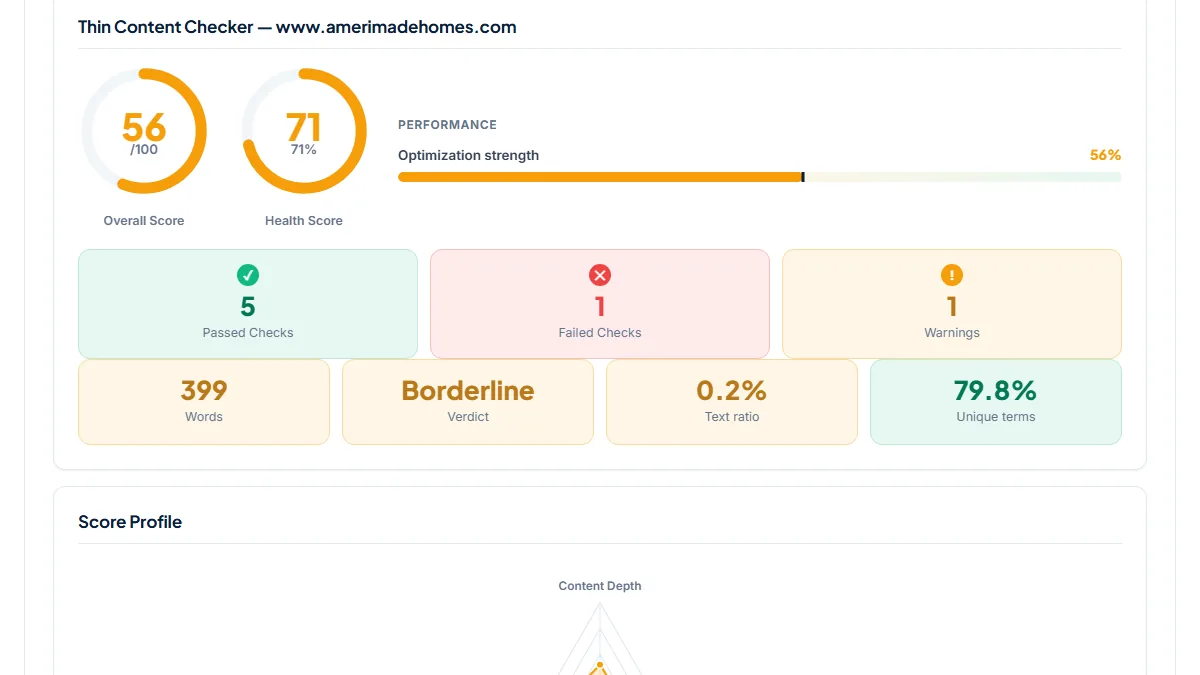
1. A brokerage listing page: 399 words, none written by the office
- Situation
- Amerimade Realty in Toledo, Ohio runs a WordPress site with an IDX feed from the NORIS MLS. We ran the page for 4315 Beverly Drive (MLS 10015565) on 10 November 2026, a day after it was listed.
- Input
https://www.amerimadehomes.com/idx/mls-10015565-4315_beverly_drive_toledo_oh_43614- Reading the result
- 399 words, verdict Borderline, Overall score 56/100 (Health 71), text ratio 0.2 %, Unique terms 79.8 %. Splitting the counted text: 112 words of listing remarks, 109 words of the MLS reciprocity notice, and 178 words of MLS fields (price, tract, schools, heat, basement) plus share-button and contact-form labels. Every sentence comes from the feed, so the same text can be shown on any site that displays this listing, and nothing on the page says what the office knows about the street.
2. The same listing on an agent site and on the portal
- Situation
- HAR.com gives Houston-area agents a personal site under
/web/. We ran one agent's copy of 27 Lazy Morning Pl, The Woodlands, then the portal's own page for that listing, the same day. - Input
https://www.har.com/web/angelaschimmels/homedetail/5325712?lid=11250879and the har.com/homedetail/page it names as canonical- Reading the result
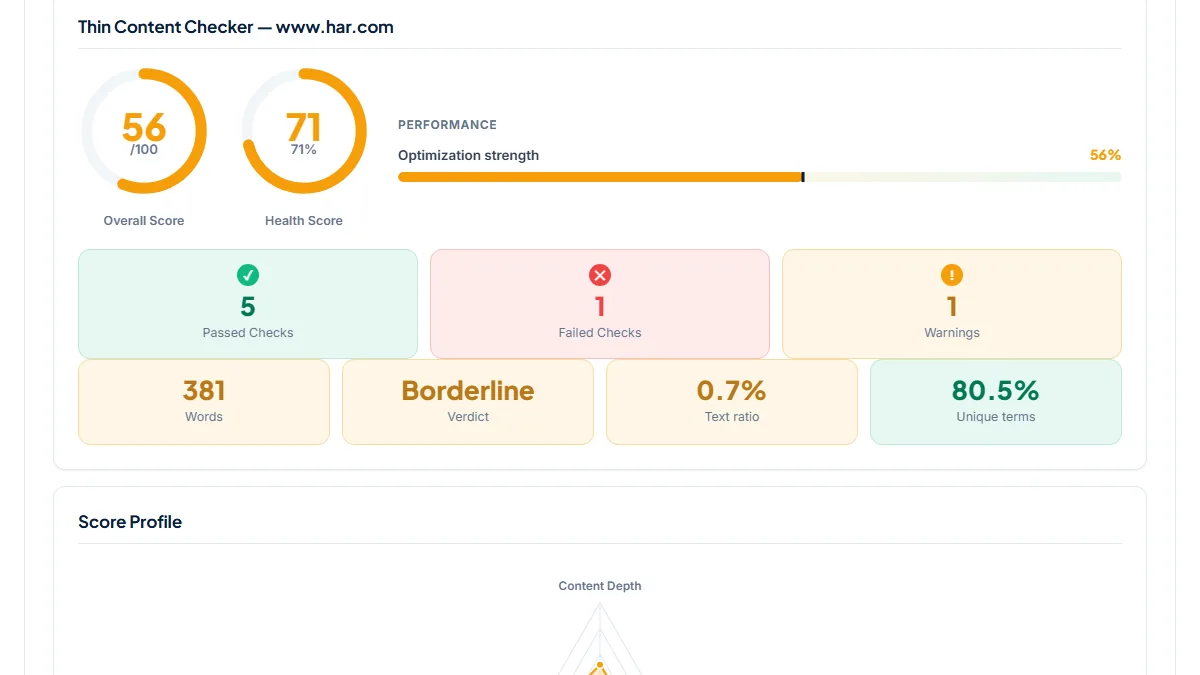
- Agent copy: 381 words, Borderline, 56/100. Portal copy: 617 words, Substantial, 87/100. The checker scores each page separately and has no way of knowing they describe the same house. The page source answers that: the agent copy's canonical tag points to the portal page, and comparing the two extracted texts shows about nine in ten of the agent page's words in the same order on the portal. The agent copy is not meant to rank; the portal page is.
3. An agent page with her own bio and listing cards: 548 words
- Situation
- On the same Amerimade site, each agent has a page that combines a profile with her current listings. We ran Misty King's page, also on 10 November 2026.
- Input
https://www.amerimadehomes.com/idx/listings/misty-king/- Reading the result
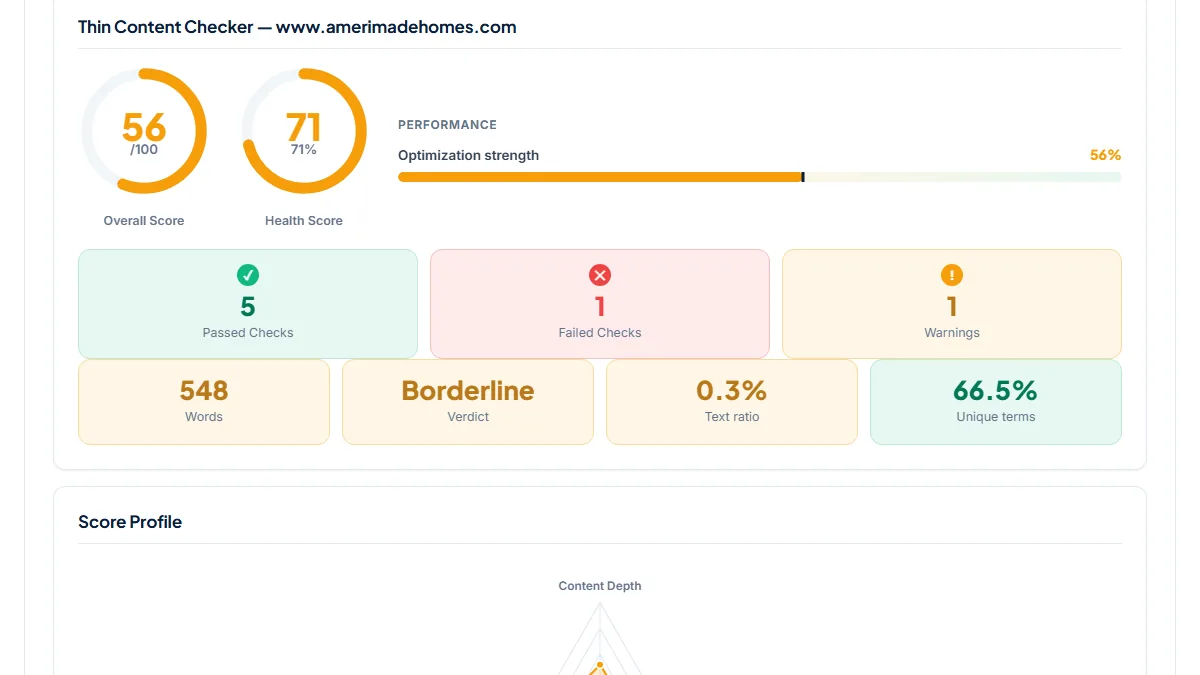
- 548 words, Borderline, 56/100, exactly the score of the listing page above. This time 316 words are her own: licensing history, certifications, local boards she serves on and why she sells homes. The seven listing cards add 120 words and the MLS notice 112. The same score hides a very different page, which is why you read the counted text rather than stop at the number.
Common mistakes
- Treating a Substantial verdict on a listing as proof of original content. A long MLS description pushes Words up just as well as your own writing does.
- Editing the public remarks on your IDX copy to make them "unique". The feed is supposed to be shown as the MLS supplies it; add your text beside it instead.
- Running only listing pages. Your neighborhood and agent pages are where your own words can actually be, so run them as well and see whether they are any longer than the feed.
- Reading a very low count as a thin page when the description is loaded by JavaScript. Check the page source; if the remarks are missing there, the checker could not count them.
Frequently asked questions
Can the checker tell me which of my IDX pages are duplicates of the MLS?
No. It reads one page at a time and never sees the MLS feed, a portal or another broker's site, so it cannot say where a sentence came from. What it gives you is the word count and the extracted text. You recognise the feed parts yourself: the public remarks, the property fields and the MLS display notice. For a direct comparison, paste your remarks and a portal's copy into Text Similarity.
Should I rewrite the MLS description so my listing page is unique?
Not in the feed itself. AgentFire's help article notes that IDX property data has to be presented exactly as the MLS provides it, and your MLS rules decide what may be changed. Leave the remarks as they are and add your own material outside the feed: a short note on your own listings if your IDX product allows it, and neighborhood or agent pages that link to the listing.
My listing page shows a long description, but the checker counts very few words. Why?
The checker reads the HTML your server sends and does not run JavaScript. Some IDX products fill in the description and photos with a script after the page loads, so the server HTML holds little more than the disclaimer. Open the page source and search for a sentence from the remarks. If it is not there, the checker could not count it, and you can ask your vendor whether the listing content is rendered server-side.
Is a listing page under 300 words thin in Google's eyes?
Google does not publish a word count rule. The 300 and 600-word lines are this checker's own thresholds, a quick way to sort pages into groups. For listing pages the more useful question is how much of the page anyone else could show, because a 600-word page built only from MLS text is the same 600 words on every IDX site carrying that home.
Reference: AgentFire's support article Why IDX Property Pages Often Struggle with SEO and Indexing explains the three reasons behind unindexed listings: MLS data shown exactly as supplied, the same listing on many sites, and URLs that change with the listing status.