Why Etsy Sellers need this
A shopper who knows what they want does not stop at "necklace". They type "birth flower necklace for grandma" or "linen apron with pockets", and Etsy can only show a listing whose title and tags hold those words. You get a 140-character title and 13 tags of up to 20 characters each. The hard part is knowing the wording before the listing goes live, while your stats are still empty.
Autocomplete is where that wording shows up. The phrases a search box offers are ones people have typed before, and the long ones, four or five words, come from someone who already knows what they want. Fewer listings match a phrase like that word for word.
This tool collects those phrases from Google, not from Etsy. One seed becomes 32 Google autocomplete lookups: the seed itself, the seed followed by each letter of the alphabet, and the seed after how, what, why, best and vs. The answers are merged into one alphabetical list you can copy. No scores, no search volumes. It is a raw list you can skim in two minutes, and the last step, trying your shortlist in Etsy's own search bar, is yours.
Etsy Sellers specific guidance
Tips for Etsy Sellers
Enter the product in two or three words, the way you would name it to a stranger. The result is a single card, "Keyword Ideas for" your seed with the total in front, sorted A to Z. That order matters. The phrases at the top are not the popular ones, only the ones that start with a number or an early letter, so read to the end.
Skim with three questions. What do people add after the product? Those are attributes: metal, colour, month, size, who it is for, "with name", "with pockets". What do they put in front of it? Often a style or an origin, such as "japanese" or "irish". And which lines are not yours: another shop's brand, a big retailer, tattoo ideas, sewing patterns. Google mixes neighbouring topics into its suggestions and the tool passes them on unfiltered.
Then sort what is left by length. A phrase of 20 characters or fewer can go into a tag box as it stands. A longer one belongs in the title, which has room for two or three of them, or gets cut into shorter pieces that keep the buyer's words. The tool does not count characters, so paste a doubtful phrase into the Word Counter.
Finish on Etsy. Type each shortlisted phrase slowly into Etsy's search bar and watch what it offers. Where Etsy completes the phrase the way Google did, shoppers use that wording in both places. Where it does not, keep Etsy's version.
If you want every phrase scored, grouped and split into questions, use our Keyword Research tool, which reads four search engines and has a country setting. This one is the quick pass: one source, one list, no numbers to interpret.
The costliest mistake
The usual mistake is to judge the list by its first screen, or to press Copy all and paste everything into a listing. In our two full runs between a tenth and a sixth of the phrases had drifted to another topic, and many more named someone else's brand.
Quick start
- Type the item in two or three words and run it.
- Read the whole list, not only the first rows.
- Cross out brands, retailers and off-topic lines.
- Mark phrases of 20 characters or fewer as tag candidates.
- Try each candidate in Etsy's search bar before you save.
What this tool does not tell you
- It does not read Etsy. Every phrase comes from Google autocomplete, so nothing here says what Etsy's search bar suggests or how many Etsy shoppers type a phrase.
- It gives no numbers per phrase: no search volume, no competition, no character count. The only figure on the screen is the total in the card title.
- The list is not filtered or ranked. It is alphabetical, includes off-topic and brand phrases as Google returned them, and has no country setting, so markets are mixed.
Real examples
1. Birth flower necklace: the seed itself is one character too long for a tag
- Situation
- A jewellery shop is about to list a pendant with a flower for each birth month. We ran the seed on 12 November 2026 with Language set to English.
- Input
birth flower necklace, English- Reading the result
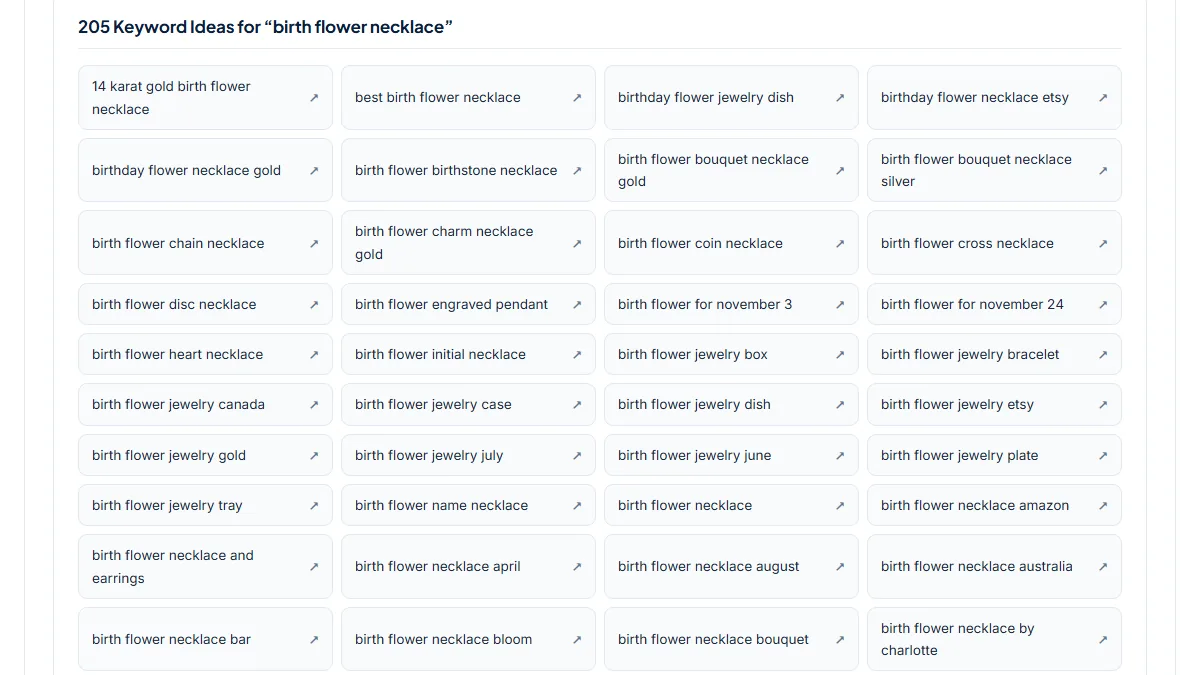
- 205 Keyword Ideas, and none of them fits a 20-character tag: the seed alone is 21 characters. So every line is title material first. The list shows what to put there: all twelve months appear after the seed, "gold" is in 19 phrases and "silver" in 6, and the buyer words are "for mom", "for grandma", "with name", "with birthstone", "dainty" and "waterproof". Tags come from cutting: "birth flower pendant" is exactly 20 characters, "necklace for grandma" is 20, "birth month flower" is 18. Roughly 40 lines name another jewellery brand or a retailer, and a few are about tattoos or jewellery dishes. Those stay out.
2. Linen apron: over half the list is already tag length
- Situation
- A sewing shop that makes aprons to order checks how people describe them. Same day, same setting.
- Input
linen apron, English- Reading the result
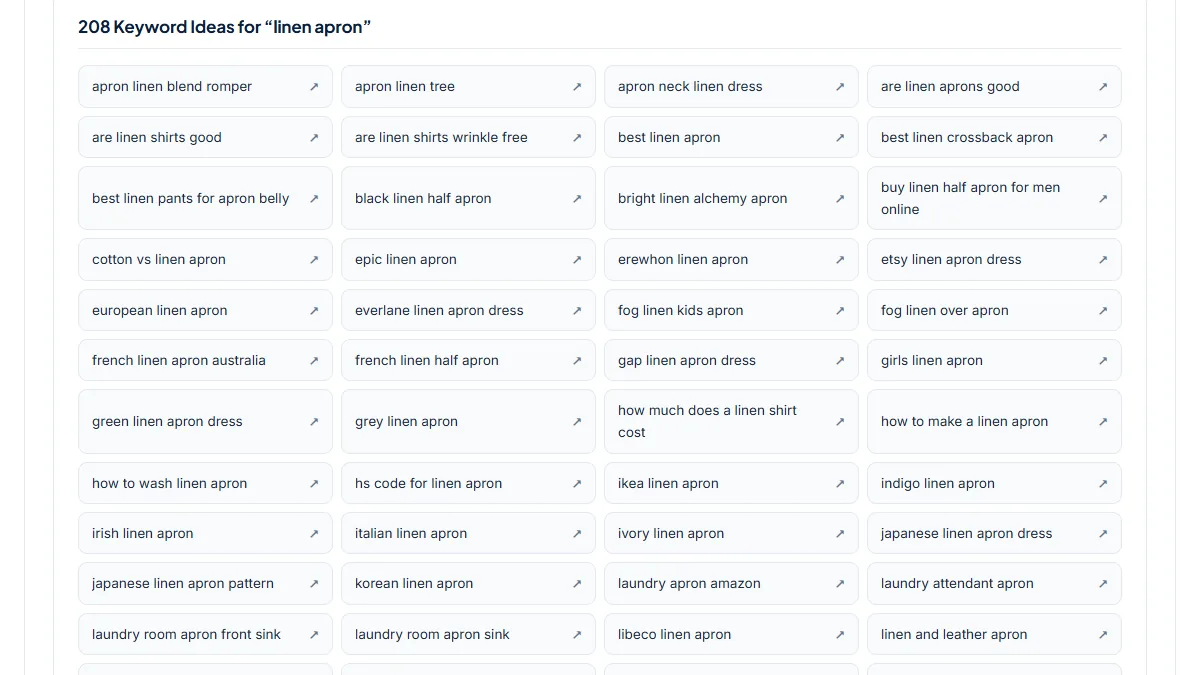
- 208 Keyword Ideas, and 119 are 20 characters or fewer. Usable as they stand: "linen apron for men", "linen garden apron", "linen pinafore dress", "linen apron no tie", "linen apron pottery", plus a run of colours from beige to striped. "linen apron cross back" and "linen apron with pockets" run to 22 and 24 characters, so they go in the title. The noise is easy to spot: more than twenty lines name a shop or brand, 23 lack one of the two seed words ("laundry room apron sink", "are linen shirts good"), and a handful are sewing-pattern searches. One list also mixes markets: "made in usa", "nz", "uk" and the British spelling "personalised".
3. Personalised linen apron: a narrower seed returns two lines
- Situation
- The same shop tries a more specific seed, hoping for more specific ideas. Same day.
- Input
personalised linen apron, English- Reading the result
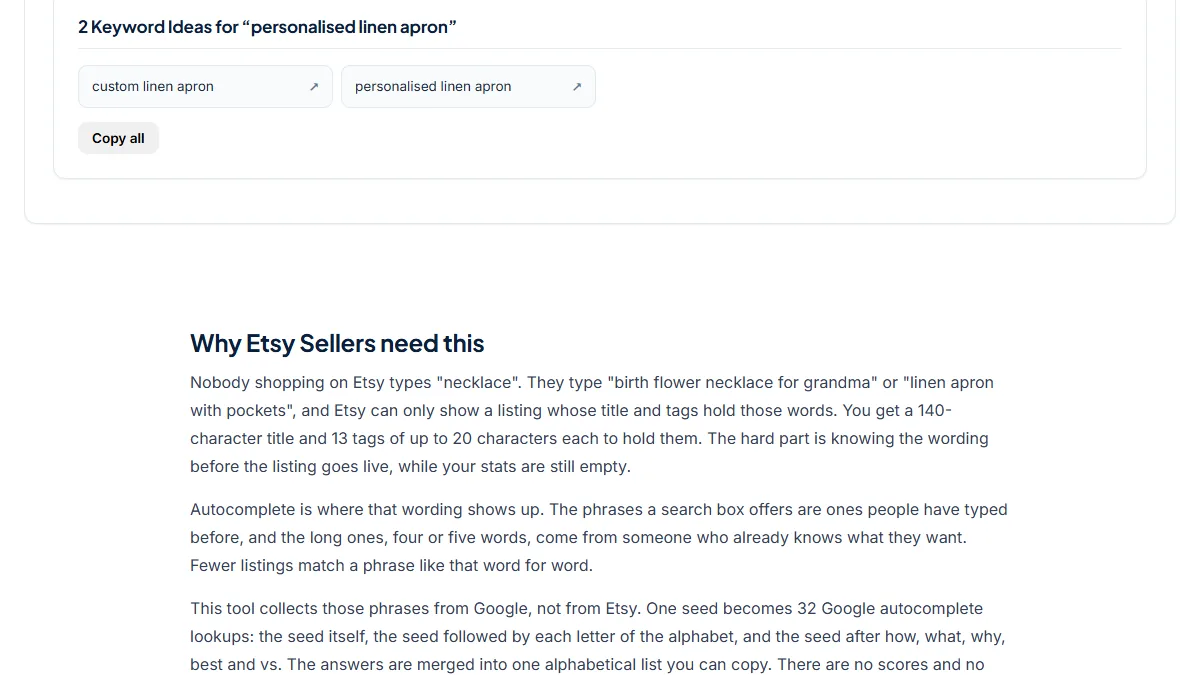
- 2 Keyword Ideas: the seed and "custom linen apron". An eight-word listing title, "dainty gold birth flower necklace gift for mom", returned no card at all, only the message "No suggestions returned. Try another keyword or language." Google has completions for short product names, not for finished titles. The specific wording was in the broad run all along ("linen apron personalised", "linen apron custom", "linen apron with logo"), and the two-line result still says something: Google pairs this product with "custom", a word worth one tag.
Common mistakes
- Typing a finished listing title as the seed. Eight words returned nothing in our run; two or three words returned about 200 phrases.
- Reading only the top of the list. It is alphabetical, so "14 karat gold" comes first because of the digit, not because more people search it.
- Pasting a phrase into a tag without counting. "birth flower necklace" is 21 characters and "linen apron cross back" is 22; neither fits a 20-character tag.
- Keeping lines that name another brand or a retailer. They describe someone else's product, and a shopper who types them is not looking for yours.
- Treating a Google suggestion as proof of Etsy demand. Check the phrase in Etsy's search bar, and in your shop stats once the listing has been live for a while.
Frequently asked questions
Does this tool show what Etsy's search bar suggests?
No. It asks Google only: 32 autocomplete lookups for your seed, merged into one list. Etsy's search bar has its own suggestions, built from what Etsy shoppers type, and this tool never sees them. Treat the result as a list of shopper wording to test. People describe a product with the same attributes wherever they search, so most ideas carry over, but the check on Etsy is the step that tells you which ones do.
The phrase I want is longer than 20 characters. What should I do with it?
Put the full phrase in the title, which can hold up to 140 characters, and use tags for shorter pieces of the same wording. For "birth flower necklace for grandma" that could be "birth flower pendant" and "necklace for grandma", both exactly 20 characters. Keep the buyer's own words when you cut and avoid abbreviations nobody types. The tool cannot tell you how Etsy treats a phrase split over two tags, so watch your shop stats after the change.
Which phrases in the list are searched the most?
The tool does not know. It shows no volume, and because the list is sorted A to Z, position means nothing. Two rough signals remain. A phrase Google offers for the bare seed, before any letter is added, tends to be a common one, and the arrow next to each line opens a Google search so you can see what comes up. For a relative demand score per phrase, run the same seed in our Keyword Research tool.
How is this different from your Keyword Research tool?
Keyword Research reads Google, YouTube, Bing and DuckDuckGo, lets you choose a country, and scores each phrase for demand, difficulty and opportunity, with questions and modifiers in their own sections. Keyword Suggestion reads Google only and returns one unscored list in a few seconds. Use this one when you are writing a listing and need wording now. Use Keyword Research when you are deciding which product line or market deserves the work.
Can I use it for buyers who do not search in English?
Yes, with limits. The Language field offers English, Turkish, German, Spanish, French and Arabic, and Google answers in that language. There is no country field, so an English run mixes American, British and Australian wording in one list. Only Turkish has its own question words (nasıl, nedir, neden and a few more). In the other languages the five words placed before the seed (how, what, why, best, vs) stay English, so for a German or French seed most ideas come from the A to Z lookups.
Reference: Marmalead's guide to improving your Etsy SEO recommends the last step on this page, typing into Etsy's search bar and reading its autocomplete, and explains why longer, more specific phrases are easier to be found for than broad ones.