Why Etsy Sellers need this
Before Etsy ranks anything, it gathers the listings whose title, tags, categories and attributes match the shopper's words. A listing called "Luna" with tags like "gift" and "handmade" never makes it into that first pool, however good the photos are.
So the words come first, and guessing them is where most shops lose. Sellers describe the item the way a maker thinks about it; buyers type what they want it to do or say: "with name", "for small dogs", "and leash set". Each tag can hold only 20 characters and you get 13 of them, so every slot spent on a word nobody searches is a lost match.
This tool expands one product idea into hundreds of phrases from live Google, YouTube, Bing and DuckDuckGo autocomplete and shows the words that keep coming back next to it. It does not read Etsy's own search box. Google sends Etsy shoppers too, and the modifiers people use there are the same attributes they type on Etsy.
Etsy Sellers specific guidance
Tips for Etsy Sellers
Read "How People Qualify This Topic" first. Those modifiers are your attributes and tag ideas: materials (leather), sizes (small, large), add-ons (name, leash, handle) and occasions. Then go through Priority Targets and All Keyword Ideas and split what you find three ways. Long phrases such as "personalized dog collar with name and phone number" belong in the title and the first sentence of the description. Etsy's help says Google shows only the first 50 to 60 characters of a listing title, so the most important traits go first. Phrases of 20 characters or fewer, such as "custom dog collar uk" or "bespoke pet portrait", can be tags exactly as they are. The rest you shorten into tags that keep the buyer's words.
Ignore the Intent, Stage and "Page type to build" columns for listings. They are written for websites, and most product phrases default to Informational there. For a shop, the useful split is buyer phrases against maker phrases: "how to", "diy", "tutorial", "free pattern" are people who want to make the thing, not buy it, unless you sell the pattern or kit.
Run the seed again with the country set to each market you ship to. UK shoppers write "personalised" and "bespoke", and both show up in the results.
Common mistakes
The common mistake is to fill the 13 tags with single words, or to repeat the category and attributes Etsy already reads from the listing. Use each tag for a different multi-word phrase a buyer typed, and keep the title readable instead of stuffing every phrase into it.
Quick start
- Enter the item in two or three plain words.
- Copy the top modifiers into a list of attributes.
- Pick title phrases from Priority Targets; lead with the item.
- Choose 13 different tags of 20 characters or fewer.
- Cross out maker phrases unless you sell patterns or kits.
Real examples
1. Personalized dog collar: the buyer adds what it should say and hold
- Situation
- A US shop making engraved dog collars wants new title and tag ideas. On 25 October 2026 we ran the seed at standard depth for the United States.
- Input
personalized dog collar, English, United States, Standard- Reading the result
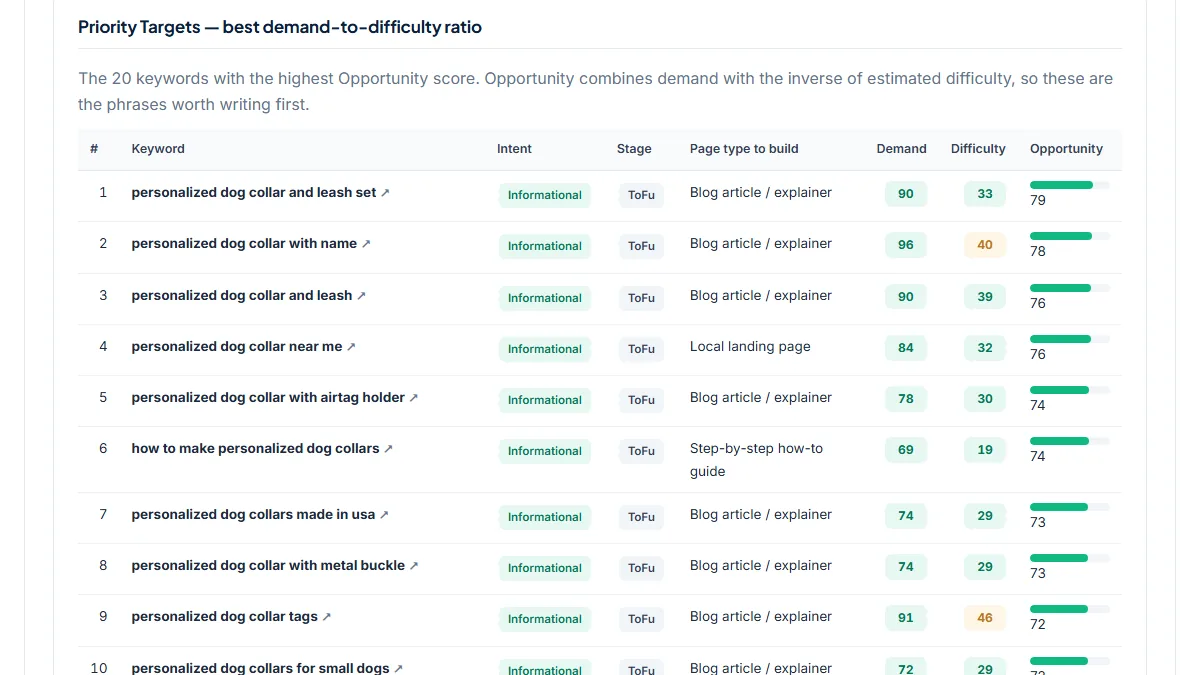
- 474 ideas and 22 questions; topic opportunity 77/100. The top Priority Targets are all buyer attributes: "and leash set" (opportunity 79), "with name" (demand 96), "with airtag holder", "with metal buckle", "for small dogs", "with name and phone number", "made in usa". Leading modifiers: custom 115, personalised 66 (the UK spelling, even in the US market), name 34, leather 19, leash 12. Of the 255 phrases in All Keyword Ideas, only a handful fit Etsy's 20-character tag limit as they stand, "custom dog collar uk" among them, so most become title phrases and get shortened for tags.
2. Macrame wall hanging: a third of the ideas are makers, not buyers
- Situation
- A seller of finished macrame pieces checks what people search around their main product, also for the United States.
- Input
macrame wall hanging, English, United States, Standard- Reading the result
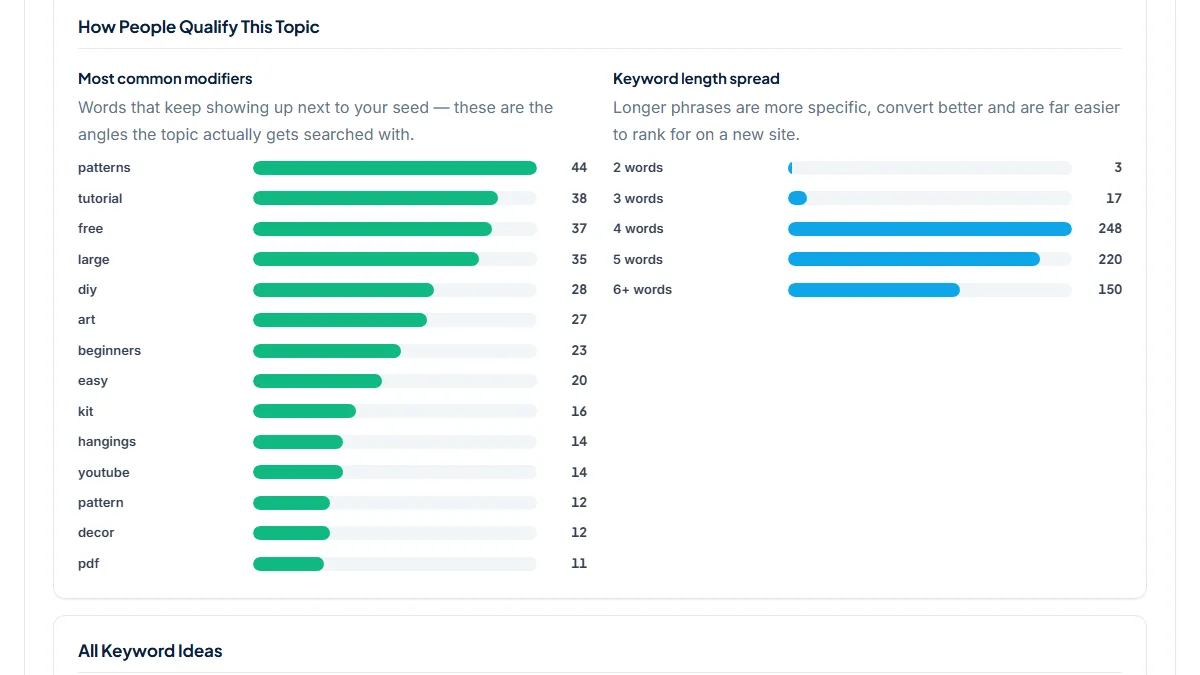
- 638 ideas, opportunity 86/100, but the first Priority Targets are "for beginners", "tutorial", "how to make" and "free patterns", and 91 of the 255 phrases in All Keyword Ideas contain how-to, DIY, tutorial, pattern, free or make. Those are people learning the craft. The modifiers sort the shop's options: "large" (35) and "decor" are buyer words for finished pieces, while "kit" (16), "pattern" and "pdf" (11) are products only if the shop also sells patterns or kits, which is a separate listing.
3. Custom pet portrait in the UK: Google shoppers type "etsy"
- Situation
- A UK illustrator selling pet portraits from photos runs the seed for the United Kingdom.
- Input
custom pet portrait, English, United Kingdom, Standard- Reading the result
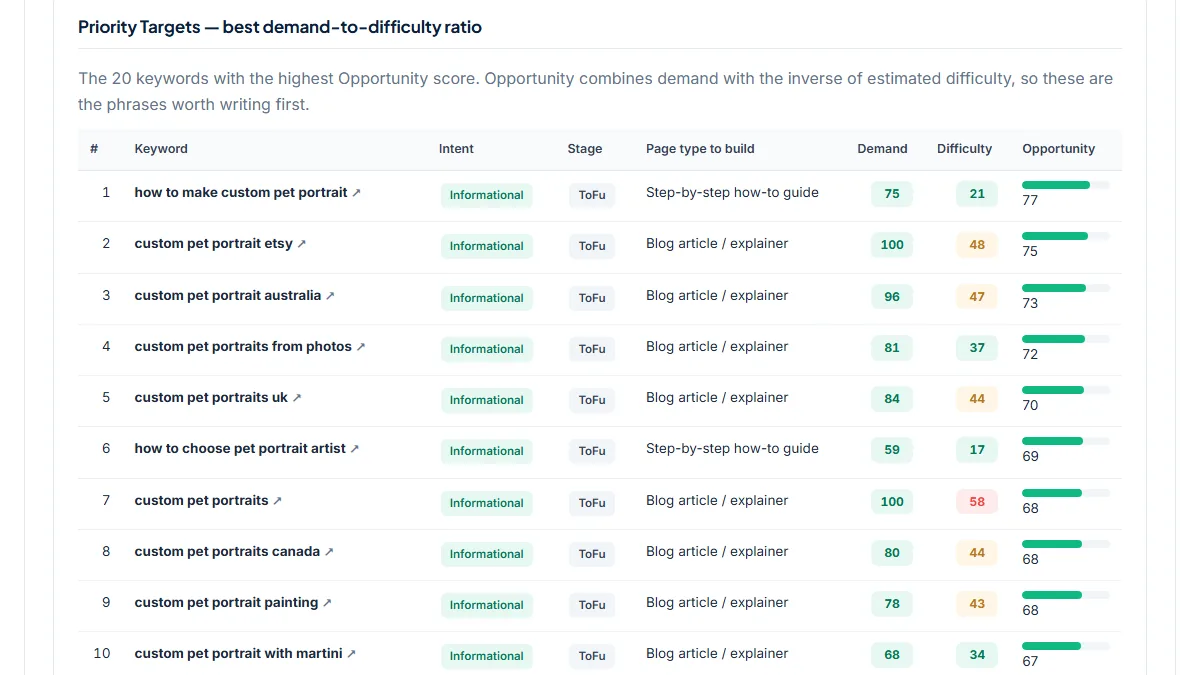
- 337 ideas; "custom pet portrait etsy" scores the maximum demand (100) in Priority Targets, so buyers search Google with Etsy already in mind, and the listing title doubles as its Google title. Location phrases appear ("uk", "australia", "canada"), plus "from photos" (81/37) and "bespoke pet portrait", a UK wording that fits a tag at exactly 20 characters. Eight phrases are short enough to use as tags unchanged; "custom pet photo mug" and "urn" are other products and stay out.
Common mistakes
- Using one-word tags like "dog" or "portrait". Etsy matches phrases, and a 20-character slot holds a full buyer phrase such as "dog collar with name".
- Repeating the category or the attributes you already selected as tags. Etsy reads those fields anyway, so the tag slot adds nothing new.
- Copying how-to and DIY phrases from the results into a finished-product listing. They bring pattern hunters, not buyers.
- Opening the title with a creative product name. Shoppers and Google read the first words, so start with what the item is.
- Researching one market only. "Personalised" and "bespoke" are what UK buyers type; if you ship there, check the UK results as well.
Frequently asked questions
Does this show Etsy search volume?
No. It reads autocomplete suggestions from Google, YouTube, Bing and DuckDuckGo and turns their ranking signals into a relative 0–100 demand index, not monthly searches. That still works for Etsy: the phrases people finish in Google are the same product words they type on Etsy, and Google sends Etsy its own share of shoppers. For Etsy's internal numbers, check your shop's Search Visibility page in Shop Manager after the listing has been live for a while.
Should every word in my title also be a tag?
Sellers in the Etsy Community disagree about this, and Etsy does not require it. What Etsy does say is that tags help most where no attribute matches and for buyer-minded phrases such as "gift for her". A practical rule: put your main phrase in both the title and one tag, then use the other twelve tags for different phrases from the results, so each slot can win a new search.
Do I need to tag both singular and plural, or US and UK spellings?
Plurals rarely deserve their own slot: seller tools report that Etsy treats "collar" and "collars" as the same word, though Etsy's help doesn't say so. Spellings are different words. The US results for "personalized dog collar" show "personalised" 66 times, so if UK buyers matter to you, test one tag with the spelling your title doesn't use and check your stats after a few weeks.
How many tags should I use, and how long can they be?
All of them. Etsy allows up to 13 tags per listing, each up to 20 characters including spaces, using letters, numbers and spaces; apostrophes and hyphens are allowed inside words. Every empty slot is a search you can't be matched to. Use the results to fill them with distinct multi-word phrases, and avoid tags that only repeat each other with one word changed.
Will my Etsy listing show up on Google with these keywords?
It can. Etsy's help says the item title becomes the page title Google shows, that Google displays only the first 50 to 60 characters, and that search engines read the full description. Lead the title with the main phrase from your research and describe the item clearly in the first sentence. A shop tagline of up to 55 characters and a complete About section also help Google understand what you sell.
Reference: Etsy's guide on how to use tags to get found in search sets the limits this page works to: up to 13 tags per listing, each up to 20 characters, matched against shoppers' searches.