Why Affiliate Marketers need this
An affiliate site runs on two kinds of pages. Money pages (roundups, single reviews, versus articles, deal pages) carry the links that earn commission. Guides answer questions, bring readers in and pass them on to the money pages, but few of their visitors click through to a merchant. The keyword list you work from mixes both kinds, whether it came from Search Console, a keyword tool or a competitor's article titles. A roundup written for a how-to search, or a guide written for a "best" search, gives the searcher the wrong page.
The Keyword Intent Classifier labels up to 100 keywords per run as Informational, Commercial, Transactional or Navigational, and adds a funnel stage and a content type to each. It reads only the words inside each keyword. It does not look at Google's results, search volume or the sites that rank, so treat it as a fast first sort and not as a verdict. Buying words such as best, review, vs, coupon and price are picked up consistently. Buying phrases that carry no such word, like "vpn for netflix", land under Informational and need a second look from you. Most of this page is about that second look.
Affiliate Marketers specific guidance
Bring a list, not a seed
This tool does not search for keywords. Keyword Research starts from one seed, pulls phrases from autocomplete and scores them; the classifier takes the phrases you already hold and labels them. Typical sources are the Queries report in Search Console, an export from any keyword tool, or the article titles of a site in your niche.
Paste one keyword per line. A run takes the first 100 lines and tells you when it left some out, so split a longer list into batches. Exact duplicates are counted once. English and Turkish keywords can sit in the same list. The result is immediate, because nothing is fetched: the same list always returns the same labels.
Translate the four labels into affiliate pages
The Best content type column is written for a business that sells its own product. An affiliate needs a different reading:
- Commercial (best, top, review, vs, alternatives, worth it): your money pages. "Best" and "top" are roundups, a product name plus "review" is a single review, "vs" and "alternatives" are comparison pages.
- Transactional (coupon, discount, deals, price, cheap, buy): the tool suggests "Product / pricing / landing page", which you do not have. For you these are deal or coupon pages, a price section inside the review, or keywords to leave to the merchant.
- Navigational (login, download, app): the searcher wants the brand's own site. Usually skip them.
- Informational: guides and how-to posts that link to the money pages.
Re-read every Informational row
A keyword with none of the listed words is Informational by default. That default hides buying phrases. In our three runs, 4 to 6 of the 10 to 12 Informational rows were really product searches. Look for these shapes:
- product for a use or a person: "standing desk for tall people", "vpn for firestick"
- product with a feature: "standing desk with drawers"
- A or B: "surfshark or nordvpn"; in Turkish "delonghi mi philips mi"
- brand plus product, "which … is fastest", "free trial"
Move those rows to the money-page column by hand. When you are unsure, search the phrase on Google in a private window: if the first page is roundups and reviews, it is a money page whatever the label says. The table has no sort or export, so select it, paste it into a sheet and add your own "page type" column there.
What this tool does not tell you
- It never looks at Google. The label comes from word lists, so it cannot tell which page types actually rank for a keyword.
- No search volume, difficulty, CPC or commission data, and no new keyword ideas: it labels only what you paste.
- Buying phrases without a listed word ("X for Y", "A or B", Turkish "A mı B mi") fall to Informational by default.
- 100 keywords per run, and the table cannot be sorted or exported. Copy it into a sheet to group the rows.
Real examples
1. Standing desks: 12 money keywords by label, 16 after the second look
- Situation
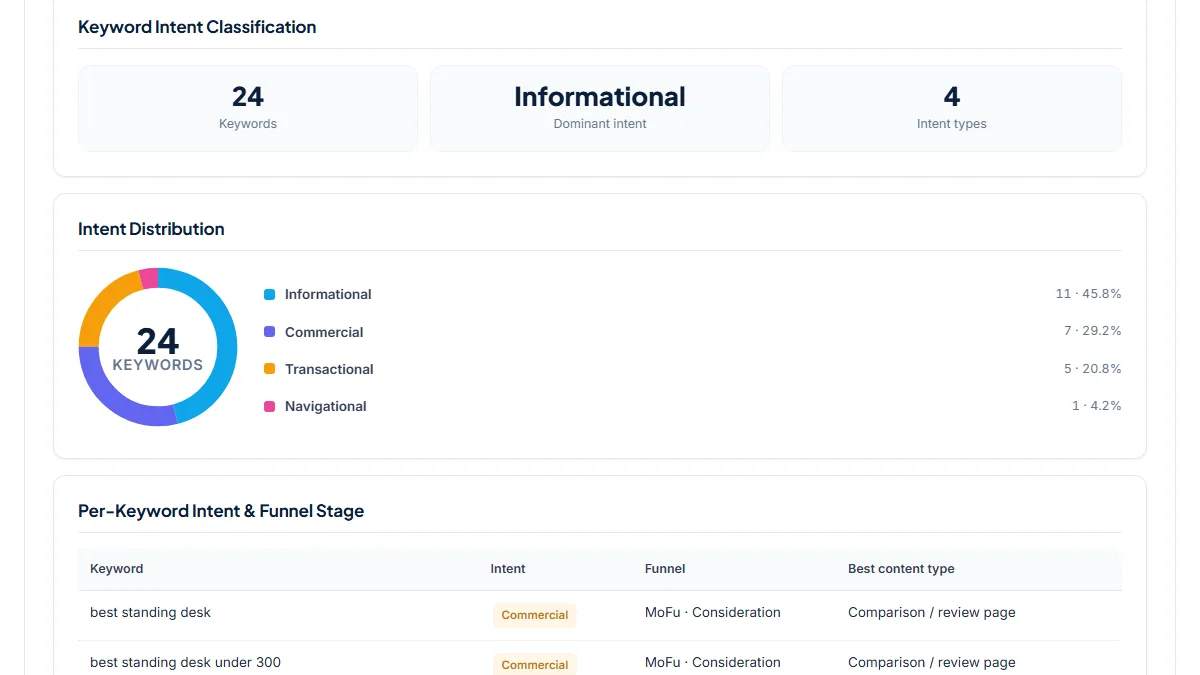
- We put together 24 keywords a home-office affiliate site would typically hold (best-of, review, versus, deal and how-to phrases) and ran the list on 12 November 2026.
- Input
- 24 keywords, from
best standing desk under 300tostanding desk wobble fix - Reading the result
- Dominant intent Informational, 4 intent types: 11 Informational (45.8%), 7 Commercial (29.2%), 5 Transactional (20.8%), 1 Navigational (4.2%). The Commercial rows are the expected money pages: "best standing desk under 300", "flexispot e7 review", "uplift v2 vs flexispot e7", "autonomous smartdesk alternatives", "top rated standing desks", "is a standing desk worth it". The Transactional rows are deal content: "flexispot discount code", "uplift desk coupon", "standing desk black friday deals", "where to buy a standing desk", "cheap standing desk". Four of the 11 Informational rows are product searches with no buying word: "standing desk for tall people", "standing desk with drawers", "standing desk or desk riser" and "ikea standing desk". The other seven ("how tall should a standing desk be", "standing desk wobble fix", "flexispot e7 assembly instructions"…) are real guide topics. "flexispot app" is Navigational: skip.
2. VPN: three Navigational rows, and only two of them belong to the brand
- Situation
- A 24-keyword list for a software affiliate site: brand terms, comparisons, coupons and setup questions. Same day.
- Input
- 24 keywords, from
nordvpn vs expressvpntovpn not connecting - Reading the result
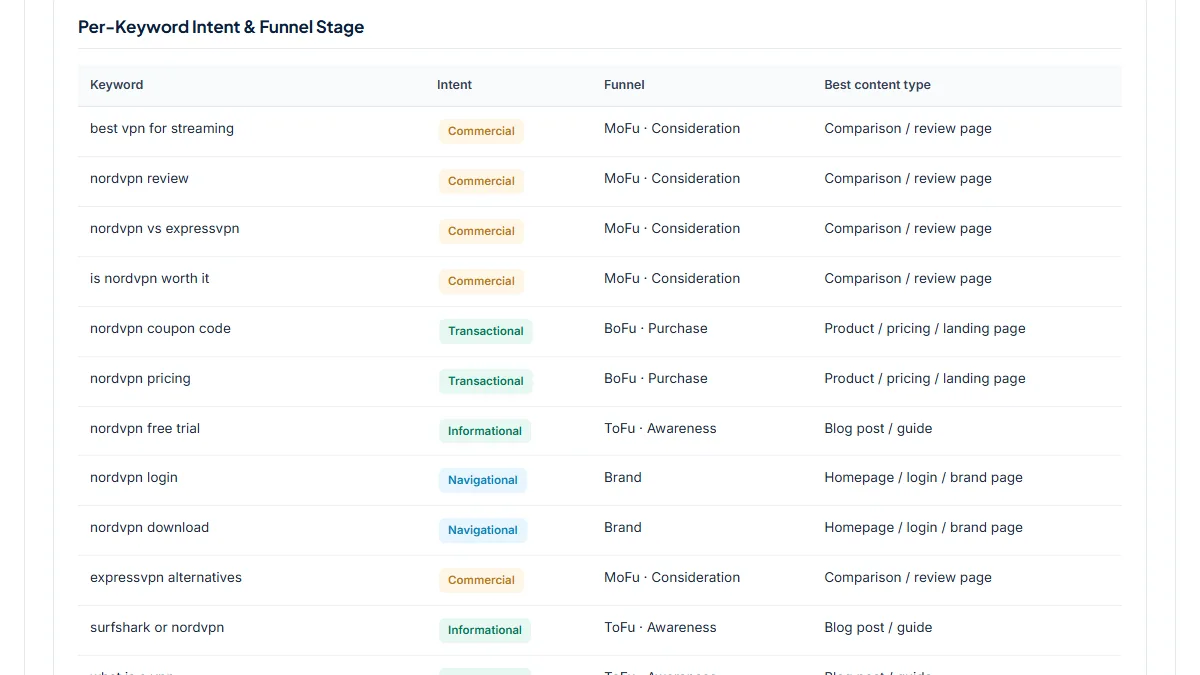
- 12 Informational (50%), 7 Commercial (29.2%), 2 Transactional (8.3%), 3 Navigational (12.5%). "nordvpn login" and "nordvpn download" are Navigational for a good reason: those searchers want the brand's site. The third, "vpn app for iphone", is a product search that gets the label only because it contains the word "app"; it belongs with the roundups. Six Informational rows are buying phrases too: "surfshark or nordvpn", "vpn for netflix", "vpn for firestick", "which vpn is fastest", "nordvpn free trial" and "free vpn". Word order also matters: "cheapest vpn" is Commercial, while "nordvpn pricing" and "nordvpn coupon code" are Transactional. "how to cancel nordvpn subscription" is Informational; before a fix we made that day, the word "subscription" had put it under Transactional with a pricing page as the suggestion.
3. A Turkish espresso machine list: suffixes are read, question particles are not
- Situation
- An affiliate site in Turkey reviewing coffee machines: 20 Turkish keywords and 4 English ones in the same list. Same day.
- Input
- 24 keywords, from
en iyi espresso makinesitobreville barista express review - Reading the result
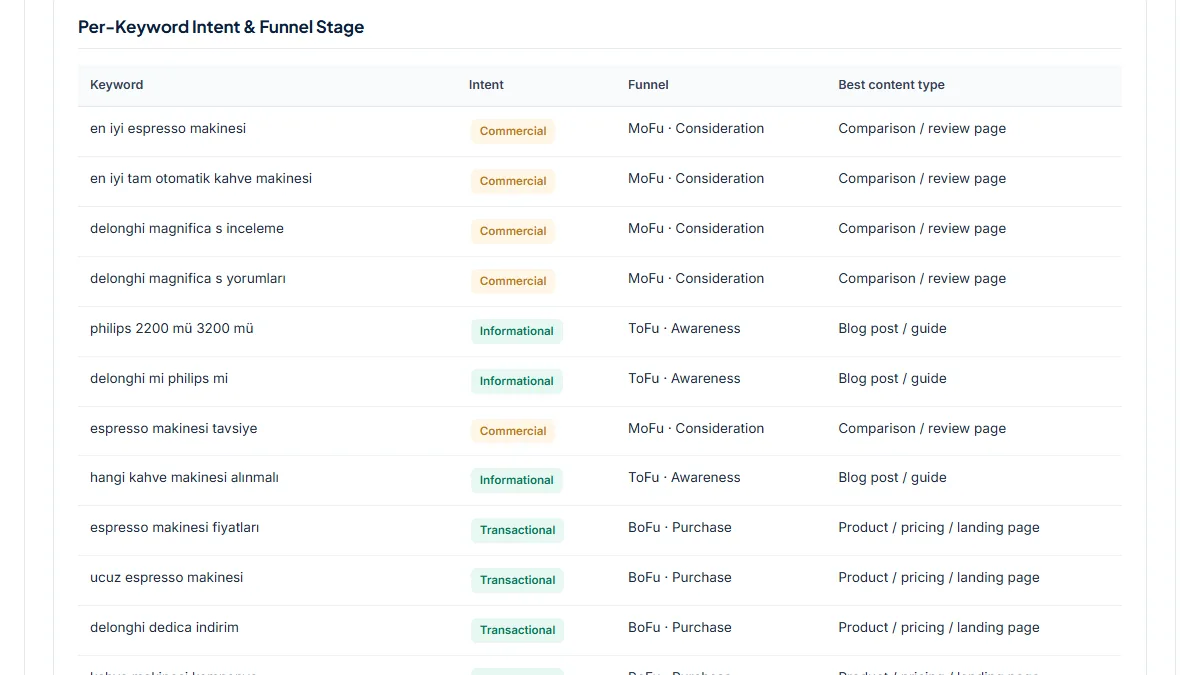
- 10 Informational (41.7%), 9 Commercial (37.5%), 5 Transactional (20.8%), no Navigational. Turkish buying words are matched with their suffixes: "espresso makinesi fiyatları" (prices), "delonghi dedica indirim" (discount) and "kahve makinesi kampanya" (deal) are Transactional; "delonghi magnifica s yorumları" (reviews), "espresso makinesi tavsiye" and "kahve makinesi önerileri" (recommendations) are Commercial, next to the English "delonghi magnifica evo vs philips 3200". What the tool cannot read is the Turkish way of asking "A or B": "delonghi mi philips mi" and "philips 2200 mü 3200 mü" are comparison searches labelled Informational. So are "hangi kahve makinesi alınmalı" (which coffee machine to buy) and "öğrenci evi için kahve makinesi" (coffee machine for a student flat). Moved by hand, the money list grows from 14 to 18 of 24.
Common mistakes
- Treating the Informational pile as "guides only". In our runs 4 to 6 rows in it were product searches such as "vpn for netflix" and "standing desk with drawers".
- Building the page the Best content type column names. "Product / pricing / landing page" is a seller's page; an affiliate answers a coupon or price keyword with deal content or leaves it.
- Writing a review page for every Navigational row. "nordvpn login" wants the brand's own site, but check the rows that only contain "app", like "vpn app for iphone".
- Reading the distribution chart as your niche. It describes the 24 or 100 lines you pasted and nothing else; a different list gives a different chart.
- Counting on a Commercial label to make the page rank. The label says which page type to write; the review still needs your own testing.
Frequently asked questions
How do I tell which keywords are money pages for an affiliate site?
Paste the list and start with the Commercial rows: best, top, review, vs and alternatives phrases are roundups, single reviews and comparison pages. Add the Transactional rows you can serve with deal or coupon content. Then read the Informational rows again and pull out product searches that have no buying word, such as "standing desk for tall people". For any row you doubt, one Google search settles it: a first page of reviews and roundups means a money page.
Does the classifier check Google to decide the intent?
No. It makes no request to Google or to any other source. Each keyword is compared with four word lists, in a fixed order: Transactional first, then Commercial, Navigational and Informational. The first list with a matching word decides the label, and a keyword that matches none is Informational. That is why "how much does it cost" is Transactional and why a phrase without a listed word can be mislabelled. Use the labels to sort quickly and confirm the important keywords by hand.
How is this different from Keyword Research?
Keyword Research finds phrases: you give it one seed and it returns autocomplete suggestions with demand, difficulty and opportunity estimates, clusters and its own intent labels. The Keyword Intent Classifier finds nothing new. It labels a list you already have, up to 100 lines, in the order you pasted it. Use Keyword Research to build the list and the classifier to sort a list that came from somewhere else. The two tools use different rules, so the same phrase can get different labels.
Does it work with Turkish keywords?
Partly. It knows a short list of Turkish buying and question words (fiyat, indirim, kampanya, satın al, en iyi, inceleme, yorumlar, tavsiye, öneri, nasıl, nedir) and matches them with their suffixes, so "fiyatları" and "yorumları" count. It does not understand grammar. Comparison questions built with mi/mı, "hangi" questions and "için" phrases have no listed word and come back Informational. In our Turkish run that was 4 of 24 keywords, so the manual second look matters even more for a Turkish list.
Reference: In Niche Pursuits' interview with Gael Breton on SEO after Google's updates, the Authority Hacker co-founder says affiliate sites spent years "writing the same content" and that the age of review sites that never touch the product may be coming to an end. Sorting keywords tells you which pages to write; the testing behind each money page is still yours to do.