Why Affiliate Marketers need this
An affiliate page earns when the visitor is choosing what to buy. Someone searching "best robot vacuum for dog hair" or "ninja vs cosori air fryer" is close to a decision; someone searching "how to clean a robot vacuum" already owns one. Both kinds of phrase sit in the same autocomplete lists, and a site that builds roundups around the second kind collects visits that never click a product link.
Keyword Research expands one seed through Google, Bing, DuckDuckGo and YouTube autocomplete, then gives each phrase an intent label, a suggested page type, a Demand Index, a Difficulty estimate and an Opportunity score, and groups the phrases into clusters. For an affiliate the useful work is sorting: which phrases are best-of lists, which are single reviews, which are versus pages, which belong in an FAQ and which to skip. The three numbers are SeoMods' own relative estimates from autocomplete, not search volume, and Difficulty does not look at who ranks. They order a shortlist; the search results page decides what goes on it.
Affiliate Marketers specific guidance
Pick the seed by the page you want to write
The seed decides what kind of list you get back. A bare category such as "robot vacuum" returns everything people type about the product: features, repairs, setup, history. Good for mapping a whole niche, weak for finding money pages, because phrases like "robot vacuum for pet hair" carry no buying word and come back labelled Informational. A best-of seed such as "best air fryer" returns mostly Commercial phrases, plus every recipe that starts with "best". A versus seed returns comparisons only: since 9 November 2026 a phrase must match both sides of the "vs" to stay in the list.
Set Country / market to the store your links go to. It is sent to Google, Bing and DuckDuckGo (YouTube suggestions get the language only), but autocomplete still lets other markets in: expect phrases naming India, EU model codes and the odd German query in a US run.
Sort Priority Targets by intent before you trust the score
Priority Targets holds the 20 phrases with the highest Opportunity. Easy, low-competition informational phrases score high by design, so on a broad seed the top 20 can contain no buying phrase at all. Read the Intent and Page type to build columns first. Commercial plus "Listicle / buyer's guide" is a roundup; "Comparison page" is a versus article; Informational buying questions such as "will robot vacuum fall down stairs" make good FAQ entries inside a review.
Then open Topic Clusters. The cluster names are the buying criteria people use: pet hair, mop, toaster oven combo, PFAS-free. Each strong cluster is one roundup; its spokes are the subheadings or the single reviews that link to it. Open the Google link on each shortlisted row and check that the results are other reviews and roundups, not recipes or shops.
Only target what you can test
Google asks review writers to back "best" picks with their own testing, measurements and comparisons. A keyword list cannot supply that. Before you claim "best air fryer for 2 people" or "ninja crispi pro vs cosori iconic", check that you own the product or can borrow it, and cut the phrases you cannot back with first-hand evidence. Export JSON keeps the full list for the next round.
What this tool does not tell you
- No search volume, CPC or commission data. Demand, Difficulty and Opportunity are SeoMods' own estimates from autocomplete, not numbers from Google.
- Difficulty never looks at who ranks. A phrase marked easy can be held by big publishers and retailers.
- Intent labels come from word lists. Phrases without a buying word ("robot vacuum for pet hair", "ninja or cosori air fryer") read Informational.
- Country / market narrows the suggestions but does not filter them, so other markets and languages can slip into the list.
Real examples
1. Robot vacuum: a category seed where the money phrases sit in the clusters
- Situation
- A home-gadget affiliate site maps the robot vacuum niche before writing roundups. We ran the seed on 9 November 2026: English, United States, Standard depth.
- Input
robot vacuum, English, United States, Standard- Reading the result
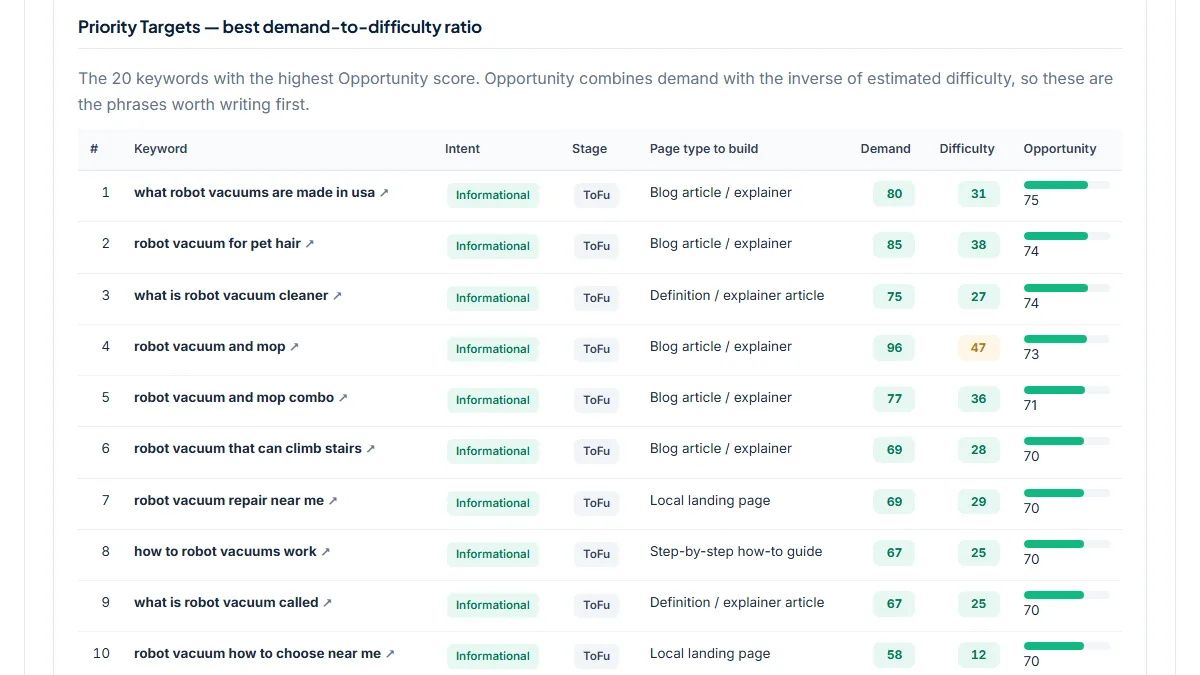
- 1,259 keyword ideas, 45 questions, 11 clusters. Intent mix: 840 Informational (66.7%), 305 Commercial (24.2%), 105 Transactional. All 20 Priority Targets are Informational, from "what robot vacuums are made in usa" (Opportunity 75) to "robot vacuum for pet hair" (Demand 85, Difficulty 38, Opportunity 74), a classic roundup topic that gets no buying label because it has no buying word. The commercial phrases appear in the clusters: Mop holds "top robot vacuum and mop" (90 / 59) and "best robot vacuum and mop" (84 / 57); Best holds 15 phrases led by "best robot vacuum for pet hair". The Wikipedia trend for Robotic vacuum cleaner peaked in December 2025 (4,622 views) and was 22% lower over the last three months than the three before: plan roundup refreshes ahead of the holiday season.
2. Best air fryer: half the top 20 are people cooking, not buying
- Situation
- A kitchen review site wants new roundup angles for air fryers. Same day, same settings.
- Input
best air fryer, English, United States, Standard- Reading the result
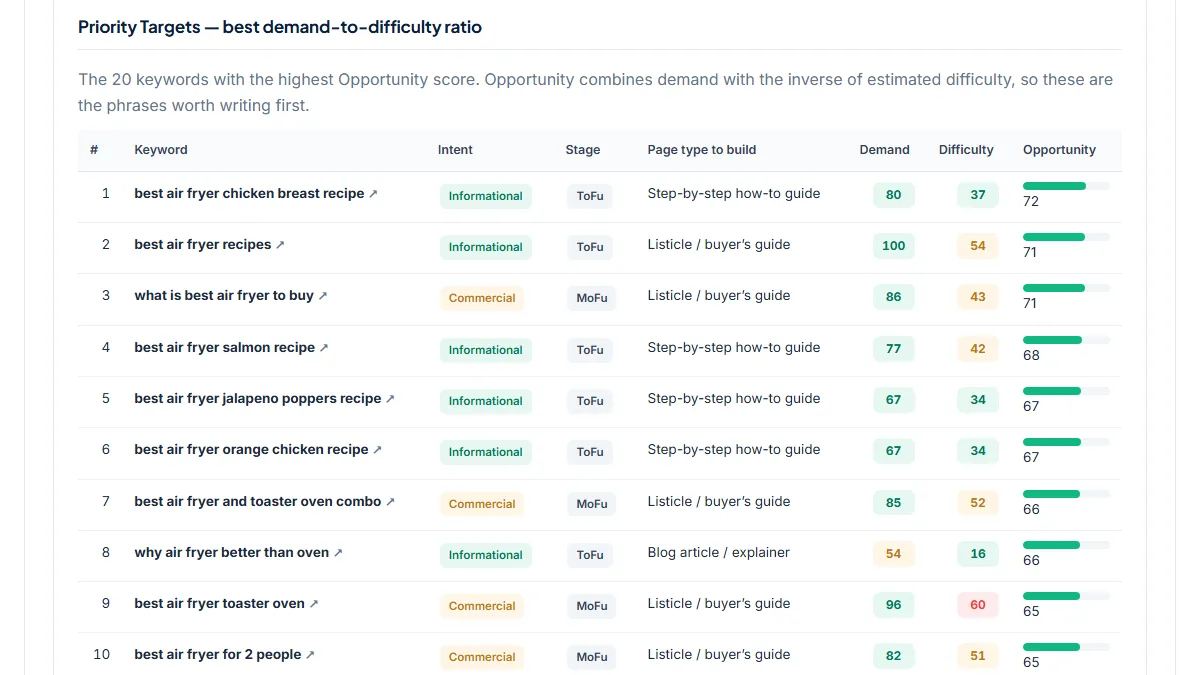
- 1,033 ideas, 806 Commercial (78%). But 10 of the 20 Priority Targets are cooking searches, labelled Informational, such as "best air fryer chicken breast recipe" (Opportunity 72). Two more, "best air fryer chicken wings" and "best air fryer chicken breast", are also cooking searches yet show Commercial, because the label sees "best" and no "recipe". The buying phrases left are clear: "what is best air fryer to buy" (86 / 43 / 71), "best air fryer and toaster oven combo" (85 / 52 / 66), "best air fryer for 2 people" (82 / 51 / 65). The Free cluster names a buying criterion for its own roundup: PFAS-free, BPA-free, teflon-free. In the Buy cluster "best buy air fryer sale" is the retailer, not a "best" query.
3. Ninja vs Cosori: a versus seed that names model-level pages
- Situation
- The same site plans comparison articles between two brands it already reviews. Same day.
- Input
ninja vs cosori, English, United States, Standard- Reading the result
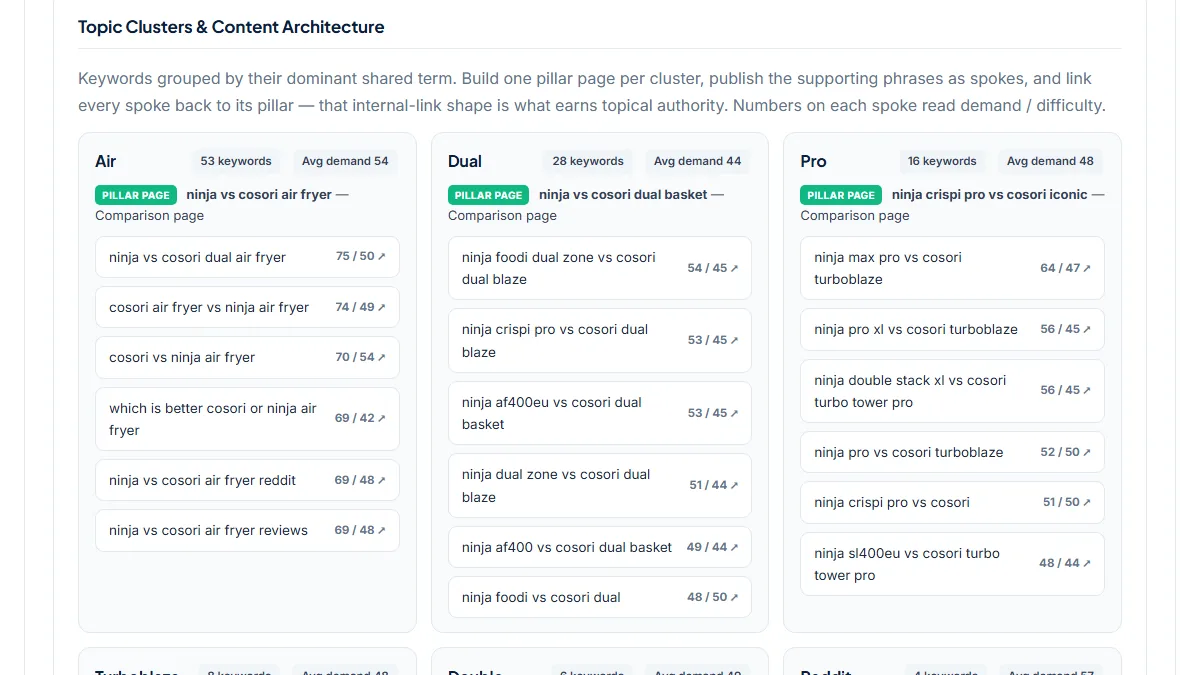
- 153 ideas, 146 Commercial (95.4%). "ninja vs cosori air fryer" has the top Demand (100, Difficulty 61). The clusters go a level deeper: Dual (28 phrases, such as "ninja foodi dual zone vs cosori dual blaze"), Pro (16, such as "ninja crispi pro vs cosori iconic", 64 / 47 / 59) and Turboblaze (8). Each is a narrower comparison to write once you have both models. Two things to filter: "ninja or cosori air fryer" (64 / 33 / 65) shows Informational because "or" is not a buying word, and the German "was ist besser cosori oder ninja" and EU codes like af400eu reach a US run anyway, because autocomplete does not keep strictly to one market.
Common mistakes
- Writing the top Priority Target first. On the "robot vacuum" run all 20 were Informational; the roundup phrases were in the Mop and Best clusters.
- Treating every phrase with "best" as a buying phrase. "best air fryer chicken wings" is a recipe search; one Google search shows recipe cards, not product lists.
- Reading Demand as search volume. It is a 0-100 index relative to the other phrases in the same run, so it cannot forecast clicks or commission.
- Planning a "vs" page for two products you have never used. Google asks reviewers to compare alternatives from first-hand experience; a keyword does not replace the test.
Frequently asked questions
How do I find commercial keywords for an affiliate site for free?
Enter a product category or a best-of phrase, set Country / market to the store you link to, and run Standard depth. Read the Intent column for Commercial rows and the Page type to build column for buyer's guides and comparison pages, then open Topic Clusters to see the buying criteria people use. Keep the phrases you can back with your own testing, and search each one on Google to confirm the results are reviews and roundups, not recipes or shops.
Is the Demand Index the same as monthly search volume?
No. It is a relative 0-100 index that SeoMods builds from autocomplete weights, position, how many engines suggest the phrase and how many expansions return it. It ranks phrases against each other inside one run and is not a count of searches. Difficulty is also an estimate: it looks at phrase length, intent and demand, never at the sites ranking. Use both to order a shortlist, then judge each phrase on the real results page.
Why does a phrase like "robot vacuum for pet hair" show Informational?
The intent label reads the words in the phrase. Buying words such as best, review, vs, compare or price, and buying questions such as "which is better" or "is it worth it", make a phrase Commercial. "robot vacuum for pet hair" has none of them, so it falls back to Informational, even though its search results are full of product roundups. Check rows like this by opening the Google link, and move them to your roundup list when the results confirm it.
Should I write a separate page for every "vs" phrase the tool finds?
Only for pairs where the search is different and you can test both products. On our "ninja vs cosori" run most phrases were rewordings of one comparison, which belong on a single page, while the Dual, Pro and Turboblaze clusters named model pairs that deserve their own article. Separate pages for near-identical wordings compete with each other. Write the main brand comparison first and link it to the model-level pages you can genuinely support.
Reference: Google's guide on how to write high quality reviews explains why the phrases you choose have to be backed by your own testing: it asks reviewers to show first-hand experience, compare products with alternatives and explain why a pick is the best.