Why Dentists need this
An implant or whitening page asks a patient to trust a stranger with surgery or with their teeth. Google files health topics under "Your Money or Your Life" and says its systems give even more weight to content with strong E-E-A-T there. Google also says E-E-A-T itself is not a specific ranking factor, so no checklist score moves rankings by itself.
What you can check is whether the page shows what Google's guidance asks about: who created the content, whether a byline exists where one is expected, and why the reader should trust it. Treatment pages are usually written once by an agency and then left alone, so the dentist's name, qualifications and sources tend to sit on the team page and never reach the page patients land on.
The E-E-A-T Analyzer reads one page and runs 11 checks in four groups: Experience, Expertise, Authoritativeness and Trustworthiness. It reports which signals it found in the markup and the main text. It does not verify a licence or judge whether the clinical content is correct; that review stays with the dentist.
Dentists specific guidance
Tips for Dentists
Start with the two critical checks, because they weigh most. "Named author / byline" looks only at markup: Person schema, rel="author", itemprop="author", a meta author tag or an element with an author or byline class. A sentence such as "Led by Dr Smith" in the copy does not pass it. On a treatment page that usually means adding a short "Reviewed by" line marked up as the author, with the reviewing dentist's name and a link to their profile.
"First-hand experience signals" looks for phrases such as "in my experience", "our experience", "we used" or "hands-on" in the main text. Dental copy rarely uses them. Don't paste them in to turn the check green. Write what the practice actually does: how many implant cases a year, which system you place, how the consultation runs.
Then open the detail lines. "Cites authoritative sources" counts every link to another site except social networks, so booking widgets and Google Maps links count as citations. Read the links behind the number. A link to the GDC register or a dental association is a source; a booking link is not. "Publish / update date" passes on a date in schema, which WordPress SEO plugins such as Yoast add to every page, so a page can pass with no date on screen.
"Author credentials / qualifications" reads wording: a Dr or Dt. title before a name, DDS, DMD, BDS, GDC, specialist, certified, years of experience and similar terms. It shows that the words are there, not that they are true.
The costliest mistake
Two misreadings are common. Practices treat the Overall Score as a Google grade; it is SeoMods' own weighting of 11 checks. And a green row is taken as proof: the tool cannot tell a real registration number from a typed one, or a sound treatment explanation from an outdated one.
Quick start
- Paste your main implant or whitening page.
- Fix "Named author / byline" first: a marked-up reviewer line naming the dentist.
- Put the dentist's qualifications and registration on the treatment page itself.
- Open the counted outbound links and add a real source if none is there.
- Re-run the page and check another treatment built on a different template.
What this tool does not tell you
- It cannot verify a licence, a GDC or state board registration or a qualification. It reads the wording, so a wrong title passes too.
- It does not judge whether the treatment information is accurate, current or in line with expert consensus. That review needs a dentist.
- It reads one page's raw HTML without running JavaScript. It does not open the team or contact pages it finds links to, and it does not read reviews on Google or other sites.
- A date in schema counts as a publish or update date even when no date is visible, and the age of the date is not checked.
Real examples
1. Implant page that names its dentist, but only in the copy
- Situation
- A family practice in Mona Vale, Australia, with a dedicated implants page. We ran it on 8 November 2026; the practice's teeth whitening page returned exactly the same result.
- Input
https://parkstdental.com.au/dental-implants/- Reading the result
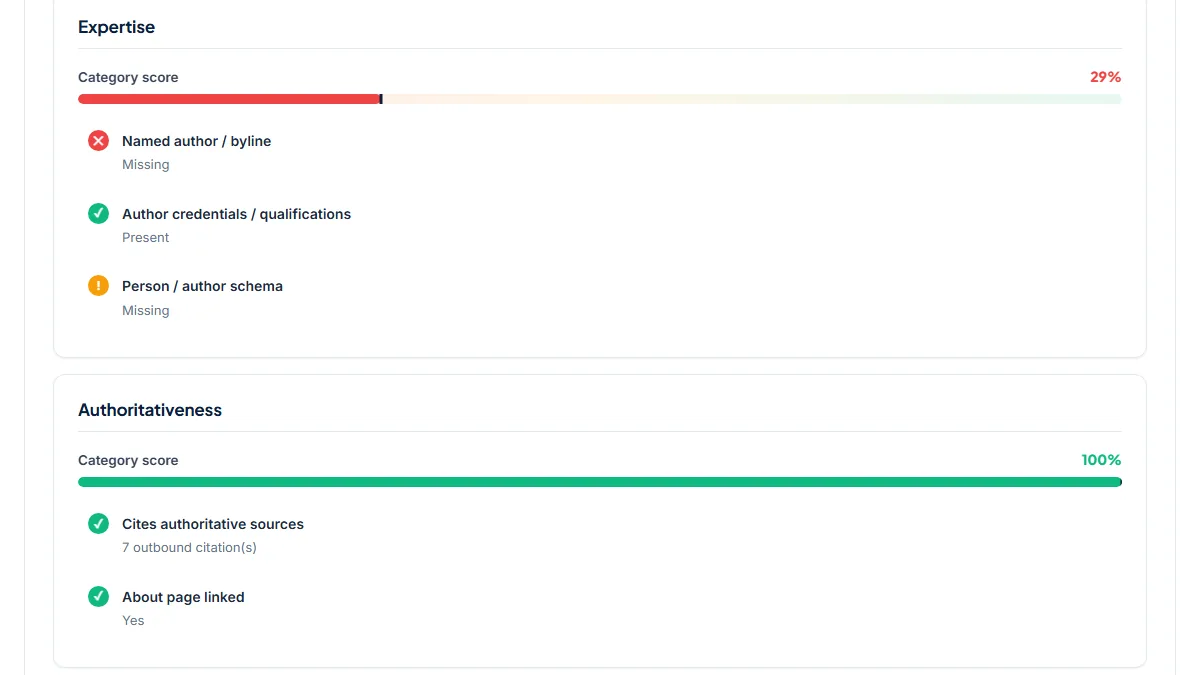
- Overall Score 62, Health Score 73% (8 of 11 checks passed). Experience 27, Expertise 29, Authority 100, Trust 100. The copy says the treatment is led by Dr Neda Gorji, "who holds postgraduate qualifications in dental implantology", so credentials pass. But "Named author / byline" is Missing (critical) and Person schema is Missing, although the page already carries Dentist and AggregateRating schema. The 7 outbound citations are 5 online-booking links, a Google Maps link and a review request: none is a source. The fix is markup and one real reference, not new copy.
2. Short implants and veneers page with no dentist on it
- Situation
- A general practice in Fort Worth, Texas, with one page covering implants and veneers. Same day.
- Input
https://bellasmilesdental.com/dental-services/implants-veneers/- Reading the result
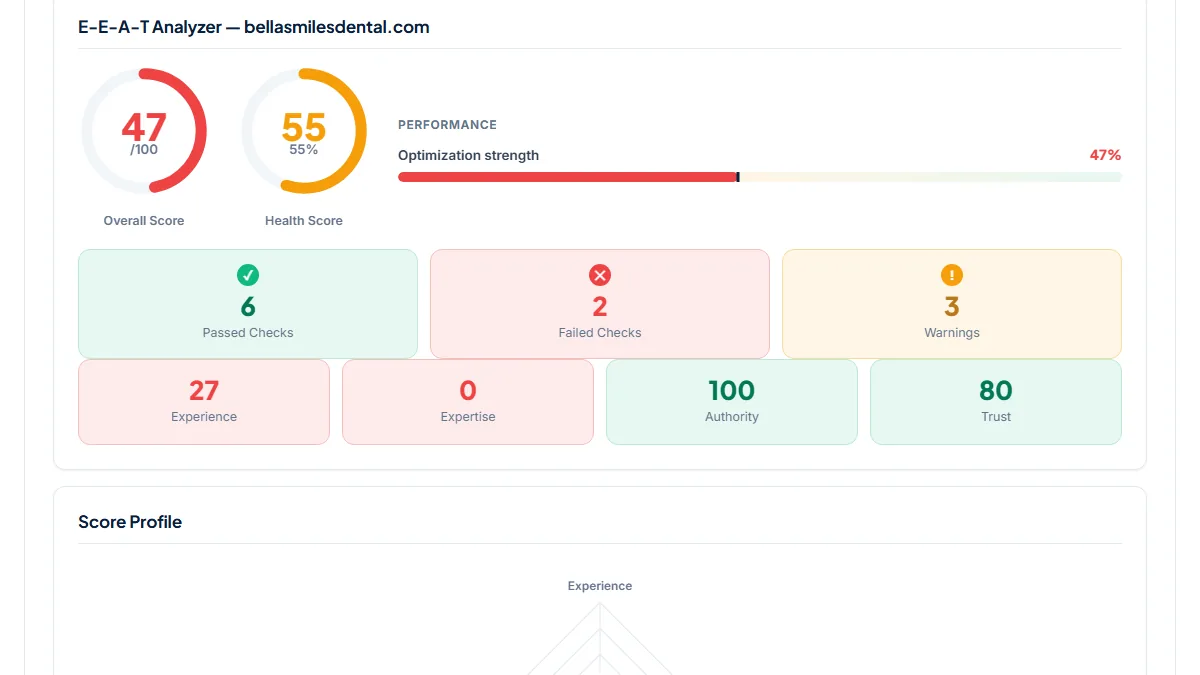
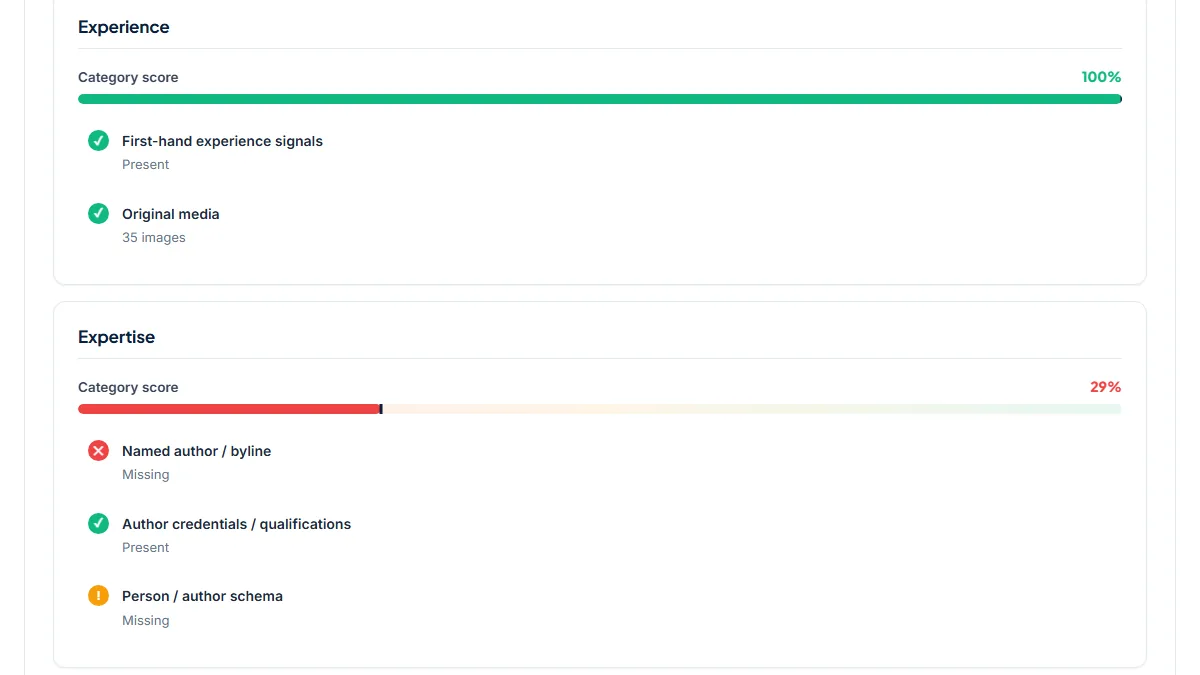
- Overall Score 47, Health Score 55%. Expertise 0: no byline, no credential wording and no Person schema in 218 words of main text. The page quotes the American Academy of Cosmetic Dentistry's definition of a veneer but does not link it, so the quote is not counted; the 3 counted citations are two booking links and Google Maps. Reviews / testimonials is Missing because the reviews sit on a separate page linked from the menu. The date passes on a schema date from 2018. A "Meet Your Dentist" link in the menu counts as the About page.
3. Whitening page with registration numbers and a GDC register link
- Situation
- A cosmetic practice in central London, treatment page for teeth whitening. Same day.
- Input
https://www.harleystreetdentalstudio.com/teeth-whitening/- Reading the result
- Overall Score 68, Health Score 73%. Experience 100 ("from our experience on Harley Street" is in the copy), Expertise 29, Authority 100, Trust 67. The page names Dr Adam Thorne with over 20 years of experience, lists GDC registration numbers and links to the GDC online register. The tool counts that link as one outbound citation; it cannot open the register or confirm the number. "Named author / byline" is still Missing, and "Publish / update date" is Missing: there is no date in the markup at all.
Common mistakes
- Reading the Overall Score as Google's verdict on the page. It is SeoMods' weighting of 11 checks, and Google says E-E-A-T is not a ranking factor by itself.
- Assuming the dentist's name in the text counts as a byline. The byline check reads markup only, so "Led by Dr …" in a paragraph still leaves it Missing.
- Trusting the citation count. Booking widgets, Google Maps and review-request links all count; a source you quote without a link does not.
- Adding "we tested" or "hands-on" to turn Experience green. Patients read that copy too; real case numbers and the treatment process are the experience.
Frequently asked questions
Is the E-E-A-T score what Google uses to rank dental pages?
No. The score is SeoMods' own weighting of 11 checks. Google says E-E-A-T itself is not a specific ranking factor, though its systems give more weight on health topics to content that shows strong E-E-A-T, and its quality raters have no say over rankings. Use the score to find missing signals on a treatment page and the checks to decide what to add. A higher number is not a promise of a higher position.
Our dentist is named on the page. Why is "Named author / byline" Missing?
Because the check reads markup, not sentences. It passes on Person schema, a rel="author" or itemprop="author" link, a meta author tag, or an element whose class contains author or byline. A name inside a paragraph does not match any of them. A short "Reviewed by Dr …" line, marked up as the author and linked to the dentist's profile page, is the usual way to show patients and search engines who stands behind a treatment page.
Can it check our GDC or state licence number?
No. It sees text and links, nothing else. "GDC" and dental degrees such as DDS, DMD or BDS count as credential wording, and a link to the GDC register counts as an outbound link, but the tool never looks up a register. If you publish a registration number, link it to the official register entry so patients can check it themselves, as the London whitening page in our third example does.
Should every treatment page be tested, or is the homepage enough?
Test the treatment pages patients land on from search, starting with high-value ones such as implants. Pages built on one template often score the same: the Mona Vale practice's implants and whitening pages gave identical results, because menu, footer and schema are shared. The homepage tells you little about a treatment page. When one template is fixed, re-run one page from each different layout on the site.
Reference: Google's guide to creating helpful, reliable, people-first content explains how E-E-A-T is used on health topics, says it is not a specific ranking factor, and lists the questions this check is built around: who created the content, whether a byline exists where one is expected, and whether it leads to more about the author.