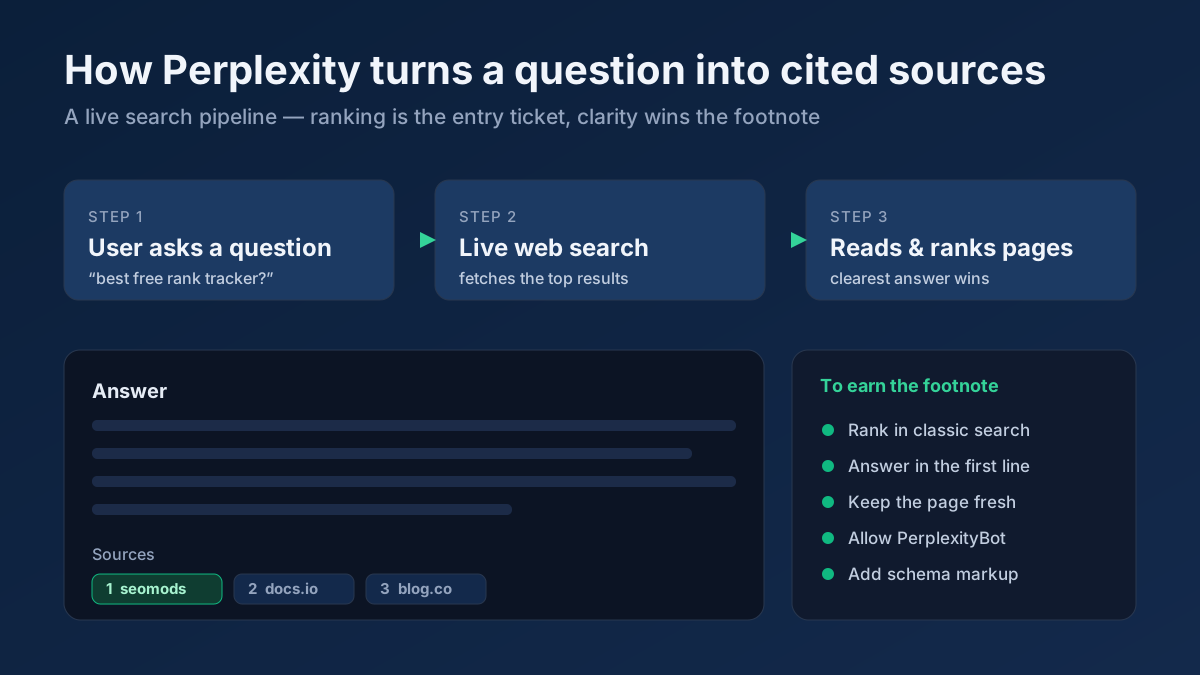
Short answer: Perplexity does not have a fixed ranking list you can climb. For every question it runs a fresh web search, reads the strongest pages it finds, and writes an answer with numbered footnotes pointing back to those pages. So to get cited you need three things at once: rank near the top of a normal web search for the query, let Perplexity’s crawlers fetch your page, and write passages that are so clear and verifiable that the model wants to quote you. This guide walks through each of those in order, with concrete steps you can apply today.
What Perplexity actually is and why it is different
Perplexity AI is an answer engine, not a chatbot with a frozen memory and not a classic search engine that hands you ten blue links. When you type a question, it behaves more like a fast research assistant: it interprets your intent, issues one or more live web searches, pulls the top candidate pages, extracts the readable text from each, and then uses a language model to synthesize a short, direct answer. Crucially, it attaches inline numbered citations — little footnote markers — next to the sentences that came from a source, and lists those sources beside the answer. Click a footnote and you land on the page it drew from.
Under the hood Perplexity runs its own family of models it calls Sonar, and it can route harder questions to larger reasoning models, but you do not need to know the model internals to rank. What matters is the behavior: every answer is grounded in pages fetched at query time. The model is discouraged from inventing facts because it is instructed to answer from the documents it just retrieved. That single design choice changes everything about how you optimize. You are not trying to please a static algorithm that learned your site months ago; you are trying to be one of the handful of live pages the engine reads at the exact moment someone asks your question.
Why classic search ranking is your entry ticket
Here is the part most people miss. Because Perplexity leans on live search results to decide which pages to read, the candidate set it pulls from is essentially the top of a real search engine result page. If your page is not visible in that first screen of organic results for a query, Perplexity usually never fetches it, never reads it, and therefore can never cite it. The AI layer sits on top of ordinary search — it does not replace the ranking work, it depends on it.
That is genuinely good news, because it means your existing SEO fundamentals are not wasted. Title tags that match intent, a fast server-rendered page, a sensible internal link structure, real backlinks and topical depth all still do the heavy lifting of getting you into the candidate pool. The difference is what happens after you are in the pool: a page that ranks fifth but states the answer with surgical clarity can get cited ahead of a page that ranks second but buries its answer under fluff. So the workflow is two-stage — first earn ranking, then earn the citation. Start by baselining the page with a full On-Page SEO Audit so you know whether it is even fetchable and technically sound before you worry about extraction.
If you want the broader strategic picture of how AI answer engines and traditional search now interact, our explainer on how GEO differs from and builds on SEO lays out the whole landscape. The one-line takeaway: GEO is not a replacement discipline, it is a layer you add on top of solid SEO.
Let Perplexity crawl and fetch you: robots.txt and bots
None of the content work matters if you block the engine at the door. Perplexity uses two distinct user agents, and they do two different jobs, so treat them separately:
- PerplexityBot is the indexing crawler. It discovers and stores pages so they can surface as citable sources. If you want to appear in Perplexity answers at all, this bot must be allowed to crawl the URLs you care about.
- Perplexity-User is the live fetcher. When a user’s question triggers a visit to a specific page in real time, this agent retrieves it. Blocking it means that even a page Perplexity knows about cannot be read fresh to answer a live query.
Check your robots.txt and make sure neither agent is disallowed, and that no blanket User-agent: * block accidentally sweeps them up. Also confirm your firewall, CDN or bot-management rules are not silently returning a 403 to these agents — a lot of “why am I invisible” cases come down to an over-eager WAF, not robots.txt. Here is a minimal allow pattern you can adapt:
User-agent: PerplexityBotthenAllow: /User-agent: Perplexity-UserthenAllow: /
One more technical trap: most AI fetchers, Perplexity included, do not run JavaScript reliably. If your main content only appears after a client-side render, the fetcher may see an almost-empty shell. Serve the actual words in the initial HTML through server-side rendering, static generation or prerendering, then verify by viewing raw source. For the full crawler-permission reference, see our guide to optimizing your whole site for AI search
Structure content so the model can extract it
Once you are fetchable and ranking, the game becomes extraction. A language model reads your page as chunks of text and tries to find the passage that most directly answers the question. Your job is to make that passage impossible to miss. The single most effective habit is answer-first writing: open every section with a one or two sentence conclusion, then expand underneath. Do not warm up for three paragraphs before you say the thing. If the question is how long a meta description should be, the first sentence of that section should state the number.
Concretely, follow these principles:
- Put a 40 to 60 word standalone summary right after each heading. It should make sense quoted with zero surrounding context, because that is exactly how it will be lifted into an answer.
- Write headings as real questions or precise noun phrases. The engine maps a natural-language query onto your headings, so
How much does Perplexity Pro cost?beats a vaguePricing. Keep one H1, use real H2 and H3 tags, and never skip levels. - Use genuine structural HTML. Real
<ul>,<ol>and tables — not bold text pretending to be a heading. Extractors chunk your page by these tags. - Keep passages short and self-contained. Dense, single-idea paragraphs are far more quotable than long ones that braid three thoughts together.
Before publishing, run the page through the Heading Structure Analyzer to confirm the outline is clean, hierarchical and free of skipped levels — a messy heading tree is one of the most common reasons an otherwise strong page gets passed over. If you want to see how these passages surface in traditional results too, check which SERP features your target query triggers, because featured-snippet-shaped content is also the content Perplexity finds easiest to quote.
Cite your own sources and use precise, verifiable facts
Perplexity is optimizing for trust. Its whole value proposition is that its answers are backed by sources, so it prefers to cite pages that are themselves well-sourced and specific. Vague copy is hard to quote and risky to repeat; specific copy with numbers, named entities, units and dates is low-risk and quotable. Replace compression can significantly shrink files with GZIP typically reduces HTML and CSS by 60 to 80 percent. Replace recently updated with updated in June 2026.
Then go one step further and cite where your own facts come from. Link out to the primary study, the official documentation, the original data. This feels counterintuitive — why send people away? — but it signals to the engine that your claims are checkable, and checkable claims are exactly what a citation-driven system wants to attach its name to. Never invent a statistic to sound authoritative; if a fabricated number gets cross-checked against the real source, you lose the trust you were trying to build, and Perplexity is unusually good at surfacing contradictions between sources.
Consistency across your own site matters too. Perplexity forms a picture of who you are by reading more than one page. If your product name, founding date or core definitions drift from page to page, you introduce contradictions that lower confidence in everything you publish. Pick canonical facts and repeat them verbatim.
Freshness and recency signals
Because Perplexity searches live, recency carries real weight, especially for anything time-sensitive: pricing, versions, statistics, best-of lists, news-adjacent topics. A page dated this month, with content that visibly reflects the current state of the world, is more likely to be chosen than a stale one that ranks slightly higher. Practical moves that help:
- Show a genuine, accurate last-updated date and keep it honest — refresh the actual content when you bump the date, do not fake it.
- Attach explicit dates to time-sensitive claims inside the body text, not just in metadata, so the extracted passage carries its own timestamp.
- Re-audit and update your cornerstone pages on a schedule. A quarterly content refresh keeps you in the fresh candidate pool.
- Use
ArticleorBlogPostingstructured data with accuratedatePublishedanddateModifiedfields. Generate valid markup fast with the Schema (JSON-LD) Generator rather than hand-writing JSON-LD.
Perplexity Pages and being referenced across the web
Perplexity Pages lets users and creators publish curated, shareable answer articles built from Perplexity searches. These pages are themselves indexable and can rank, so a well-made Page on a topic you own is another surface where your brand and links can appear. More broadly, though, the strongest lever is off-page: being referenced across the wider web. When multiple independent sites mention your brand, your data or your definitions, you become an entity the model recognizes and trusts, and you show up in the search results Perplexity reads from more queries.
This is where classic authority-building and GEO converge. Digital PR, being quoted in roundups, earning links from topically relevant sites, and getting your statistics cited elsewhere all increase the odds that Perplexity encounters corroborating references to you. Use the keyword research tool to find the exact questions people ask in your niche, then make sure you have a genuinely best-in-class page answering each one — that is what earns both the ranking and the third-party mentions that reinforce it.
Get into the pages Perplexity actually reads
Everything so far rolls up into one blunt requirement: be at the top of the normal search results for your target query. Perplexity overwhelmingly reads from the first handful of results. If you are on page two of a conventional search, you are effectively invisible to the answer engine no matter how quotable your content is. So prioritize the queries where you already rank on the cusp of the top — positions three through eight — and push them up, because small ranking gains there translate directly into citation opportunities.
Target long-tail, question-shaped queries first. They are lower competition, they match how people actually phrase things to an answer engine, and a focused page can rank for them quickly. Our deep dive on ranking in Google’s AI Overviews covers the same top-of-results dynamic for Google’s AI layer, and most of the wins transfer directly to Perplexity because both systems read from live search.
Test and measure whether Perplexity cites you
You cannot improve what you do not measure, and Perplexity gives you two practical feedback loops. First, test directly: open Perplexity and ask the exact questions your target audience asks in your niche. Watch the numbered citations. Are you there? Which competitors are cited instead, and what did their passage say that yours did not? This manual probing, done on a rotation of your priority queries, is the fastest qualitative signal you have.
Second, measure referral traffic. When someone clicks a Perplexity citation, your analytics records a referral from perplexity.ai. Set up a segment or filter for that referrer and track it over time — a rising line means your citation footprint is growing. Follow these steps:
- Build a list of 15 to 30 priority questions in your niche and record, for each, whether Perplexity currently cites you.
- In your analytics, create a referral segment for
perplexity.aiand note the current baseline of sessions and landing pages. - Apply the fixes in this guide to the pages that should answer those questions — answer-first passages, dates, sources, clean headings.
- Re-run the manual citation check every few weeks and watch the referral segment for movement.
- Double down on the pages that start earning citations, and rework the ones that still get skipped.
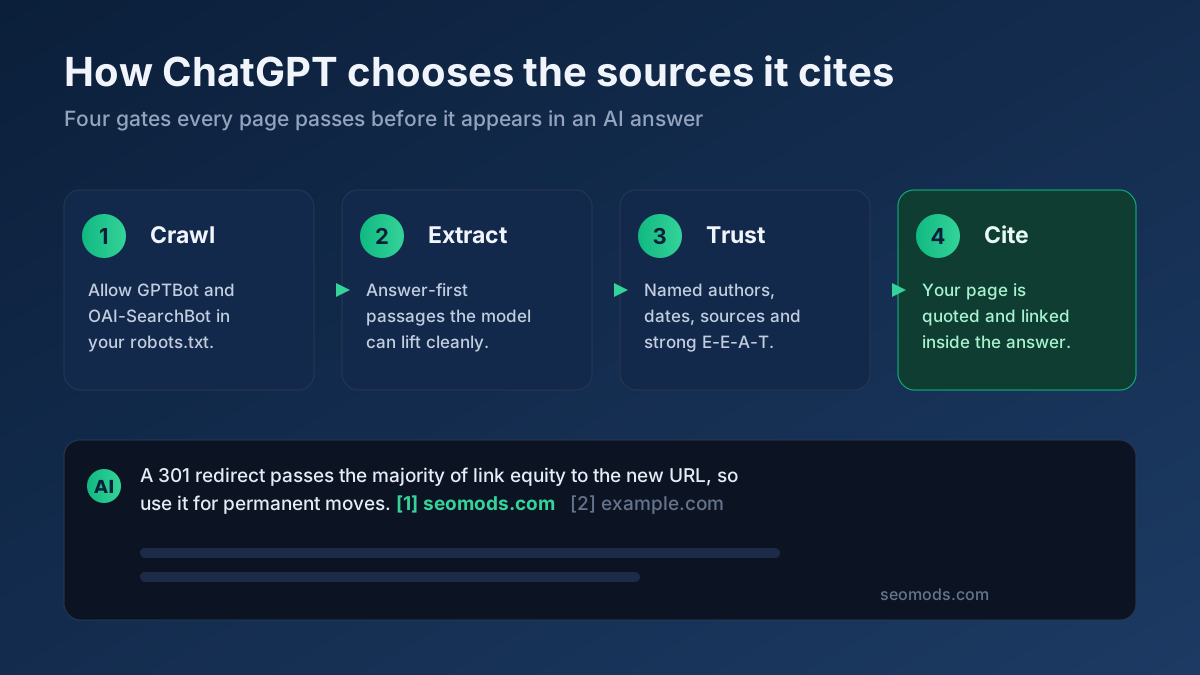
For a complementary playbook aimed at the other big answer engine, our guide to getting cited by ChatGPT shares the same measure-and-iterate loop, and the two efforts reinforce each other because the underlying content quality signals overlap heavily.
Common mistakes that keep you out of the answers
Most failures are avoidable and fall into a short list. Watch for these:
- Blocking the bots. A stray
Disallowor an aggressive WAF that 403s PerplexityBot or Perplexity-User. Check this first, always. - JavaScript-only content. If the words are not in the raw HTML, the fetcher may read nothing. Server-render your content.
- Burying the answer. Long introductions before the point. Lead with the conclusion; expand afterward.
- Vague, undated claims. No numbers, no sources, no dates. These are hard to quote and easy to distrust.
- Chasing head terms you cannot rank for. If you are not top-of-results, you are not in the reading pool. Win the winnable long-tail queries first.
- Ignoring measurement. Not testing your queries in Perplexity and not tracking the
perplexity.aireferral means you are optimizing blind. - Thin, contradictory site facts. Inconsistent definitions and names across pages erode the trust the engine needs to cite you.
Applying this to your own site? See the tools picked by audience: SEO Tools for Freelance SEOs and SEO Tools for Marketing Agencies.
Frequently asked questions
Does Perplexity have a ranking algorithm I can optimize for directly?
Not in the classic sense. There is no fixed index position to climb inside Perplexity. It runs a live web search per query and reads the top results, so you optimize indirectly: rank well in normal search, stay fetchable, and write passages that are clear and verifiable enough to be quoted.
How do I let PerplexityBot and Perplexity-User access my site?
In robots.txt, make sure neither PerplexityBot (the indexer) nor Perplexity-User (the live fetcher) is disallowed, and confirm your CDN or firewall is not returning a 403 to them. Both agents need access: one to discover your pages, the other to read them in real time when a question triggers a visit.
Why does Perplexity cite competitors instead of me even though I rank?
Usually because their passage answers the question more directly. Ranking gets you into the reading pool, but the citation goes to the page that states the answer first, backs it with specifics and dates, and is easy to extract. Rewrite your relevant section answer-first and add concrete, sourced facts.
How can I tell if Perplexity is sending me traffic?
Check your analytics for referrals from perplexity.ai. Clicks on Perplexity citations show up under that referrer. Create a dedicated segment or filter for it, note a baseline, and watch whether the line rises after you apply content and structure fixes.
Do I need structured data to get cited by Perplexity?
It is not strictly required, but it helps by removing ambiguity about your content, authorship and dates. Article, FAQPage and Organization schema are the highest-value types. The bigger wins are still ranking, fetchability and quotable, well-sourced passages.
How long does it take to start getting cited?
It depends on whether you already rank. If your page is fetchable and near the top of results, tightening it into answer-first, well-dated, well-sourced passages can produce citations within weeks. If you first have to earn the ranking, expect the normal SEO timeline of a few months before the AI layer follows.