Why News Publishers need this
Google's news policies say that sources on its news surfaces should provide clear dates and bylines and information about the authors. On most news sites that information lives in one place: the staff profile a byline links to. A newsroom can have hundreds of those pages, built from a CMS template years ago and rarely opened since. Reporters leave, desks get renamed, URL patterns change, and nobody checks whether the page behind a byline still says who the person is.
The Author Page Audit reads one profile URL and scores seven signals in three groups: a photo and Person schema (Identity), bio length and stated credentials (Bio & Credibility), and profile links, links to the reporter's stories and outbound links (Authority Signals). The 0-100 Author E-E-A-T score is SeoMods' own criterion, not a Google score or a Google News eligibility test. Run it on a sample of profiles, one desk at a time, and you will find where the template itself leaves gaps rather than any single reporter.
News Publishers specific guidance
Which pages to test
Start from a story, not from the staff directory. Open three recent articles from different desks, click each byline and copy the address you land on. That tells you two things the tool cannot: whether the byline is a link at all, and which URL it really points to. Profile URLs move: on 9 November 2026 a Texas Tribune staff URL redirected to its /author/ page, which is fine, while a Guardian and an NPR profile URL we tried both answered 404. The tool follows redirects and puts a warning above the result when the page answers with an error code such as 404. Include one profile of a reporter who has left, because their bylines stay on archive stories long after they go.
How to read the seven checks on a newsroom template
Read the result for what the template does, then for what the reporter wrote. Bio words is not a bio detector: it counts words inside the page's first <main> area. On a template that lists stories inside <main>, headlines and excerpts pass the 60-word mark with no bio at all; on a template that puts the bio above <main>, the bio is not counted. Profiles linked counts X, LinkedIn, Facebook, Instagram, YouTube or GitHub links anywhere on the page, so the outlet's own accounts in the header or footer pass it. Credentials matches words such as editor, founder, award or years of experience; titles like correspondent, reporter or media writer are not on the list. Person schema passes on any Person node in the JSON-LD, without checking which properties it has. Open the page source and read the Person block yourself.
Fix the template, then the people
Most gaps repeat across every profile, so fix them once in the template. Output a ProfilePage or Person block with the name, job title, image, a short description and a sameAs array of the reporter's own accounts, then check it with the Schema Checker. Show the reporter's own social links next to the bio, not only the outlet's. Then work through the people: a bio of a few sentences naming the beat, the years on it and earlier newsrooms, a headshot, and a list of recent stories. For staff who have left, keep the page and switch the bio to the past tense rather than deleting it, so archive bylines still lead somewhere.
What this tool does not tell you
- It reads one profile per run and never opens a story, so it cannot tell you whether bylines link to the profile or whether article markup names the author.
- It reads the HTML as served and does not run JavaScript, so a profile whose bio or story list loads in the browser may score lower than readers see.
- It checks that signals exist, not that they are true: a credential word is not a verified credential, and the score is not a Google News eligibility check.
Real examples
1. ProPublica: a full bio, but no Person markup
- Situation
- An investigative newsroom's profile of an assistant managing editor. We ran it on 9 November 2026.
- Input
https://www.propublica.org/people/jesse-eisinger- Reading the result
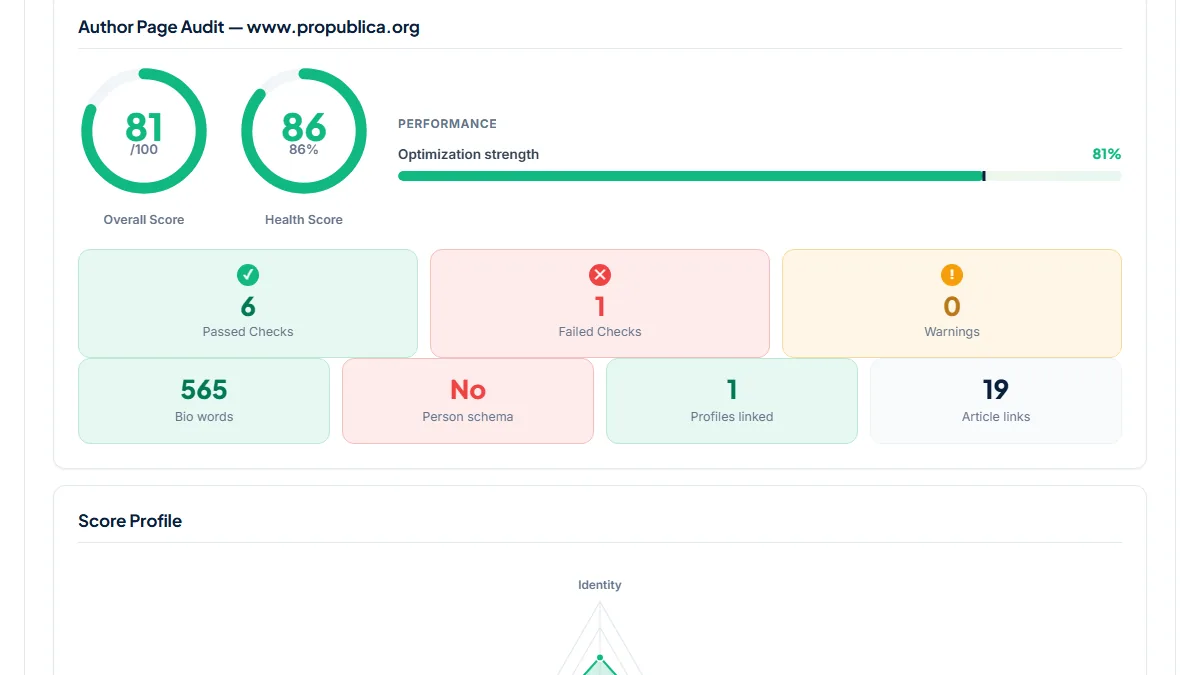
- 81/100, 6 of 7 checks passed. Bio words 565: a long bio naming the Pulitzer Prizes, a book and earlier jobs, plus the story list below it. Credentials passed (editor, author of), Profiles linked 1 (his own X account), Article links 19, 8 outbound links. The one failure is Person schema: the JSON-LD declares the page as a WebPage with no Person node. Everything a reader needs is on the page; the template just doesn't say in markup that the page is about a person. One template change fixes it for every staff page.
2. The Texas Tribune: high score, two passes worth a second look
- Situation
- A former political correspondent's profile on a nonprofit state newsroom. Same day; the old /about/staff/ URL redirected to /author/patrick-svitek/.
- Input
https://www.texastribune.org/about/staff/patrick-svitek/- Reading the result
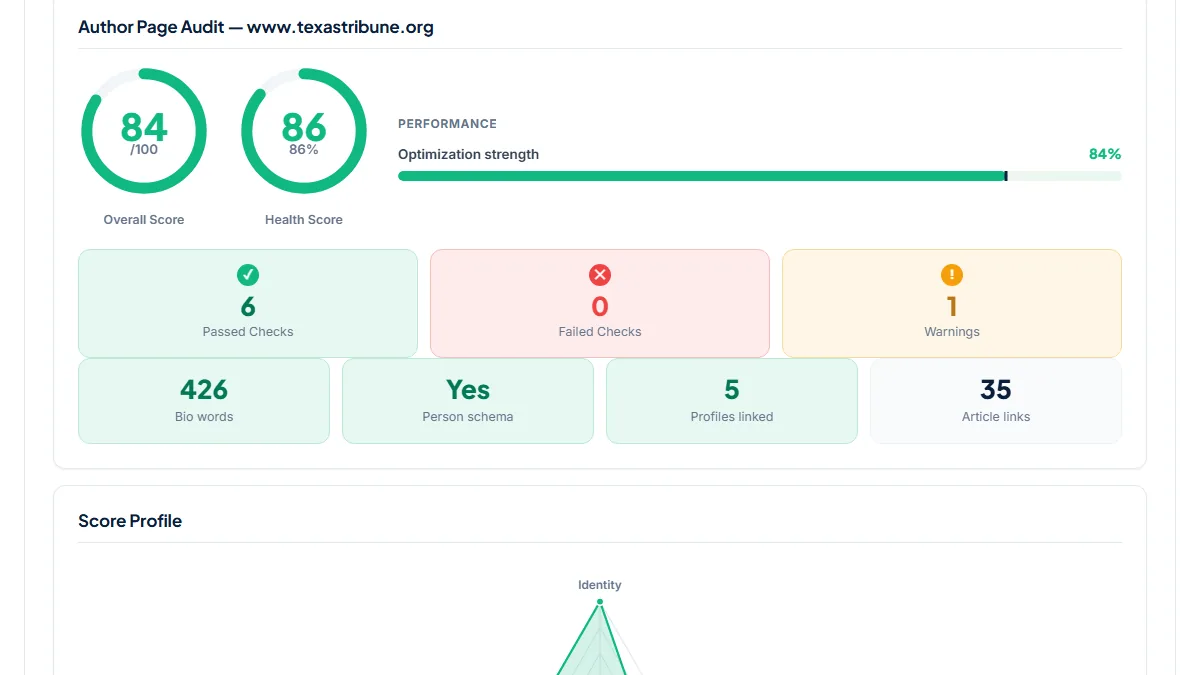
- 84/100, Person schema Yes (a Person node with name, image and description, but no sameAs or job title). Bio words 426, but those are story headlines and excerpts inside <main>; the real bio, 55 words above it, is not counted. Profiles linked 5: all five are the Tribune's own accounts in the footer. Credentials is the one warning, because "correspondent" and a journalism degree are not on the word list. The bio itself is good and written in the past tense for a reporter who has left; the gaps to fix are sameAs and the reporter's own profile links.
3. AP News: "0 bio words" on a page that shows a bio
- Situation
- A wire service profile of a media writer who retired in May 2026. Same day.
- Input
https://apnews.com/author/david-bauder- Reading the result
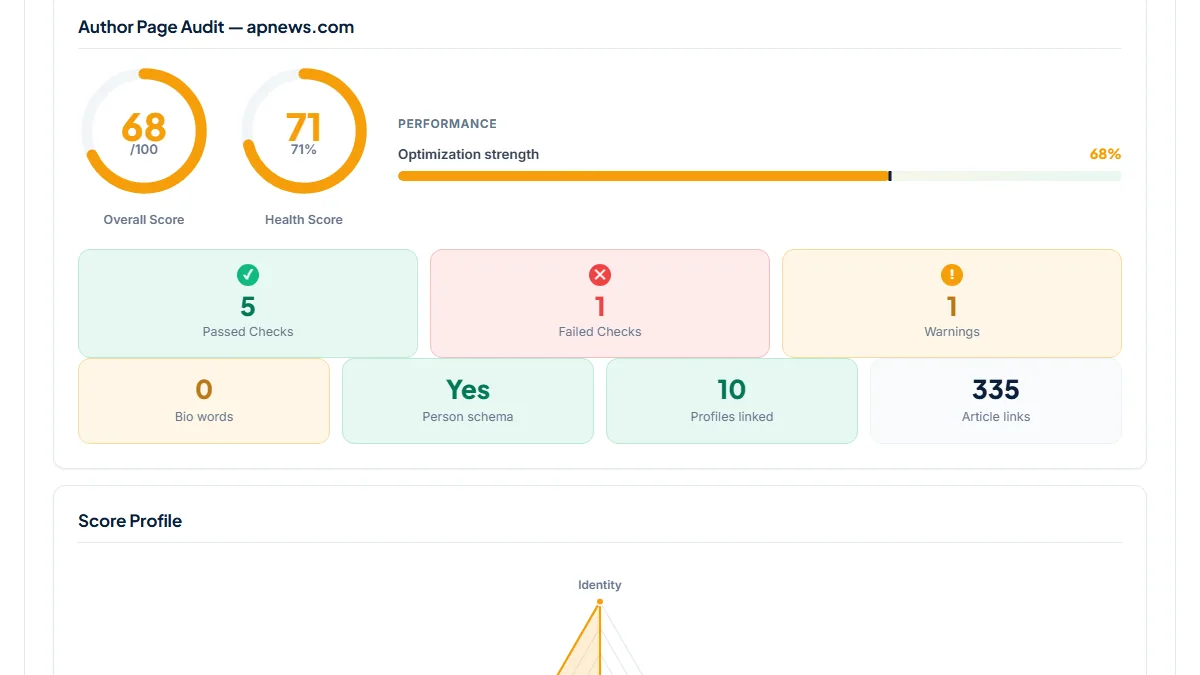
- 68/100. Person schema Yes: a ProfilePage whose mainEntity is a Person with a description and a sameAs link to his X account, the strongest markup of the three. Bio words 0, because the one-sentence bio (20 words) sits above <main> and the story list inside it is wrapped in a search form, which the tool skips. Profiles linked 10: one is his, nine are AP's own accounts. Article links 335. The 0 is a template artefact, but the conclusion stands: one sentence is a thin bio for a reporter with a long career at the wire.
Common mistakes
- Pasting a story URL. The tool reads one profile page and does not look at bylines. Click the byline yourself and test the page it opens.
- Trusting Profiles linked on a newsroom page. The outlet's own X, Facebook and Instagram links in the footer count. Look for the reporter's own accounts next to the bio.
- Reading Bio words as bio length. It counts the main content area, so story lists inflate it and a bio placed above it can show 0. Read the bio itself.
- Deleting profiles of staff who left. Their bylines stay on archive stories. A past-tense bio keeps those bylines pointing to a real page instead of a 404.
- Fixing one reporter at a time. Missing Person markup or missing personal links usually come from the template. Test three desks, then fix the template once.
Frequently asked questions
Does Google News require author pages or Person schema?
Google's news policies ask for clear dates and bylines and for information about the authors, publication and publisher; they do not prescribe a profile template or Person markup. A profile page is the usual way to give that author information, and Person markup is a clear machine-readable way to describe who the page is about. Treat the Person schema check as a recommendation, and read the policy page itself for what Google asks of publishers.
What should a journalist's profile page include?
Readers want to know who wrote the story and why they can trust it. Give the full name, job title and beat, a headshot, a bio of a few sentences with years on the beat and earlier newsrooms, contact or tip information, the reporter's own social accounts, and a list of recent stories. In markup, a ProfilePage or Person block with name, jobTitle, image, description and sameAs mirrors what the page shows. Keep what the page says and what the markup says the same.
What should happen to a profile when a reporter leaves?
Keep it live. The reporter's bylines stay on every archive story, and those links should still lead to a page that says who wrote the piece. Rewrite the bio in the past tense with the years they worked at the outlet, as the Texas Tribune and AP pages in our examples do, and keep the story list. Deleting the page or changing the URL pattern without redirects turns those byline links into 404s, which this tool flags above the result.
Why does the audit show a low bio word count when the page has a bio?
Bio words counts the words inside the page's first main content area and skips forms, menus, sidebars and footers. Many newsroom templates put the bio in a header above that area, so it is not counted, as on the AP page where the count was 0. The opposite also happens: a story list inside the main area can pass the 60-word mark with no bio at all. Use the number as a pointer and read the bio yourself.
Reference: Under "Transparency", Google News policies list what news sources on Google should provide: clear dates and bylines, information about the authors, the publication and the publisher, and contact information. A profile page behind every byline is where most newsrooms give the author part of that.