
Every modern search and answer system runs the page through the same basic machinery first: segment it, find the entities, work out the intent. This tool reports what that machinery sees. It is a diagnostic rather than a scorecard, and its usefulness is in explaining results the other tools only describe — a page that keeps scoring badly for reasons nobody can name usually turns out to be hard to parse in some specific, fixable way.
Here is where that sits. The median SeoMods score is 65/100, which ranks it 9 of the 25 tools with a published benchmark by median. The ranking runs over the 25 tools on the main benchmark page; 1st is the highest median. The middle half of results falls between 50 and 74 — a band 24 points wide. That is wide: in this sample sites’ scores diverge markedly on this measure.
How the scores are distributed
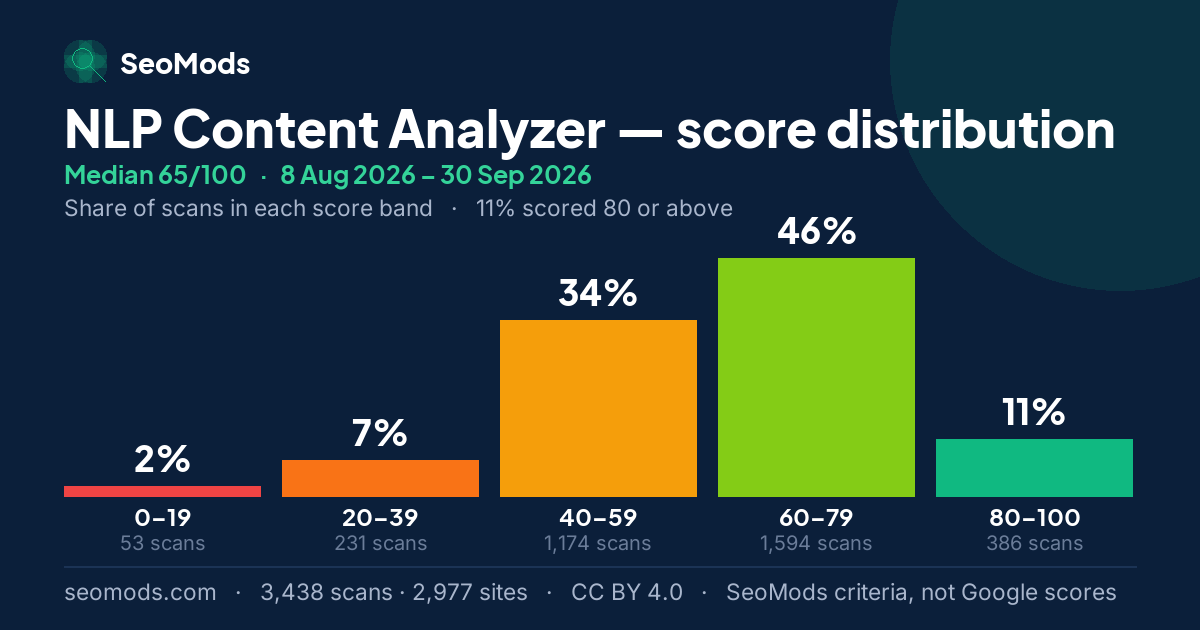
An average on its own misleads. The chart below splits all 3,438 scans into five score bands, totalling 100%. Most results sit in the middle bands, which means sites differ here by degree rather than by whether they bothered at all.
- 0–19
- 20–39
- 40–59
- 60–79
- 80–100
| Score band | NLP Analysis |
|---|---|
| 0–19 | 2% · 53 |
| 20–39 | 7% · 231 |
| 40–59 | 34% · 1,174 |
| 60–79 | 46% · 1,594 |
| 80–100 | 11% · 386 |
| Total runs | 3,438 |
The grade mix
The same data as letters: A+ 95–100, A 85–94, B 75–84, C 65–74, D 50–64 and F below 50.
Where does my score sit?
Read this as a legibility measure, not a quality one. A high score means the processing layer sees your page clearly: the sentences resolve, the entities are identifiable, the structure signals intent. It says nothing about whether what it sees is any good — but a page the machinery cannot parse cleanly will underperform regardless of how good it is.
| Tool | P10 | P25 | Median | P75 | P90 | Mean | Lowest | Highest |
|---|---|---|---|---|---|---|---|---|
| NLP Analysis | 41 | 50 | 65 | 74 | 85 | 61.3 | 0 | 100 |
A score from the NLP Content Analyzer can be read against the five values below. All of them are calculated from the scans in this benchmark: they place a SeoMods score within this sample, not in Google’s results.
| Percentile | Score | What it means for a score |
|---|---|---|
| P10 | 41 | About one scan in ten scored 41 or lower. Below it, a page is in the lowest tenth of this sample. |
| P25 | 50 | The edge of the bottom quarter. A score under 50 is below about three quarters of the scans. |
| Median | 65 | The middle of the sample: half the scans scored lower, half higher. A score of 65 is the typical result here. |
| P75 | 74 | Where the top quarter begins. A score of 74 or more is at or above about three quarters of the scans. |
| P90 | 85 | Where the top tenth begins. A score of 85 or more is among the highest 10% of scans in this sample. |
Percentiles describe the sites SeoMods scanned, not the whole web, and they apply to this tool only: the same number on another tool sits somewhere else.
The SeoMods checks most often unmet
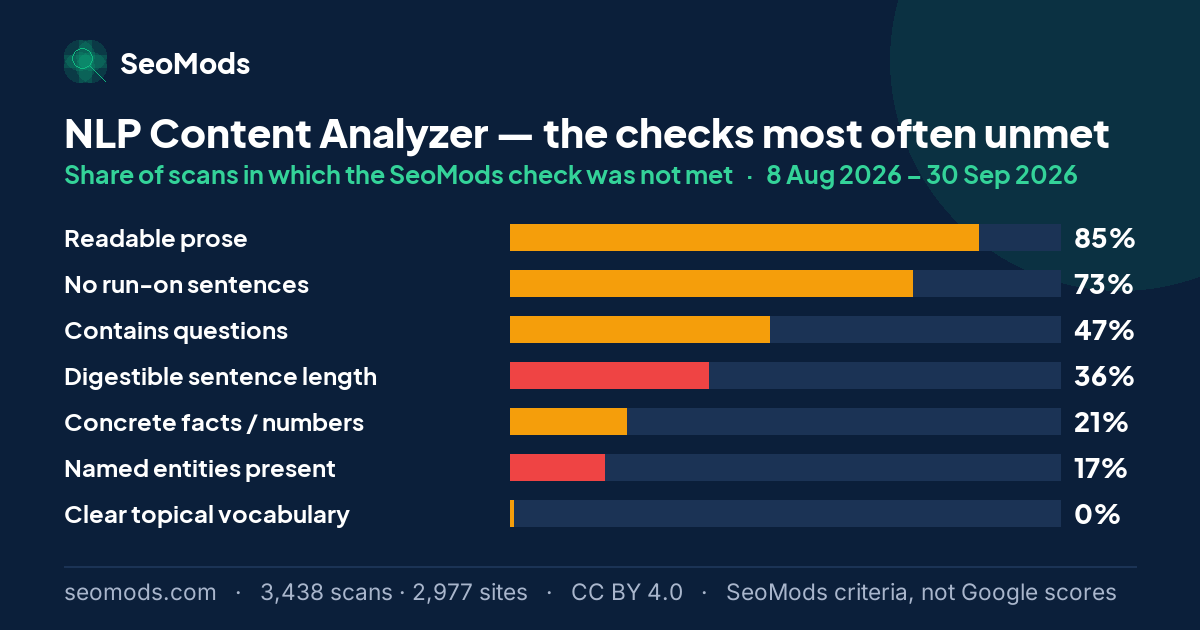
Three things dominate the failures. Sentences that run on, so the parser loses the subject. Missing named entities, so nothing anchors the page to a known thing in the world. And an absence of concrete facts, so there is nothing to extract even once the text is understood. They are separate problems with one shared symptom: the page is about something in a way no machine can pin down.
| Check | Not met (share of scans) | Weight |
|---|---|---|
| Readable prose | 85% | Partial |
| No run-on sentences | 73% | Partial |
| Contains questions | 47% | Partial |
| Digestible sentence length | 36% | Hard fail |
| Concrete facts / numbers | 21% | Partial |
| Named entities present | 17% | Hard fail |
| Clear topical vocabulary | 0% | Partial |
The rate is the share of scans in which a SeoMods check was not met. It is SeoMods’ criterion, not Google’s assessment of these pages. “Hard fail” means the check’s full weight is deducted from the SeoMods score; “partial” means part of it.
The weakest areas
This tool groups its checks into categories. The chart below shows how often each category was the lowest-scoring one in a scan — which area is most often the weak link. It is not the average score in that category; it is how often it came last.
“Structure & Intent” was the weakest area in 53% of scans.
What to fix first
Name things explicitly instead of referring back to them. Pronouns and "it" chains are the single most common cause of low scores here, because they force the parser to resolve a reference that may be several sentences away. Repeating a proper noun where you would normally write "it" reads slightly more formally and parses enormously better.
A typical scan passes 4.2 of 7 checks and leaves 2.8 open items behind. In this sample what brings a SeoMods score down is mostly not one large omission but accumulated small ones.
Run the NLP Content Analyzer on your own page
Month by month
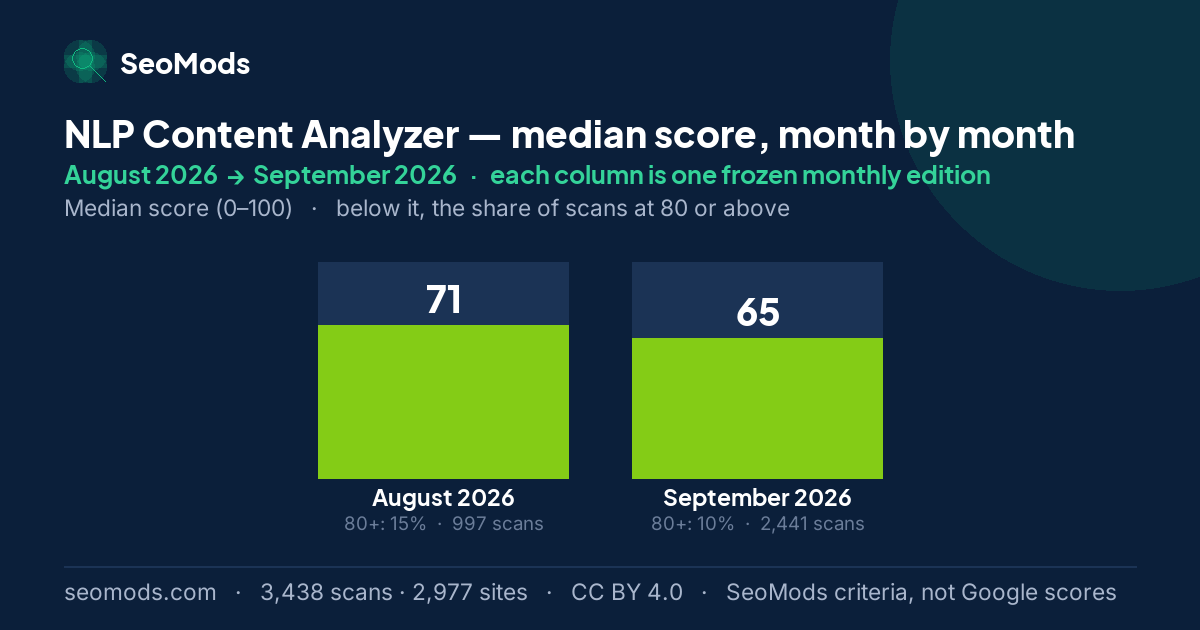
This page adds every published month together. Underneath it, each month is frozen as an edition of its own whose figures are never edited again — which is the only reason two months can be set side by side at all. Below is the NLP Content Analyzer across the 2 published editions, with the combined figure in the last row of the table.
Between August 2026 and September 2026 the median went from 71 to 65, and the share of scans at 80 or above went from 15% to 10%. The two months do not measure the same sites — the September 2026 sample has about 3 times as many sites — so read the gap as a change in the cross-section measured, not as the same sites getting better or worse.
| Edition | Median | vs. previous | Scored 80+ | Issues/run | Runs |
|---|---|---|---|---|---|
| August 2026 | 71 | baseline | 15% | 2.6 | 997 |
| September 2026 | 65 | −6 pts | 10% | 2.9 | 2,441 |
| All published months, combined | 65 | — | 11% | 2.8 | 3,438 |
Reading a monthly difference. Each month is a separate sample, and its size changes from month to month. A change in sample size can move a median and a distribution by itself, so a monthly difference should not be mistaken for a change in scores: it does not show that sites improved or got worse.
Which checks moved
Each check’s rate in the first edition that measured it, beside its rate in the latest. Moves under two points are marked as no change: these are independent monthly samples of a shifting set of sites, and a difference that small is not evidence that anything on the web changed.
| Check | Not met in August 2026 | Not met in September 2026 | Change |
|---|---|---|---|
| Digestible sentence length Hard fail | 26% · August 2026 | 40% · September 2026 | +14 pp |
| No run-on sentences | 70% · August 2026 | 75% · September 2026 | +5 pp |
| Readable prose | 83% · August 2026 | 86% · September 2026 | +3 pp |
| Contains questions | 46% · August 2026 | 48% · September 2026 | no change |
| Concrete facts / numbers | 22% · August 2026 | 21% · September 2026 | no change |
| Named entities present Hard fail | 16% · August 2026 | 17% · September 2026 | no change |
What this score does not measure
- It is not a direct measurement of the signals every AI system uses. Which system uses which signal, and how, is not public; the score measures the checks SeoMods chose.
- It does not measure whether a page is actually cited in AI answers. It measures readiness on the page, not what any assistant returned.
- It is not a Google ranking. A high score does not guarantee a better position, and a low one does not mean Google has penalised the page.
About this benchmark. This benchmark is calculated from data on the sites SeoMods has scanned. The results do not necessarily represent all websites, or a random selection of them. The scores express SeoMods’ own measurement and scoring criteria; they are not ranking, quality, E-E-A-T or AI visibility scores issued by Google. Sample, anonymization and licence: the full methodology.
Frequently asked questions
What is a named entity and why does it matter?
It is a specific thing a system can identify and connect to what it already knows: a company, a person, a place, a product, a standard. Entities are how a page gets attached to a subject rather than merely containing words about one. A page with no identifiable entities is topically vague to a machine even when it is perfectly clear to a reader.
Does this measure keyword density?
No, and deliberately not — keyword density has not been a useful signal for a very long time. What it looks at is whether the page reads as being about an identifiable subject: which entities appear, whether they recur naturally, whether the surrounding vocabulary supports them. Repeating a phrase to hit a ratio works against that rather than for it.
How does this relate to search intent?
Intent is inferred largely from structure and phrasing — questions, comparisons, instructions, definitions each look different to a parser. A page whose structure does not signal any particular intent is harder to match to a query, which is why the check looks at whether questions are asked and whether the page states things plainly.
What is a good score on the NLP Content Analyzer?
In this dataset the median SeoMods score is 65/100, so scoring 65 sits exactly in the middle of the sample. 74 is the start of the upper quartile and 85 or above is the top 10%; below 50 is the bottom quarter. Those thresholds are specific to this tool — the 25 tools with a published benchmark have very different medians, so 70 here and 70 elsewhere do not mean the same thing. They place a page among the sites SeoMods scanned; they say nothing about Google rankings.
Is the score from the NLP Content Analyzer issued by Google?
No. It is a benchmark score calculated against the check list SeoMods defined for this tool. A SeoMods check going unmet does not mean Google has penalised the page or ranked it lower.
Which SeoMods check goes unmet most often on the NLP Content Analyzer?
“Readable prose”, which was not met in 85% of scans. The largest losses on the SeoMods score, though, come from the checks scored as hard fails — this tool has 2, the most common being “Digestible sentence length” at 36%.
Questions that govern the whole series — how the sample is collected, how sites are anonymized, how often the figures are refreshed — are answered in the methodology on the hub.
Using this data
The figures, tables and charts on this page are free to reuse under CC BY 4.0; the only condition is a link back to this page. Suggested citation: SeoMods — NLP Content Analyzer benchmarks, 2 October 2026, https://seomods.com/seo-score-benchmarks/nlp-analyzer. If you need to cite by date, use the September 2026 edition instead: this page changes at every refresh and that one never does.