
An author page is the one place a site can answer "who is this and why would they know" without interrupting an article to do it. Most sites either do not have one or have a name and a sentence. The scores here reflect that: this is a page type nearly everybody publishes and almost nobody finishes, which makes it one of the few remaining places where a small amount of work produces a visible difference.
Here is where that sits. The median SeoMods score is 49/100, which ranks it 16 of the 25 tools with a published benchmark by median. The ranking runs over the 25 tools on the main benchmark page; 1st is the highest median. The middle half of results falls between 24 and 65 — a band 41 points wide. That is wide: in this sample sites’ scores diverge markedly on this measure.
How the scores are distributed
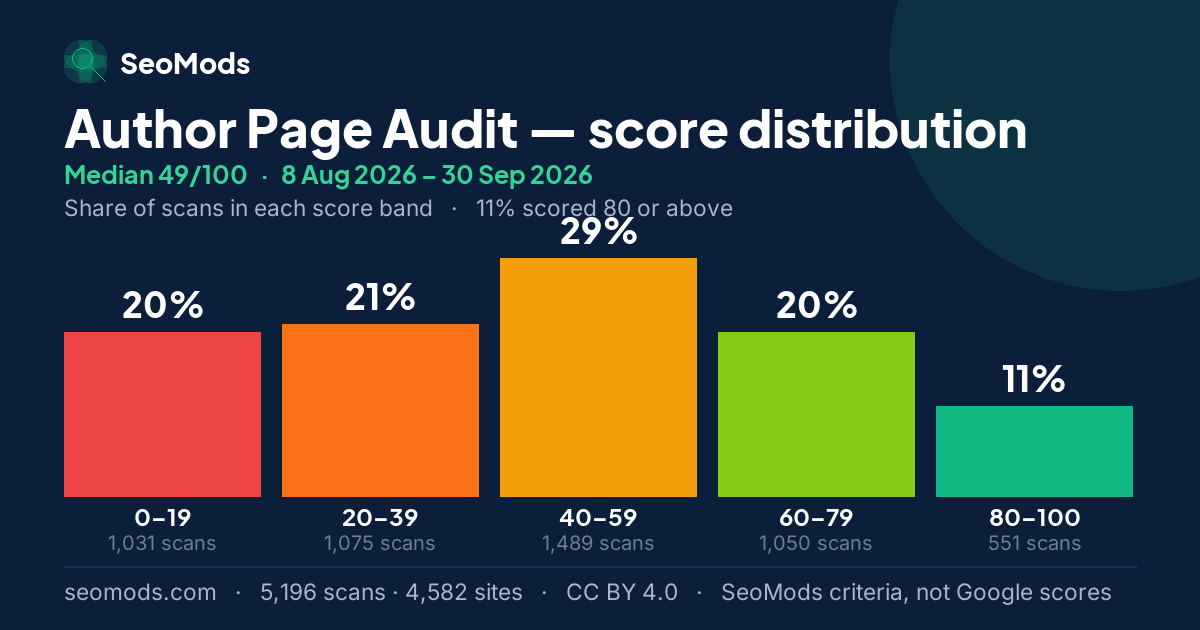
An average on its own misleads. The chart below splits all 5,196 scans into five score bands, totalling 100%. The spread is wide and fairly even: in this sample sites land at very different levels on this measure.
- 0–19
- 20–39
- 40–59
- 60–79
- 80–100
| Score band | Author Page |
|---|---|
| 0–19 | 20% · 1,031 |
| 20–39 | 21% · 1,075 |
| 40–59 | 29% · 1,489 |
| 60–79 | 20% · 1,050 |
| 80–100 | 11% · 551 |
| Total runs | 5,196 |
The grade mix
The same data as letters: A+ 95–100, A 85–94, B 75–84, C 65–74, D 50–64 and F below 50.
Where does my score sit?
A profile that is just a name and an avatar scores near the floor, and correctly so — it establishes that a person exists, not that they know anything. What moves the score is specificity: stated credentials, a real bio, links to what they have written and to profiles elsewhere that corroborate the claim. Each of those turns an assertion into something checkable.
| Tool | P10 | P25 | Median | P75 | P90 | Mean | Lowest | Highest |
|---|---|---|---|---|---|---|---|---|
| Author Page | 0 | 24 | 49 | 65 | 81 | 43.7 | 0 | 100 |
A score from the Author Page Audit can be read against the five values below. All of them are calculated from the scans in this benchmark: they place a SeoMods score within this sample, not in Google’s results.
| Percentile | Score | What it means for a score |
|---|---|---|
| P10 | 0 | About one scan in ten scored 0 or lower. Below it, a page is in the lowest tenth of this sample. |
| P25 | 24 | The edge of the bottom quarter. A score under 24 is below about three quarters of the scans. |
| Median | 49 | The middle of the sample: half the scans scored lower, half higher. A score of 49 is the typical result here. |
| P75 | 65 | Where the top quarter begins. A score of 65 or more is at or above about three quarters of the scans. |
| P90 | 81 | Where the top tenth begins. A score of 81 or more is among the highest 10% of scans in this sample. |
Percentiles describe the sites SeoMods scanned, not the whole web, and they apply to this tool only: the same number on another tool sits somewhere else.
The SeoMods checks most often unmet
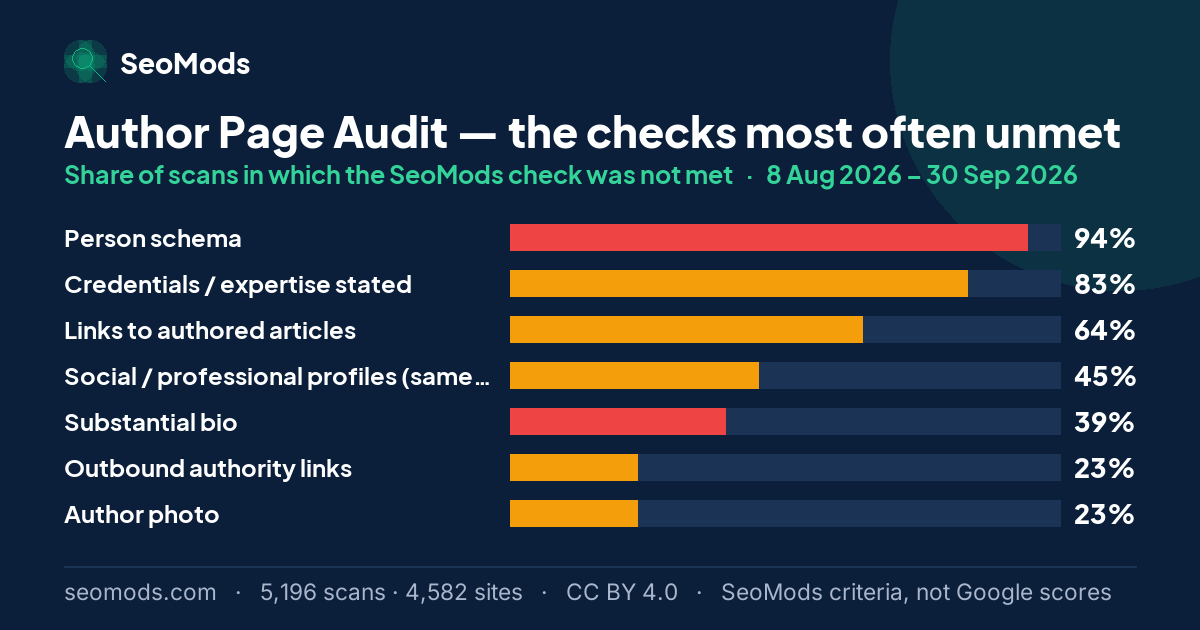
The checks are asking whether a stranger could verify the claim. A photo and a bio make the person real. Credentials say why they would know. Links to their articles show the body of work. Person schema and sameAs links connect the profile to identities elsewhere, which is what turns a self-description into something a machine can corroborate.
| Check | Not met (share of scans) | Weight |
|---|---|---|
| Person schema | 94% | Hard fail |
| Credentials / expertise stated | 83% | Partial |
| Links to authored articles | 64% | Partial |
| Social / professional profiles (sameAs) | 45% | Partial |
| Substantial bio | 39% | Hard fail |
| Outbound authority links | 23% | Partial |
| Author photo | 23% | Partial |
The rate is the share of scans in which a SeoMods check was not met. It is SeoMods’ criterion, not Google’s assessment of these pages. “Hard fail” means the check’s full weight is deducted from the SeoMods score; “partial” means part of it.
The weakest areas
This tool groups its checks into categories. The chart below shows how often each category was the lowest-scoring one in a scan — which area is most often the weak link. It is not the average score in that category; it is how often it came last.
“Identity” was the weakest area in 67% of scans.
What to fix first
Add Person schema with sameAs links to the author's professional profiles. It is a ten-minute change and it is the difference between a page that claims expertise and one that connects to a verifiable identity — which is the distinction this benchmark’s checks are built to capture.
A typical scan passes 3.3 of 7 checks and leaves 3.7 open items behind. In this sample what brings a SeoMods score down is mostly not one large omission but accumulated small ones.
Run the Author Page Audit on your own page
Month by month
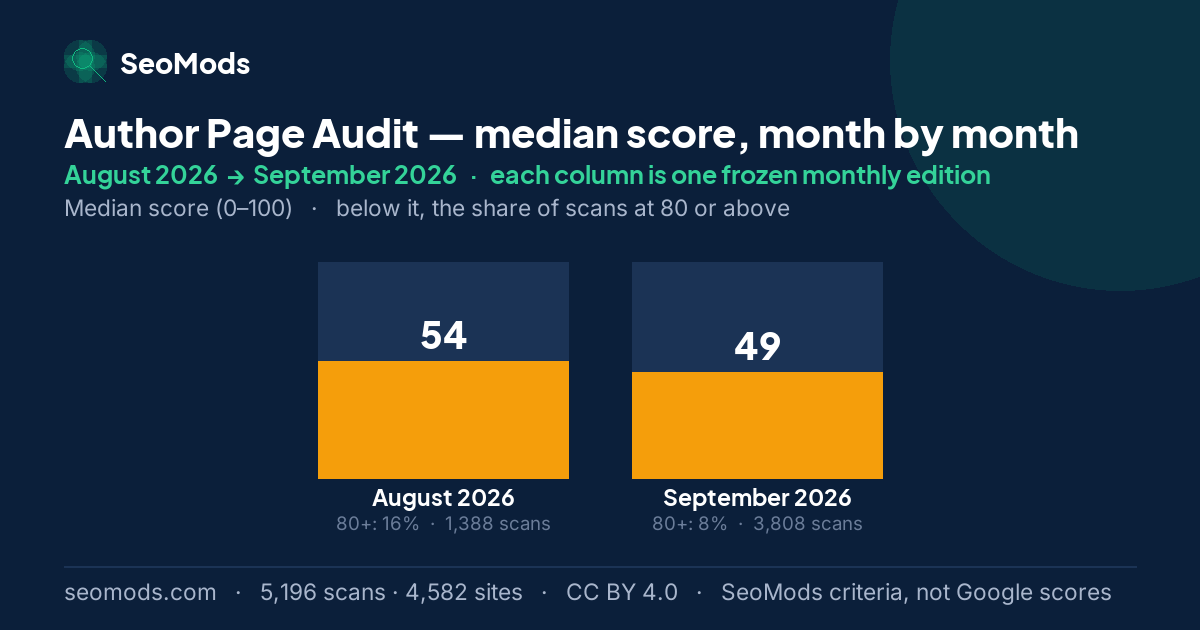
This page adds every published month together. Underneath it, each month is frozen as an edition of its own whose figures are never edited again — which is the only reason two months can be set side by side at all. Below is the Author Page Audit across the 2 published editions, with the combined figure in the last row of the table.
Between August 2026 and September 2026 the median went from 54 to 49, and the share of scans at 80 or above went from 16% to 8%. The two months do not measure the same sites — the September 2026 sample has about 3 times as many sites — so read the gap as a change in the cross-section measured, not as the same sites getting better or worse.
| Edition | Median | vs. previous | Scored 80+ | Issues/run | Runs |
|---|---|---|---|---|---|
| August 2026 | 54 | baseline | 16% | 3.5 | 1,388 |
| September 2026 | 49 | −5 pts | 8% | 3.8 | 3,808 |
| All published months, combined | 49 | — | 11% | 3.7 | 5,196 |
Reading a monthly difference. Each month is a separate sample, and its size changes from month to month. A change in sample size can move a median and a distribution by itself, so a monthly difference should not be mistaken for a change in scores: it does not show that sites improved or got worse.
Which checks moved
Each check’s rate in the first edition that measured it, beside its rate in the latest. Moves under two points are marked as no change: these are independent monthly samples of a shifting set of sites, and a difference that small is not evidence that anything on the web changed.
| Check | Not met in August 2026 | Not met in September 2026 | Change |
|---|---|---|---|
| Social / professional profiles (sameAs) | 37% · August 2026 | 48% · September 2026 | +11 pp |
| Credentials / expertise stated | 77% · August 2026 | 85% · September 2026 | +8 pp |
| Substantial bio Hard fail | 34% · August 2026 | 41% · September 2026 | +7 pp |
| Person schema Hard fail | 92% · August 2026 | 95% · September 2026 | +3 pp |
| Author photo | 25% · August 2026 | 22% · September 2026 | −3 pp |
| Outbound authority links | 21% · August 2026 | 24% · September 2026 | +3 pp |
| Links to authored articles | 64% · August 2026 | 64% · September 2026 | no change |
What this score does not measure
- It is not Google’s E-E-A-T score. Google publishes no such score; E-E-A-T is a concept from its search quality rater guidelines.
- It does not measure how trustworthy a page or an author really is. It counts the machine-visible evidence of it that is present on the page.
- It is not a Google ranking. A high score does not guarantee a better position, and a low one does not mean Google has penalised the page.
About this benchmark. This benchmark is calculated from data on the sites SeoMods has scanned. The results do not necessarily represent all websites, or a random selection of them. The scores express SeoMods’ own measurement and scoring criteria; they are not ranking, quality, E-E-A-T or AI visibility scores issued by Google. Sample, anonymization and licence: the full methodology.
Frequently asked questions
Does every site need author pages?
Any site making claims a reader would want to check does. That includes advice, analysis, reviews and anything touching health, money or safety. A purely transactional site needs it less — though even there, knowing who stands behind the business is a trust signal that does no harm.
What should an author bio contain?
Enough to answer why this person is worth reading on this subject, specifically. Years in the field, relevant qualifications, notable work, and where else they publish. A biography that could describe anybody in the industry establishes nothing; the useful parts are the ones only true of this person.
Do author profiles on external sites help?
They are the corroboration. A profile on your own site is a claim; the same identity appearing on a professional network, a conference programme or another publication is evidence that the claim holds up. Linking them with sameAs is what tells a machine these are the same person rather than a coincidence of names.
What is a good score on the Author Page Audit?
In this dataset the median SeoMods score is 49/100, so scoring 49 sits exactly in the middle of the sample. 65 is the start of the upper quartile and 81 or above is the top 10%; below 24 is the bottom quarter. Those thresholds are specific to this tool — the 25 tools with a published benchmark have very different medians, so 70 here and 70 elsewhere do not mean the same thing. They place a page among the sites SeoMods scanned; they say nothing about Google rankings.
Is the score from the Author Page Audit issued by Google?
No. It is a benchmark score calculated against the check list SeoMods defined for this tool. A SeoMods check going unmet does not mean Google has penalised the page or ranked it lower.
Which SeoMods check goes unmet most often on the Author Page Audit?
“Person schema”, which was not met in 94% of scans. The largest losses on the SeoMods score, though, come from the checks scored as hard fails — this tool has 2, the most common being “Person schema” at 94%.
Questions that govern the whole series — how the sample is collected, how sites are anonymized, how often the figures are refreshed — are answered in the methodology on the hub.
Using this data
The figures, tables and charts on this page are free to reuse under CC BY 4.0; the only condition is a link back to this page. Suggested citation: SeoMods — Author Page Audit benchmarks, 2 October 2026, https://seomods.com/seo-score-benchmarks/author-page-audit. If you need to cite by date, use the September 2026 edition instead: this page changes at every refresh and that one never does.