
Anchor text is the one on-page signal you give away every time you link to something, and it is also the one people write on autopilot. This tool reads every link on the page and asks whether the words inside it would tell a reader — or a crawler with no vision — where the link leads. Scores here run higher than most of the dataset, because a page written in ordinary prose tends to produce descriptive anchors without trying.
Here is where that sits. The median SeoMods score is 79/100, which ranks it 4 of the 25 tools with a published benchmark by median. The ranking runs over the 25 tools on the main benchmark page; 1st is the highest median. The middle half of results falls between 68 and 89 — a band 21 points wide. That is wide: in this sample sites’ scores diverge markedly on this measure.
How the scores are distributed
An average on its own misleads. The chart below splits all 4,387 scans into five score bands, totalling 100%. Most results sit in the middle bands, which means sites differ here by degree rather than by whether they bothered at all.
- 0–19
- 20–39
- 40–59
- 60–79
- 80–100
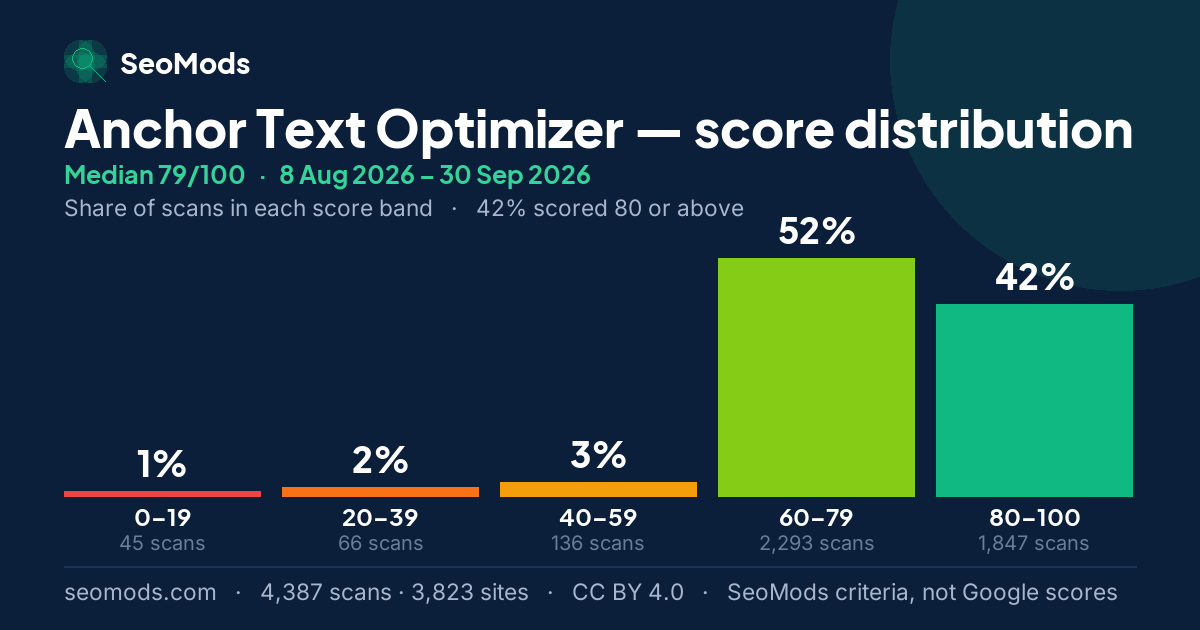
| Score band | Anchor Text |
|---|---|
| 0–19 | 1% · 45 |
| 20–39 | 2% · 66 |
| 40–59 | 3% · 136 |
| 60–79 | 52% · 2,293 |
| 80–100 | 42% · 1,847 |
| Total runs | 4,387 |
The grade mix
The same data as letters: A+ 95–100, A 85–94, B 75–84, C 65–74, D 50–64 and F below 50.
Where does my score sit?
A high score here does not mean the linking is good, only that the wording is. The tool can see that an anchor is descriptive; it cannot see whether the link was worth making. Read a strong score as "nothing is actively wrong", and spend the attention you save on whether the page links to the right places at all.
| Tool | P10 | P25 | Median | P75 | P90 | Mean | Lowest | Highest |
|---|---|---|---|---|---|---|---|---|
| Anchor Text | 68 | 68 | 79 | 89 | 100 | 80.4 | 11 | 100 |
A score from the Anchor Text Optimizer can be read against the five values below. All of them are calculated from the scans in this benchmark: they place a SeoMods score within this sample, not in Google’s results.
| Percentile | Score | What it means for a score |
|---|---|---|
| P10 | 68 | About one scan in ten scored 68 or lower. Below it, a page is in the lowest tenth of this sample. |
| P25 | 68 | The edge of the bottom quarter. A score under 68 is below about three quarters of the scans. |
| Median | 79 | The middle of the sample: half the scans scored lower, half higher. A score of 79 is the typical result here. |
| P75 | 89 | Where the top quarter begins. A score of 89 or more is at or above about three quarters of the scans. |
| P90 | 100 | Where the top tenth begins. A score of 100 or more is among the highest 10% of scans in this sample. |
Some of these values coincide. That happens when many scans land on exactly the same score, so the bands between them are not separate bands at all — read the equal values as one step.
Percentiles describe the sites SeoMods scanned, not the whole web, and they apply to this tool only: the same number on another tool sits somewhere else.
The SeoMods checks most often unmet
Two failures dominate, and they pull in opposite directions. Generic anchors — "here", "read more", "this page" — waste the signal entirely. Over-optimised anchors, where the same exact keyword is repeated across many links, look manufactured and have been a spam signal for well over a decade. The healthy middle is simply writing links the way you would say them out loud.
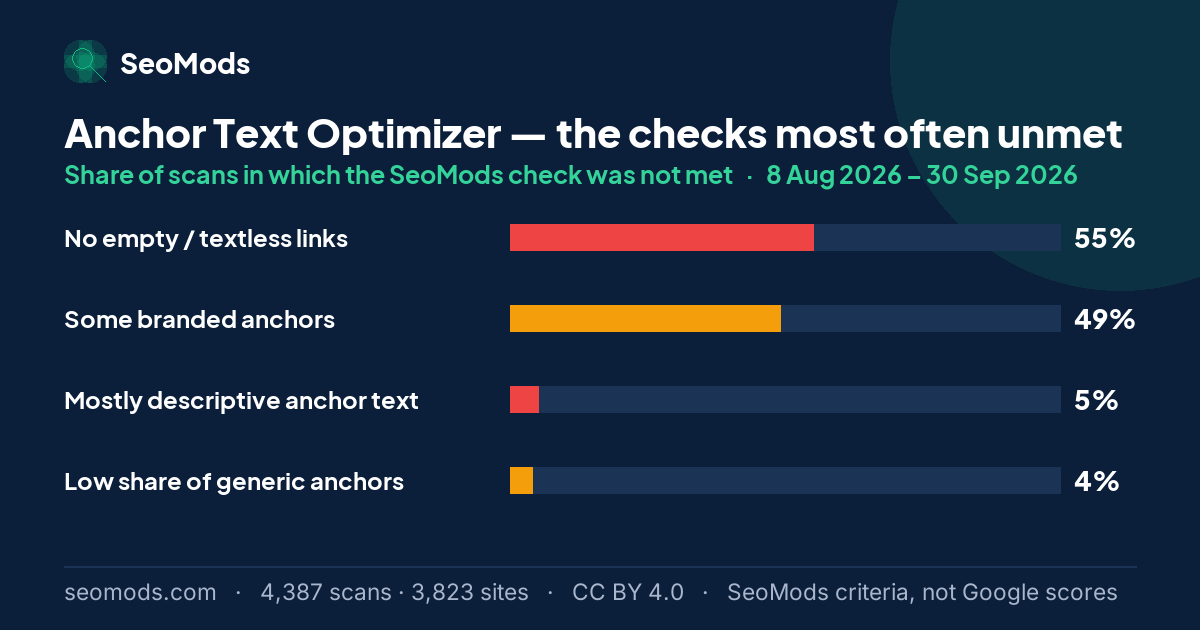
| Check | Not met (share of scans) | Weight |
|---|---|---|
| No empty / textless links | 55% | Hard fail |
| Some branded anchors | 49% | Partial |
| Mostly descriptive anchor text | 5% | Hard fail |
| Low share of generic anchors | 4% | Partial |
The rate is the share of scans in which a SeoMods check was not met. It is SeoMods’ criterion, not Google’s assessment of these pages. “Hard fail” means the check’s full weight is deducted from the SeoMods score; “partial” means part of it.
The weakest areas
This tool groups its checks into categories. The chart below shows how often each category was the lowest-scoring one in a scan — which area is most often the weak link. It is not the average score in that category; it is how often it came last.
“Descriptive anchors” was the weakest area in 52% of scans.
What to fix first
Find the empty and textless links first, because they are usually a bug rather than a style choice: an icon link with no accessible label is invisible to both a screen reader and a crawler. After that, rewrite the generic anchors, and resist the urge to replace them all with the same keyword.
A typical scan passes 3.9 of 5 checks and leaves 1.1 open items behind. In this sample what brings a SeoMods score down is mostly not one large omission but accumulated small ones.
Run the Anchor Text Optimizer on your own page
Month by month
This page adds every published month together. Underneath it, each month is frozen as an edition of its own whose figures are never edited again — which is the only reason two months can be set side by side at all. Below is the Anchor Text Optimizer across the 2 published editions, with the combined figure in the last row of the table.
Between August 2026 and September 2026 the median held at 79, and the share of scans at 80 or above went from 34% to 45%. The two months do not measure the same sites — the September 2026 sample has about 3 times as many sites — so read the gap as a change in the cross-section measured, not as the same sites getting better or worse.
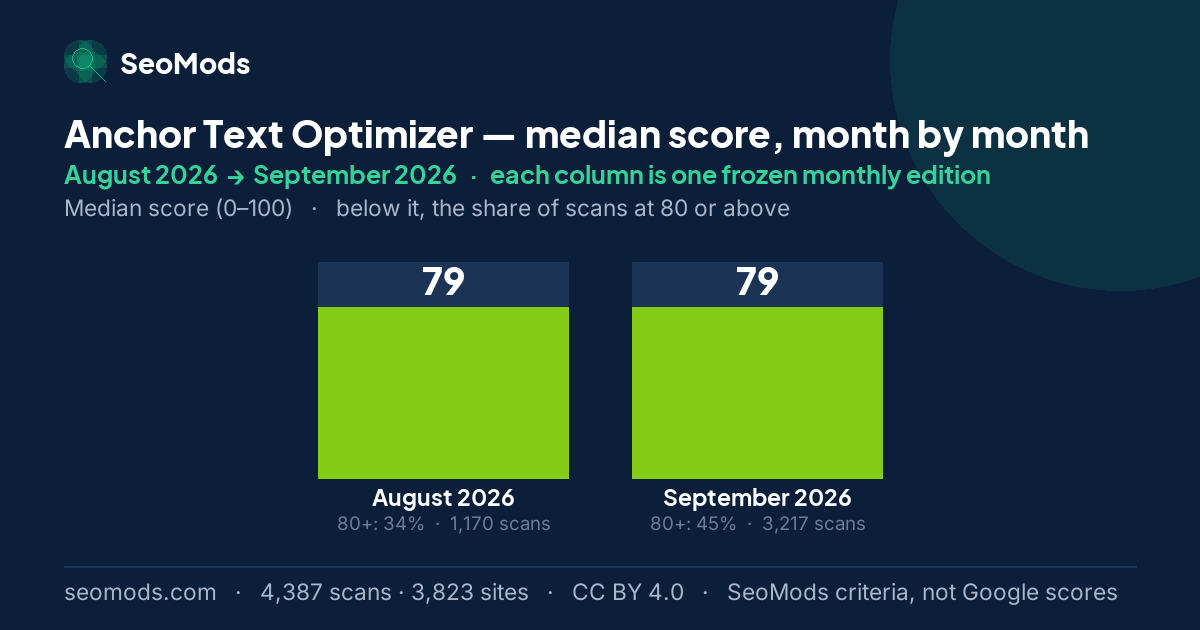
| Edition | Median | vs. previous | Scored 80+ | Issues/run | Runs |
|---|---|---|---|---|---|
| August 2026 | 79 | baseline | 34% | 1.1 | 1,170 |
| September 2026 | 79 | no change | 45% | 1.2 | 3,217 |
| All published months, combined | 79 | — | 42% | 1.1 | 4,387 |
Reading a monthly difference. Each month is a separate sample, and its size changes from month to month. A change in sample size can move a median and a distribution by itself, so a monthly difference should not be mistaken for a change in scores: it does not show that sites improved or got worse.
Which checks moved
Each check’s rate in the first edition that measured it, beside its rate in the latest. Moves under two points are marked as no change: these are independent monthly samples of a shifting set of sites, and a difference that small is not evidence that anything on the web changed.
| Check | Not met in August 2026 | Not met in September 2026 | Change |
|---|---|---|---|
| Some branded anchors | 34% · August 2026 | 54% · September 2026 | +20 pp |
| No empty / textless links Hard fail | 64% · August 2026 | 52% · September 2026 | −12 pp |
| Mostly descriptive anchor text Hard fail | 4% · August 2026 | 5% · September 2026 | no change |
| Low share of generic anchors | 3% · August 2026 | 4% · September 2026 | no change |
What this score does not measure
- It is not a Google ranking. A high score does not guarantee a better position, and a low one does not mean Google has penalised the page.
- It is not an organic traffic estimate. No click, impression or visit data goes into it.
- It does not represent the whole of the real user experience. What is measured is one URL’s HTML and server response at the moment of the scan.
About this benchmark. This benchmark is calculated from data on the sites SeoMods has scanned. The results do not necessarily represent all websites, or a random selection of them. The scores express SeoMods’ own measurement and scoring criteria; they are not ranking, quality, E-E-A-T or AI visibility scores issued by Google. Sample, anonymization and licence: the full methodology.
Frequently asked questions
What is wrong with "click here" as anchor text?
It describes the action rather than the destination, so it carries no information about the linked page for anyone who cannot see the surrounding sentence — which includes screen-reader users navigating by link list, and crawlers weighing what the target page is about. It is also almost always replaceable with two or three words that read better anyway.
Can anchor text be too optimised?
Yes. Repeating an identical keyword-rich phrase across many links is one of the oldest recognisable link-manipulation patterns, and it reads unnaturally to a human as well. Varied, descriptive wording that changes with the sentence is both safer and better writing.
Do internal and external links need different anchor strategies?
The principle is the same — describe the destination — but the stakes differ. Internal anchors are entirely under your control and are one of the clearest ways to tell a search engine what your own pages are about. External anchors mostly signal editorial judgement: what you chose to send readers to, and how you characterised it.
What is a good score on the Anchor Text Optimizer?
In this dataset the median SeoMods score is 79/100, so scoring 79 sits exactly in the middle of the sample. 89 is the start of the upper quartile and 100 or above is the top 10%; below 68 is the bottom quarter. Those thresholds are specific to this tool — the 25 tools with a published benchmark have very different medians, so 70 here and 70 elsewhere do not mean the same thing. They place a page among the sites SeoMods scanned; they say nothing about Google rankings.
Is the score from the Anchor Text Optimizer issued by Google?
No. It is a benchmark score calculated against the check list SeoMods defined for this tool. A SeoMods check going unmet does not mean Google has penalised the page or ranked it lower.
Which SeoMods check goes unmet most often on the Anchor Text Optimizer?
“No empty / textless links”, which was not met in 55% of scans. The largest losses on the SeoMods score, though, come from the checks scored as hard fails — this tool has 2, the most common being “No empty / textless links” at 55%.
Questions that govern the whole series — how the sample is collected, how sites are anonymized, how often the figures are refreshed — are answered in the methodology on the hub.
Using this data
The figures, tables and charts on this page are free to reuse under CC BY 4.0; the only condition is a link back to this page. Suggested citation: SeoMods — Anchor Text Optimizer benchmarks, 2 October 2026, https://seomods.com/seo-score-benchmarks/anchor-text-optimizer. If you need to cite by date, use the September 2026 edition instead: this page changes at every refresh and that one never does.