
This tool asks a narrower question than general AI visibility: not whether a model can read the page, but whether there is anything on it a model would want to lift. That turns out to be a much harder bar, and the scores are correspondingly low. Being readable is a matter of configuration. Being quotable is a matter of having written something specific, attributed and self-contained — which is a writing problem, and writing problems do not get fixed by a plugin.
Here is where that sits. The median SeoMods score is 46/100, which ranks it 17 of the 25 tools with a published benchmark by median. The ranking runs over the 25 tools on the main benchmark page; 1st is the highest median. The middle half of results falls between 20 and 63 — a band 43 points wide. That is wide: in this sample sites’ scores diverge markedly on this measure.
How the scores are distributed
An average on its own misleads. The chart below splits all 5,371 scans into five score bands, totalling 100%. The spread is wide and fairly even: in this sample sites land at very different levels on this measure.
- 0–19
- 20–39
- 40–59
- 60–79
- 80–100
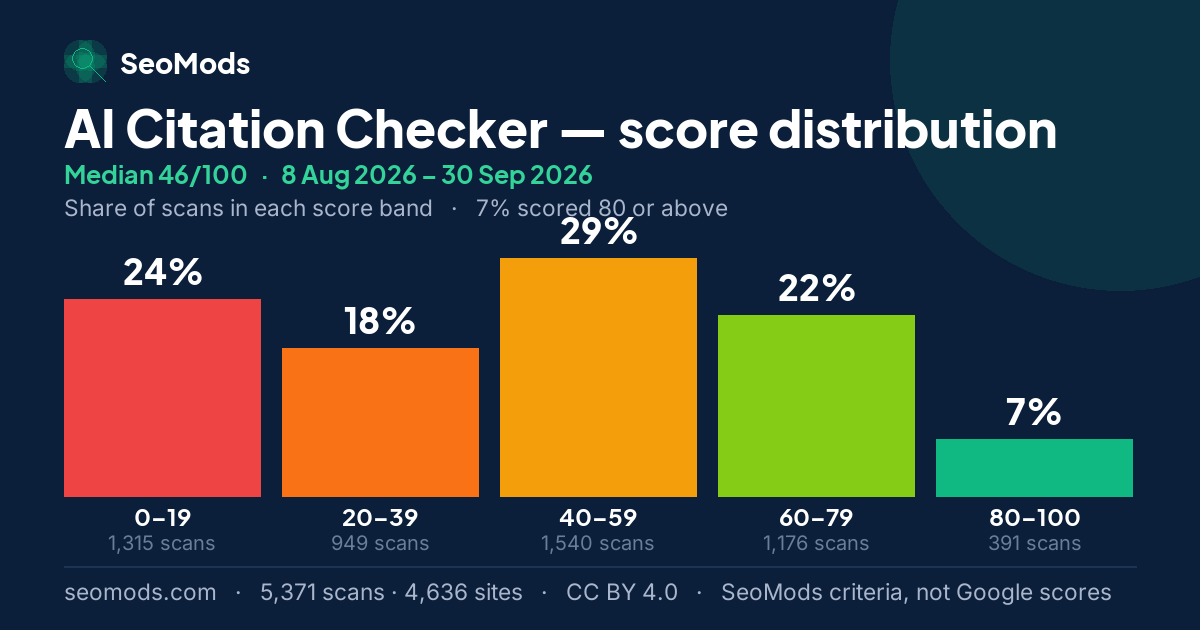
| Score band | AI Citation |
|---|---|
| 0–19 | 24% · 1,315 |
| 20–39 | 18% · 949 |
| 40–59 | 29% · 1,540 |
| 60–79 | 22% · 1,176 |
| 80–100 | 7% · 391 |
| Total runs | 5,371 |
The grade mix
The same data as letters: A+ 95–100, A 85–94, B 75–84, C 65–74, D 50–64 and F below 50.
Where does my score sit?
Expect a low number here even on pages you are proud of, and do not read it as a verdict on quality. It measures a particular kind of usefulness: whether the page contains passages that survive being taken out of context. Long, flowing, beautifully argued prose scores badly on exactly that measure — which is a fair criticism from a machine's point of view and no criticism at all from a reader's.
| Tool | P10 | P25 | Median | P75 | P90 | Mean | Lowest | Highest |
|---|---|---|---|---|---|---|---|---|
| AI Citation | 0 | 20 | 46 | 63 | 75 | 42.2 | 0 | 100 |
A score from the AI Citation Checker can be read against the five values below. All of them are calculated from the scans in this benchmark: they place a SeoMods score within this sample, not in Google’s results.
| Percentile | Score | What it means for a score |
|---|---|---|
| P10 | 0 | About one scan in ten scored 0 or lower. Below it, a page is in the lowest tenth of this sample. |
| P25 | 20 | The edge of the bottom quarter. A score under 20 is below about three quarters of the scans. |
| Median | 46 | The middle of the sample: half the scans scored lower, half higher. A score of 46 is the typical result here. |
| P75 | 63 | Where the top quarter begins. A score of 63 or more is at or above about three quarters of the scans. |
| P90 | 75 | Where the top tenth begins. A score of 75 or more is among the highest 10% of scans in this sample. |
Percentiles describe the sites SeoMods scanned, not the whole web, and they apply to this tool only: the same number on another tool sits somewhere else.
The SeoMods checks most often unmet
The failures divide into substance and shape. Substance is whether there is anything concrete to quote — a figure, a definition, a dated fact, a source. Shape is whether it can be extracted cleanly: short paragraphs, a heading that states the question, an answer that begins immediately underneath. Most pages fail on shape while having the substance somewhere in them.
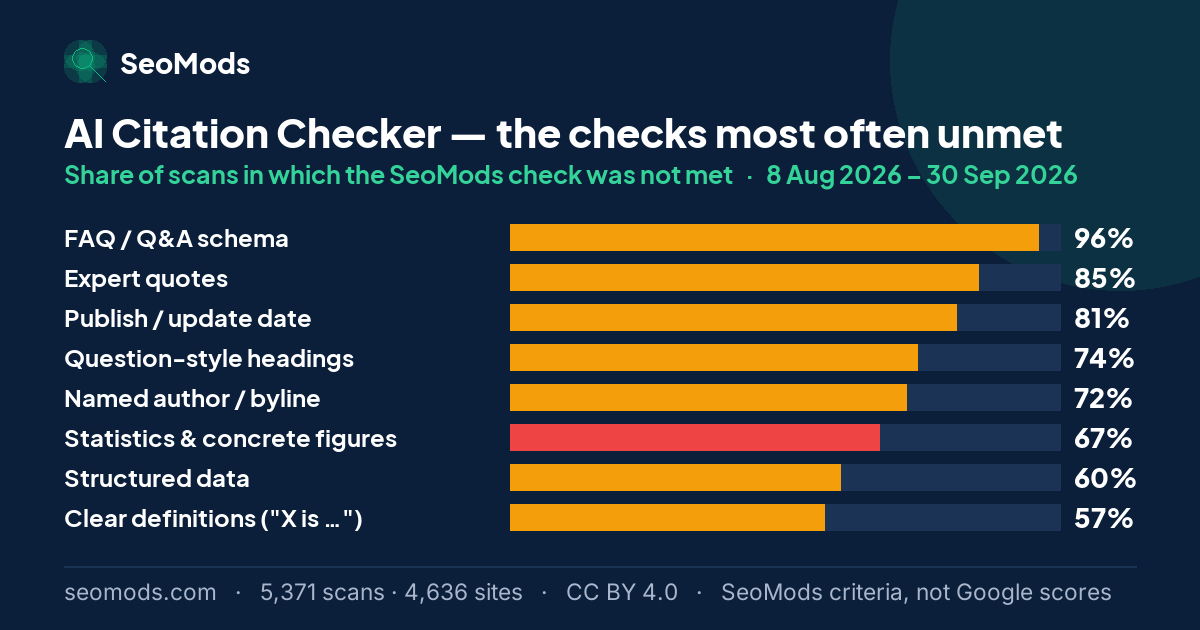
| Check | Not met (share of scans) | Weight |
|---|---|---|
| FAQ / Q&A schema | 96% | Partial |
| Expert quotes | 85% | Partial |
| Publish / update date | 81% | Partial |
| Question-style headings | 74% | Partial |
| Named author / byline | 72% | Partial |
| Statistics & concrete figures | 67% | Hard fail |
| Structured data | 60% | Partial |
| Clear definitions ("X is …") | 57% | Partial |
| Substantial content (≥700 words) | 51% | Partial |
| Concise, standalone passages | 33% | Hard fail |
| Lists / tables for extractability | 30% | Partial |
| Outbound citations to sources | 30% | Hard fail |
The rate is the share of scans in which a SeoMods check was not met. It is SeoMods’ criterion, not Google’s assessment of these pages. “Hard fail” means the check’s full weight is deducted from the SeoMods score; “partial” means part of it.
The weakest areas
This tool groups its checks into categories. The chart below shows how often each category was the lowest-scoring one in a scan — which area is most often the weak link. It is not the average score in that category; it is how often it came last.
“Trust Signals (E-E-A-T)” was the weakest area in 46% of scans.
What to fix first
Take one question your page already answers and restructure that section: heading phrased as the question, answer in the first two sentences, specifics rather than generalities. Do it once and check whether the score moves; it usually does more than a week of general editing, because you have converted existing substance into extractable form.
A typical scan passes 4.7 of 12 checks and leaves 7.3 open items behind. In this sample what brings a SeoMods score down is mostly not one large omission but accumulated small ones.
Run the AI Citation Checker on your own page
Month by month
This page adds every published month together. Underneath it, each month is frozen as an edition of its own whose figures are never edited again — which is the only reason two months can be set side by side at all. Below is the AI Citation Checker across the 2 published editions, with the combined figure in the last row of the table.
Between August 2026 and September 2026 the median held at 46, and the share of scans at 80 or above went from 8% to 7%. The two months do not measure the same sites — the September 2026 sample has about 3 times as many sites — so read the gap as a change in the cross-section measured, not as the same sites getting better or worse.
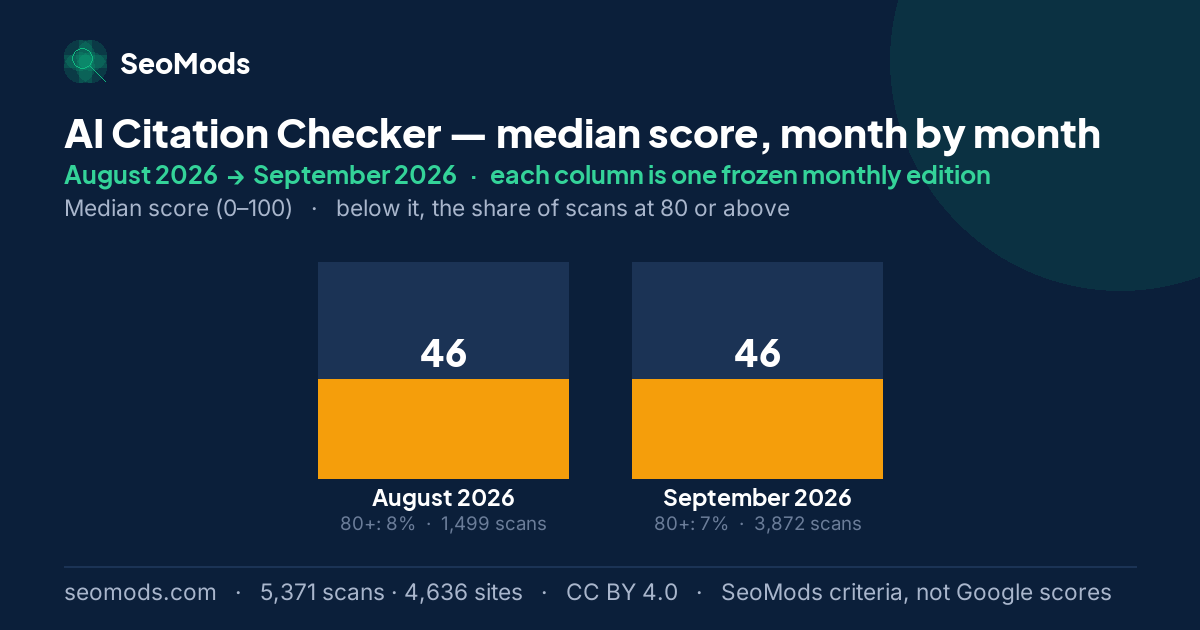
| Edition | Median | vs. previous | Scored 80+ | Issues/run | Runs |
|---|---|---|---|---|---|
| August 2026 | 46 | baseline | 8% | 7.3 | 1,499 |
| September 2026 | 46 | no change | 7% | 7.4 | 3,872 |
| All published months, combined | 46 | — | 7% | 7.3 | 5,371 |
Reading a monthly difference. Each month is a separate sample, and its size changes from month to month. A change in sample size can move a median and a distribution by itself, so a monthly difference should not be mistaken for a change in scores: it does not show that sites improved or got worse.
Which checks moved
Each check’s rate in the first edition that measured it, beside its rate in the latest. Moves under two points are marked as no change: these are independent monthly samples of a shifting set of sites, and a difference that small is not evidence that anything on the web changed.
| Check | Not met in August 2026 | Not met in September 2026 | Change |
|---|---|---|---|
| Clear definitions ("X is …") | 47% · August 2026 | 60% · September 2026 | +13 pp |
| Lists / tables for extractability | 36% · August 2026 | 28% · September 2026 | −8 pp |
| Named author / byline | 76% · August 2026 | 70% · September 2026 | −6 pp |
| Structured data | 56% · August 2026 | 62% · September 2026 | +6 pp |
| Publish / update date | 84% · August 2026 | 80% · September 2026 | −4 pp |
| Expert quotes | 82% · August 2026 | 86% · September 2026 | +4 pp |
| FAQ / Q&A schema | 94% · August 2026 | 97% · September 2026 | +3 pp |
| Statistics & concrete figures Hard fail | 69% · August 2026 | 66% · September 2026 | −3 pp |
| Outbound citations to sources Hard fail | 27% · August 2026 | 30% · September 2026 | +3 pp |
| Question-style headings | 75% · August 2026 | 73% · September 2026 | no change |
| Substantial content (≥700 words) | 51% · August 2026 | 51% · September 2026 | no change |
| Concise, standalone passages Hard fail | 33% · August 2026 | 33% · September 2026 | no change |
What this score does not measure
- It is not a direct measurement of the signals every AI system uses. Which system uses which signal, and how, is not public; the score measures the checks SeoMods chose.
- It does not measure whether a page is actually cited in AI answers. It measures readiness on the page, not what any assistant returned.
- It is not a Google ranking. A high score does not guarantee a better position, and a low one does not mean Google has penalised the page.
About this benchmark. This benchmark is calculated from data on the sites SeoMods has scanned. The results do not necessarily represent all websites, or a random selection of them. The scores express SeoMods’ own measurement and scoring criteria; they are not ranking, quality, E-E-A-T or AI visibility scores issued by Google. Sample, anonymization and licence: the full methodology.
Frequently asked questions
What makes a passage quotable to an AI?
Being complete on its own. A model lifting two sentences needs those two sentences to make sense with nothing around them — so a claim that depends on the previous paragraph, or a pronoun whose referent is three sentences back, cannot be used. Add a concrete number or a named source and it becomes a passage worth quoting rather than merely quotable.
Should I add statistics just to score better here?
No, and inventing them would be much worse than the low score. The check is a proxy for specificity: pages that make measurable claims tend to be more useful than pages that make general ones. If you have nothing concrete to say on a subject, the honest fix is to do the work that produces something concrete, not to decorate the page with numbers.
Does being quotable mean losing traffic to AI answers?
Sometimes, and it is worth being clear-eyed about it. A page that answers a simple question completely may see that question answered without a click. The trade is visibility and attribution in a surface you otherwise do not appear in at all — and for questions where the answer is a starting point rather than the whole job, the citation is what brings the reader through.
What is a good score on the AI Citation Checker?
In this dataset the median SeoMods score is 46/100, so scoring 46 sits exactly in the middle of the sample. 63 is the start of the upper quartile and 75 or above is the top 10%; below 20 is the bottom quarter. Those thresholds are specific to this tool — the 25 tools with a published benchmark have very different medians, so 70 here and 70 elsewhere do not mean the same thing. They place a page among the sites SeoMods scanned; they say nothing about Google rankings.
Is the score from the AI Citation Checker issued by Google?
No. It is a benchmark score calculated against the check list SeoMods defined for this tool. A SeoMods check going unmet does not mean Google has penalised the page or ranked it lower.
Which SeoMods check goes unmet most often on the AI Citation Checker?
“FAQ / Q&A schema”, which was not met in 96% of scans. The largest losses on the SeoMods score, though, come from the checks scored as hard fails — this tool has 3, the most common being “Statistics & concrete figures” at 67%.
Questions that govern the whole series — how the sample is collected, how sites are anonymized, how often the figures are refreshed — are answered in the methodology on the hub.
Using this data
The figures, tables and charts on this page are free to reuse under CC BY 4.0; the only condition is a link back to this page. Suggested citation: SeoMods — AI Citation Checker benchmarks, 2 October 2026, https://seomods.com/seo-score-benchmarks/ai-citation-checker. If you need to cite by date, use the September 2026 edition instead: this page changes at every refresh and that one never does.