
Where the gap finder asks which questions are missing, this asks whether the ones that are there are in usable shape. It is the stricter of the two and the scores show it — a page can have a perfectly good FAQ section written as prose and still fail nearly every check here, because none of it is marked as question and answer. The content exists; the structure does not.
Here is where that sits. The median SeoMods score is 30/100, which ranks it 22 of the 25 tools with a published benchmark by median. The ranking runs over the 25 tools on the main benchmark page; 1st is the highest median. The middle half of results falls between 30 and 30 — a band 0 points wide. That is narrow: sites in this sample score close to each other on this measure.
How the scores are distributed
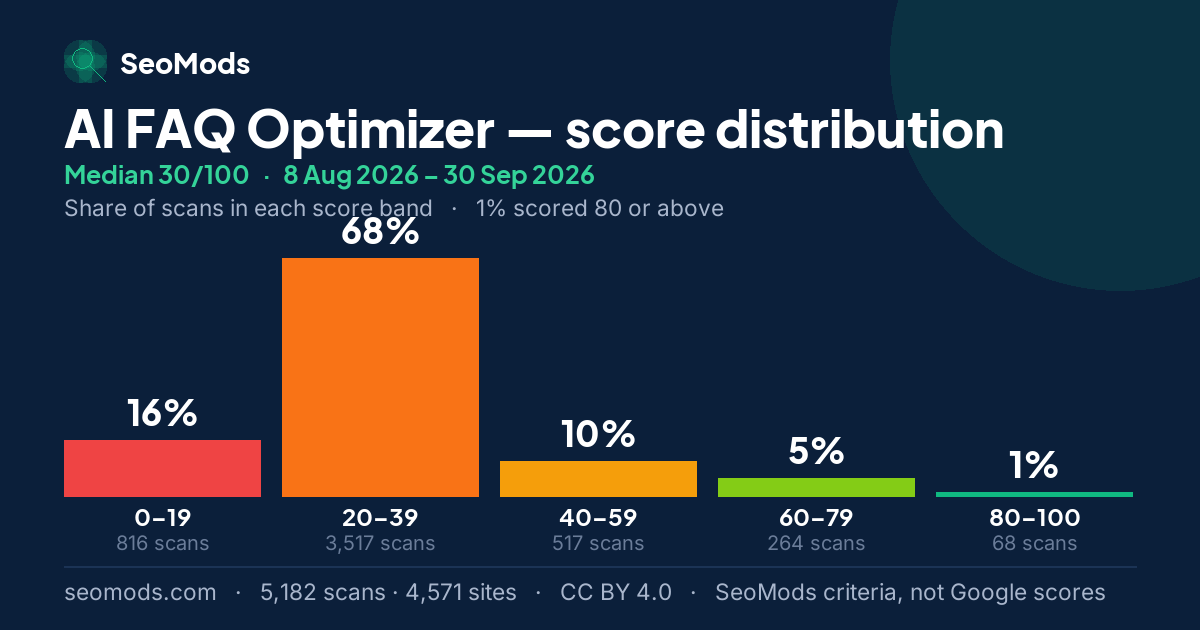
An average on its own misleads. The chart below splits all 5,182 scans into five score bands, totalling 100%. The distribution banks up against the floor: most scans in this sample score low, so even a middling result sits above the majority of them.
- 0–19
- 20–39
- 40–59
- 60–79
- 80–100
| Score band | AI FAQ |
|---|---|
| 0–19 | 16% · 816 |
| 20–39 | 68% · 3,517 |
| 40–59 | 10% · 517 |
| 60–79 | 5% · 264 |
| 80–100 | 1% · 68 |
| Total runs | 5,182 |
The grade mix
The same data as letters: A+ 95–100, A 85–94, B 75–84, C 65–74, D 50–64 and F below 50.
Where does my score sit?
The floor here is low enough that the score is best read as a checklist state rather than a grade. Either the page has recognisable question-and-answer structure or it does not, and moving from "does not" to "does" is a formatting exercise on content you have already written. Very few pages sit meaningfully in between.
| Tool | P10 | P25 | Median | P75 | P90 | Mean | Lowest | Highest |
|---|---|---|---|---|---|---|---|---|
| AI FAQ | 0 | 30 | 30 | 30 | 40 | 29.1 | 0 | 100 |
A score from the AI FAQ Optimizer can be read against the five values below. All of them are calculated from the scans in this benchmark: they place a SeoMods score within this sample, not in Google’s results.
| Percentile | Score | What it means for a score |
|---|---|---|
| P10 | 0 | About one scan in ten scored 0 or lower. Below it, a page is in the lowest tenth of this sample. |
| P25 | 30 | The edge of the bottom quarter. A score under 30 is below about three quarters of the scans. |
| Median | 30 | The middle of the sample: half the scans scored lower, half higher. A score of 30 is the typical result here. |
| P75 | 30 | Where the top quarter begins. A score of 30 or more is at or above about three quarters of the scans. |
| P90 | 40 | Where the top tenth begins. A score of 40 or more is among the highest 10% of scans in this sample. |
Some of these values coincide. That happens when many scans land on exactly the same score, so the bands between them are not separate bands at all — read the equal values as one step.
Percentiles describe the sites SeoMods scanned, not the whole web, and they apply to this tool only: the same number on another tool sits somewhere else.
The SeoMods checks most often unmet
The checks want three things aligned: a question phrased as one, an answer immediately below it and short enough to be lifted whole, and FAQPage or QAPage markup declaring which is which. Any two without the third leaves whatever reads the page to infer the rest.
| Check | Not met (share of scans) | Weight |
|---|
The rate is the share of scans in which a SeoMods check was not met. It is SeoMods’ criterion, not Google’s assessment of these pages. “Hard fail” means the check’s full weight is deducted from the SeoMods score; “partial” means part of it.
What to fix first
Convert the questions you already answer into headings phrased as questions, then generate the matching FAQ schema from them rather than writing it separately — schema that drifts out of step with the visible text is worse than none, because it makes a claim the page contradicts.
A typical scan passes 0.0 of 0 checks and leaves 0.0 open items behind. In this sample what brings a SeoMods score down is mostly not one large omission but accumulated small ones.
Run the AI FAQ Optimizer on your own page
Month by month
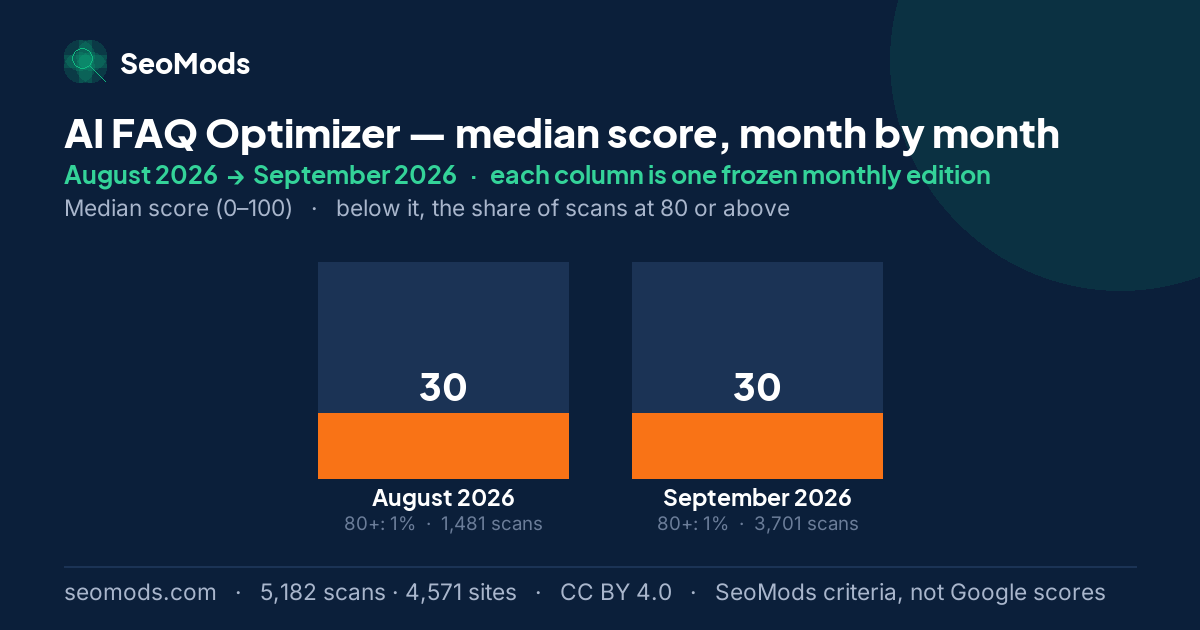
This page adds every published month together. Underneath it, each month is frozen as an edition of its own whose figures are never edited again — which is the only reason two months can be set side by side at all. Below is the AI FAQ Optimizer across the 2 published editions, with the combined figure in the last row of the table.
Between August 2026 and September 2026 the median held at 30, and the share of scans at 80 or above held at 1%. The two months do not measure the same sites — the September 2026 sample has about 3 times as many sites — so read the gap as a change in the cross-section measured, not as the same sites getting better or worse.
| Edition | Median | vs. previous | Scored 80+ | Issues/run | Runs |
|---|---|---|---|---|---|
| August 2026 | 30 | baseline | 1% | 0.0 | 1,481 |
| September 2026 | 30 | no change | 1% | 0.0 | 3,701 |
| All published months, combined | 30 | — | 1% | 0.0 | 5,182 |
Reading a monthly difference. Each month is a separate sample, and its size changes from month to month. A change in sample size can move a median and a distribution by itself, so a monthly difference should not be mistaken for a change in scores: it does not show that sites improved or got worse.
What this score does not measure
- It is not a direct measurement of the signals every AI system uses. Which system uses which signal, and how, is not public; the score measures the checks SeoMods chose.
- It does not measure whether a page is actually cited in AI answers. It measures readiness on the page, not what any assistant returned.
- It is not a Google ranking. A high score does not guarantee a better position, and a low one does not mean Google has penalised the page.
About this benchmark. This benchmark is calculated from data on the sites SeoMods has scanned. The results do not necessarily represent all websites, or a random selection of them. The scores express SeoMods’ own measurement and scoring criteria; they are not ranking, quality, E-E-A-T or AI visibility scores issued by Google. Sample, anonymization and licence: the full methodology.
Frequently asked questions
Do the questions have to match how people search?
They should be recognisably the same question, in natural phrasing. Matching a query word for word is neither necessary nor a good idea — engines handle paraphrase well, and a heading contorted to include an exact search string reads badly to the human it is meant to help.
Can FAQ schema be added to any page?
Technically yes, and it should not be. The markup asserts that the page contains those questions and answers as visible content; if it does not, the assertion is false and treated as such. Add the schema to pages that genuinely answer the questions, and it is a description rather than a claim.
Should the answer be short or thorough?
Both, in that order. Two to four sentences that answer completely, then any depth underneath. A short answer that omits the qualification is not extractable either, because an answer with no clear bounds is hard to lift out — completeness is the requirement and brevity is the constraint.
What is a good score on the AI FAQ Optimizer?
In this dataset the median SeoMods score is 30/100, so scoring 30 sits exactly in the middle of the sample. 30 is the start of the upper quartile and 40 or above is the top 10%; below 30 is the bottom quarter. Those thresholds are specific to this tool — the 25 tools with a published benchmark have very different medians, so 70 here and 70 elsewhere do not mean the same thing. They place a page among the sites SeoMods scanned; they say nothing about Google rankings.
Is the score from the AI FAQ Optimizer issued by Google?
No. It is a benchmark score calculated against the check list SeoMods defined for this tool. A SeoMods check going unmet does not mean Google has penalised the page or ranked it lower.
Questions that govern the whole series — how the sample is collected, how sites are anonymized, how often the figures are refreshed — are answered in the methodology on the hub.
Using this data
The figures, tables and charts on this page are free to reuse under CC BY 4.0; the only condition is a link back to this page. Suggested citation: SeoMods — AI FAQ Optimizer benchmarks, 2 October 2026, https://seomods.com/seo-score-benchmarks/ai-faq-optimizer. If you need to cite by date, use the September 2026 edition instead: this page changes at every refresh and that one never does.